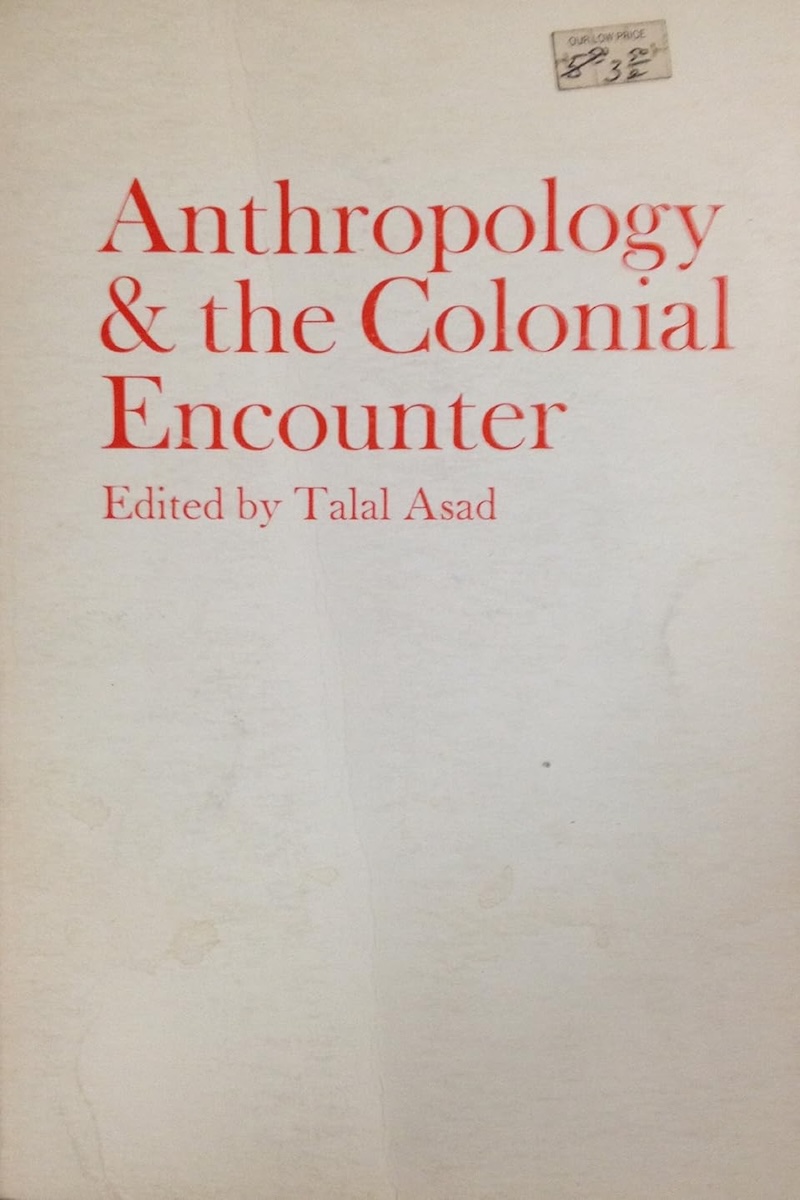
Anthropology and the Colonial Encounter
Author: Talal Asad
A critical examination of the relationship between anthropology and colonialism that challenges the discipline to confront its colonial origins and the power relations embedded in anthropological knowledge production.
Buy this book on Amazon
Anthropology and the Colonial Encounter - Talal Asad
ISBN: 978-0-903729-01-7
By purchasing through this link, we may receive a small commission at no extra cost to you. Thank you for your support!
Citation
Asad, T. (Ed.). (1973). Anthropology and the Colonial Encounter. Ithaca Press.
Intellectual & Historical Context
Anthropology and the Colonial Encounter emerged during the decolonization period of the 1960s and early 1970s, when anthropologists began critically examining their discipline's relationship with colonial power structures. The book was written as many African and Asian nations gained independence and began questioning Western academic frameworks.
This collection of essays represents a watershed moment in anthropological self-reflection, influenced by the broader anti-colonial movements and the civil rights era. The work challenged anthropology's claims to objectivity and political neutrality, forcing the discipline to confront its complicity in colonial projects.
Thesis Statement
Asad and the contributing authors argue that anthropology developed as a discipline within and in service of colonial contexts, and that this colonial foundation fundamentally shaped anthropological theory, methodology, and knowledge production. The discipline must acknowledge and address these power relations to achieve genuine decolonization.
Key Concepts
Colonial Anthropology
The practice of anthropological research conducted within colonial frameworks, often serving administrative and control functions for colonial governments.
Power and Knowledge
The interconnection between political power and the production of anthropological knowledge, showing how power relations shape what is studied and how it is interpreted.
Decolonizing Anthropology
The process of recognizing and dismantling colonial influences within anthropological theory and practice, developing new approaches that challenge Western hegemony.
Reflexivity and Self-Critique
The necessity for anthropologists to examine their own positionality, biases, and the political implications of their research.
Indigenous Knowledge Systems
Recognition of non-Western ways of understanding the world that were often dismissed or appropriated by colonial anthropology.
Anthropological Authority
The power dynamics involved in anthropologists' claims to represent and interpret other cultures, particularly in colonial and postcolonial contexts.
Chapter Summaries
Introduction by Talal Asad
Asad outlines the book's central argument about anthropology's colonial foundations and the need for disciplinary self-examination. He challenges the notion that anthropology can be separated from its political context.
Two Perspectives on the History of Anthropology
This chapter examines different interpretations of anthropological history, contrasting mainstream disciplinary narratives with critical perspectives that highlight colonial connections.
Anthropology and Colonialism in Africa
An analysis of how anthropological research in Africa served colonial administrative needs and how African societies were studied and represented within colonial frameworks.
The Politics of Anthropology in the Colonial Situation
This chapter explores the political dimensions of anthropological research, examining how anthropologists navigated relationships with colonial authorities and local populations.
Colonial Ethnography and the Invention of the Customary
An examination of how colonial anthropologists constructed notions of "traditional" culture and "customary law" that served colonial administrative purposes.
Anthropological Discourse and Colonial Common Sense
Analysis of how anthropological concepts and language reinforced colonial ideologies and ways of understanding colonized peoples.
The Development of British Social Anthropology
A critical history of British social anthropology's emergence and development within colonial contexts, particularly in Africa.
From Symbolism to Interpretation
Examination of theoretical developments in anthropology and their relationship to changing colonial and postcolonial contexts.
Critical Analysis
Paradigm Shift
The book represents a fundamental challenge to anthropology's self-understanding, forcing the discipline to confront uncomfortable truths about its origins and purposes.
Methodological Implications
Asad's critique raises important questions about anthropological methodology, particularly regarding fieldwork, representation, and the ethics of cross-cultural research.
Theoretical Contributions
The work contributed to the development of critical anthropology, postcolonial studies, and reflexive methodologies that remain influential today.
Historical Accuracy
The book provides important historical documentation of anthropology's colonial connections that had been largely ignored or downplayed in disciplinary histories.
Contemporary Relevance
While focused on historical analysis, the book's insights remain relevant for understanding ongoing power dynamics in anthropological research.
Real-World Applications
Decolonizing Curricula
The book has influenced efforts to decolonize anthropological education and incorporate critical perspectives on the discipline's history.
Research Ethics
Asad's arguments have informed the development of more rigorous ethical frameworks for anthropological research, particularly in postcolonial contexts.
Indigenous Rights
The critique has supported indigenous peoples' claims to control research conducted in their communities and to protect their intellectual property.
Academic Activism
The book has inspired anthropologists to engage in activist scholarship that challenges power structures and supports social justice.
Significance & Impact
Anthropology and the Colonial Encounter fundamentally changed anthropological discourse by making colonial critique central to disciplinary self-reflection. The book initiated ongoing debates about power, representation, and ethics that continue to shape anthropology today.
The work's influence extends beyond anthropology to fields such as postcolonial studies, development studies, and critical sociology. It helped establish the importance of reflexivity and political awareness in social science research.
Key Quotes
Anthropology is not merely an academic discipline but a human activity with human consequences.
This quote emphasizes the real-world impact of anthropological research and challenges claims of academic neutrality.
The anthropologist's relationship to his 'subject' is never politically neutral.
Here, Asad highlights the inherently political nature of anthropological research relationships.
The colonial situation provided both the practical conditions and the conceptual framework for the emergence of modern anthropology.
This statement captures the book's central argument about anthropology's colonial foundations.
Conclusion
Anthropology and the Colonial Encounter remains a foundational text in critical anthropology that successfully challenged the discipline to confront its colonial past and ongoing power relations. Asad's edited volume demonstrated that anthropological knowledge production cannot be separated from political context and power structures.
The book's enduring significance lies in its role in initiating a process of disciplinary self-reflection that continues today. As anthropology grapples with questions of decolonization, indigeneity, and social justice, Asad's insights about the relationship between knowledge and power remain highly relevant.
Through its unflinching examination of anthropology's colonial connections, the book provides essential tools for understanding how academic disciplines can both serve and challenge systems of power, offering a roadmap for more ethical and politically conscious anthropological practice.
Book Information
- Subject Category
- Anthropology
- Academic Level
- Graduate
- Publisher
- Ithaca Press
- Publication Year
- 1973
- ISBN
- 978-0-903729-01-7
Support This Project
Help us maintain and expand this global academic resource platform.
Buy Me a Coffee