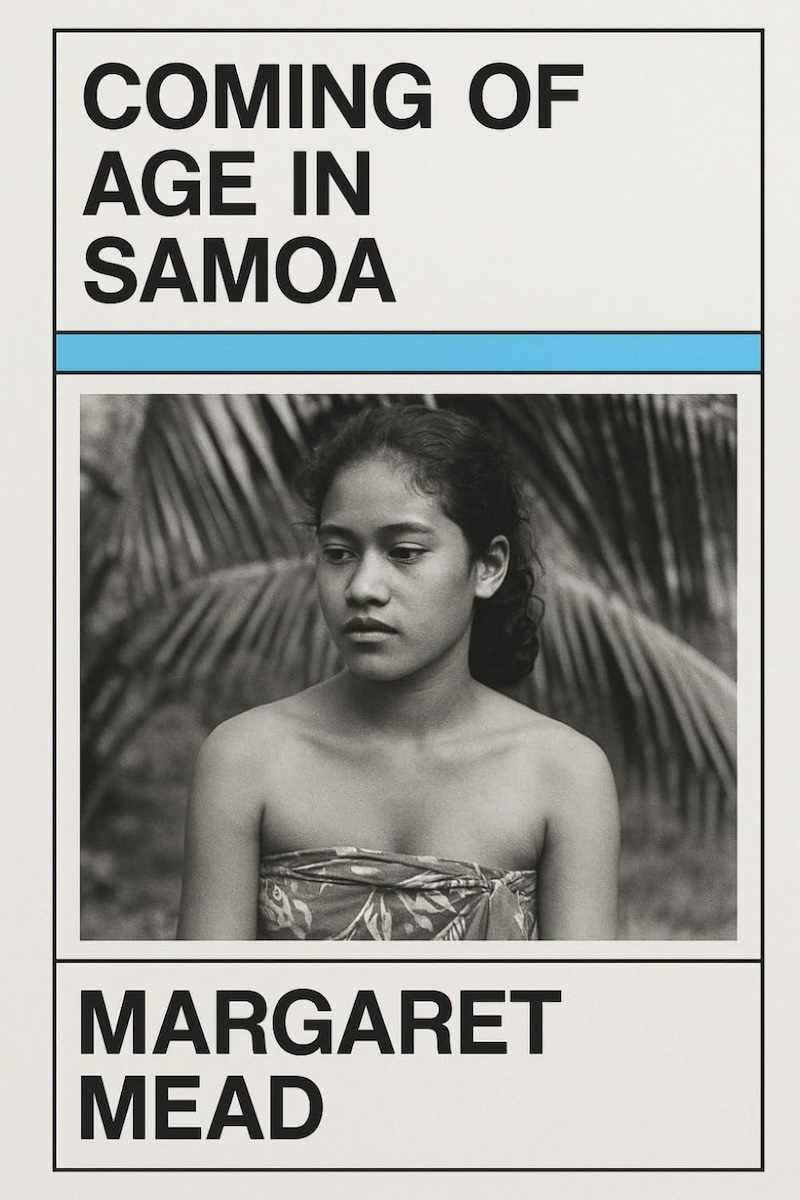
Coming of Age in Samoa
Author: Margaret Mead
A pioneering ethnographic study that challenged Western assumptions about adolescence by examining Samoan youth, arguing that many aspects of adolescent turmoil are culturally constructed rather than biologically determined.
By purchasing through this link, we may receive a small commission at no extra cost to you. Thank you for your support!
Citation
Mead, M. (1928). Coming of Age in Samoa: A Psychological Study of Primitive Youth for Western Civilisation. William Morrow.
Intellectual & Historical Context
Coming of Age in Samoa was written in the 1920s during a period when anthropology was establishing itself as a scientific discipline and challenging biological determinism in favor of cultural explanations for human behavior. Margaret Mead, a student of Franz Boas, conducted this research as part of her doctoral work when she was only 23 years old.
The book emerged during the nature vs. nurture debates of the early 20th century, when psychologists like G. Stanley Hall argued that adolescent "storm and stress" was a universal biological phenomenon. Mead's work was explicitly designed to test whether adolescent turmoil was indeed universal or culturally specific.
Thesis Statement
Mead argues that the difficulties and emotional turmoil commonly associated with adolescence in Western societies are not inevitable or biologically determined, but rather are products of specific cultural conditions. Her study of Samoan girls suggests that adolescence can be a smooth transition when cultural values and social structures support rather than complicate this life stage.
Key Concepts
Cultural Determinism
The idea that human behavior and psychological development are primarily shaped by cultural factors rather than biological or genetic predispositions.
Cultural Relativism
The principle that cultural practices and values should be understood within their own context rather than judged by external standards, particularly Western ones.
Adolescent Development
The psychological and social processes involved in the transition from childhood to adulthood, examined cross-culturally to understand universal versus culturally specific patterns.
Gender Roles and Sexuality
Examination of how different cultures construct gender expectations and sexual norms, particularly regarding young women's roles and freedoms.
Social Organization
Analysis of how kinship systems, social hierarchies, and community structures influence individual development and behavior.
Comparative Method
The anthropological technique of comparing different cultures to identify universal human patterns versus cultural variations.
Chapter Summaries
Introduction: The Problem of Adolescence
Mead outlines the Western conception of adolescent turmoil and poses the research question of whether this pattern is universal or culturally specific.
Chapter 1: A Day in Samoa
A detailed ethnographic description of daily life in a Samoan village, providing context for understanding Samoan social organization and cultural values.
Chapter 2: The Samoan Household
Analysis of family structure, kinship relationships, and household organization in Samoan society, showing how these differ from Western patterns.
Chapter 3: The Education of the Samoan Child
Examination of how Samoan children are raised and educated, emphasizing informal learning and gradual assumption of responsibilities.
Chapter 4: The Samoan Girl in Her Community
Description of the social roles and expectations for young Samoan women, including their freedoms and responsibilities.
Chapter 5: The Girl and Her Age Group
Analysis of peer relationships and age-graded activities among Samoan girls, showing how these support smooth social development.
Chapter 6: The Girl in the Community
Examination of how young women fit into the broader social structure and participate in community life.
Chapter 7: Formal Sex Relations
Discussion of Samoan attitudes toward sexuality, courtship, and marriage, contrasting these with Western norms and restrictions.
Chapter 8: The Role of the Dance
Analysis of dance and ceremonial activities as important aspects of Samoan cultural expression and social integration.
Chapter 9: The Attitude Towards Personality Differences
Examination of how Samoan society accommodates individual personality variations and differences.
Chapter 10: The Experience and Character of the Individual
Case studies of individual Samoan girls, showing how cultural patterns interact with personal characteristics.
Chapter 11: The Girl Who Conflicts
Analysis of cases where individual girls experience difficulties, examining how Samoan society handles deviance and conflict.
Chapter 12: Maturity and Old Age
Discussion of adult roles and aging in Samoan society, completing the life cycle perspective.
Chapter 13: Our Educational Problems in the Light of Samoan Contrasts
Application of Samoan insights to critique and suggestions for Western educational and child-rearing practices.
Critical Analysis
Methodological Innovation
Mead's work pioneered participant-observer methodology and established new standards for ethnographic research, particularly in studying childhood and adolescence.
Challenge to Biological Determinism
The book effectively challenged prevailing biological explanations for adolescent behavior, supporting cultural anthropology's emphasis on learned behavior.
Gender and Sexuality Studies
Mead's frank discussion of sexuality and gender roles was groundbreaking for its time and contributed to later developments in gender studies.
Subsequent Controversies
The book later became controversial when Derek Freeman challenged Mead's findings in the 1980s, leading to important debates about ethnographic methodology and interpretation.
Cultural Impact
Beyond academia, the book influenced American attitudes toward sexuality, education, and child-rearing, contributing to more liberal social attitudes.
Real-World Applications
Educational Reform
Mead's insights influenced progressive education movements that emphasized child-centered learning and cultural sensitivity.
Adolescent Psychology
The work contributed to more nuanced understandings of adolescent development that consider cultural and social factors.
Cross-Cultural Psychology
Mead's comparative approach became a model for cross-cultural psychological research and cultural psychiatry.
Feminist Scholarship
The book's attention to women's experiences contributed to the development of feminist anthropology and gender studies.
Significance & Impact
Coming of Age in Samoa became one of the most widely read anthropological works ever published, introducing general audiences to anthropological perspectives and cultural relativism. It established Margaret Mead as a public intellectual and helped popularize anthropology beyond academic circles.
The book's influence extended far beyond anthropology, affecting psychology, education, and popular culture. It contributed to changing American attitudes about sexuality, adolescence, and cultural difference during the mid-20th century.
Key Quotes
The adolescent girl in Samoa differed from her sister who had reached puberty in that she could go fishing, she could climb palms, she could go swimming, she could visit relatives, she could go visiting—she could do everything except marry.
This quote illustrates Mead's central point about the gradual and untroubled nature of Samoan adolescence.
We must bear in mind the fact that our generalizations are based upon the study of civilised man, and that if we would reach conclusions of general validity, we must extend our observations to the whole range of human behaviour.
Here, Mead advocates for the comparative method and challenges ethnocentric assumptions about human nature.
The Samoan background which makes growing up so easy, so simple a matter, is the general casualness of the whole society.
This statement captures Mead's explanation for why Samoan adolescence appears so different from Western patterns.
Conclusion
Coming of Age in Samoa remains a landmark work in anthropological literature that successfully challenged biological determinism and demonstrated the power of cultural factors in shaping human development. Despite later controversies about some of Mead's specific findings, the book's central insights about cultural variation in adolescent experience remain valid and important.
The work's enduring significance lies in its demonstration that many aspects of human behavior that seem natural or inevitable are actually culturally constructed and therefore changeable. This insight has profound implications for understanding human potential and for designing more humane social arrangements.
Through its accessible writing and compelling argument, Coming of Age in Samoa showed that anthropological research could contribute to solving practical problems and improving human welfare, establishing a model of engaged scholarship that continues to inspire anthropologists today.
Book Information
- Subject Category
- Anthropology
- Academic Level
- Undergraduate
- Publisher
- William Morrow & Company
- Publication Year
- 1928
Support This Project
Help us maintain and expand this global academic resource platform.
Buy Me a Coffee