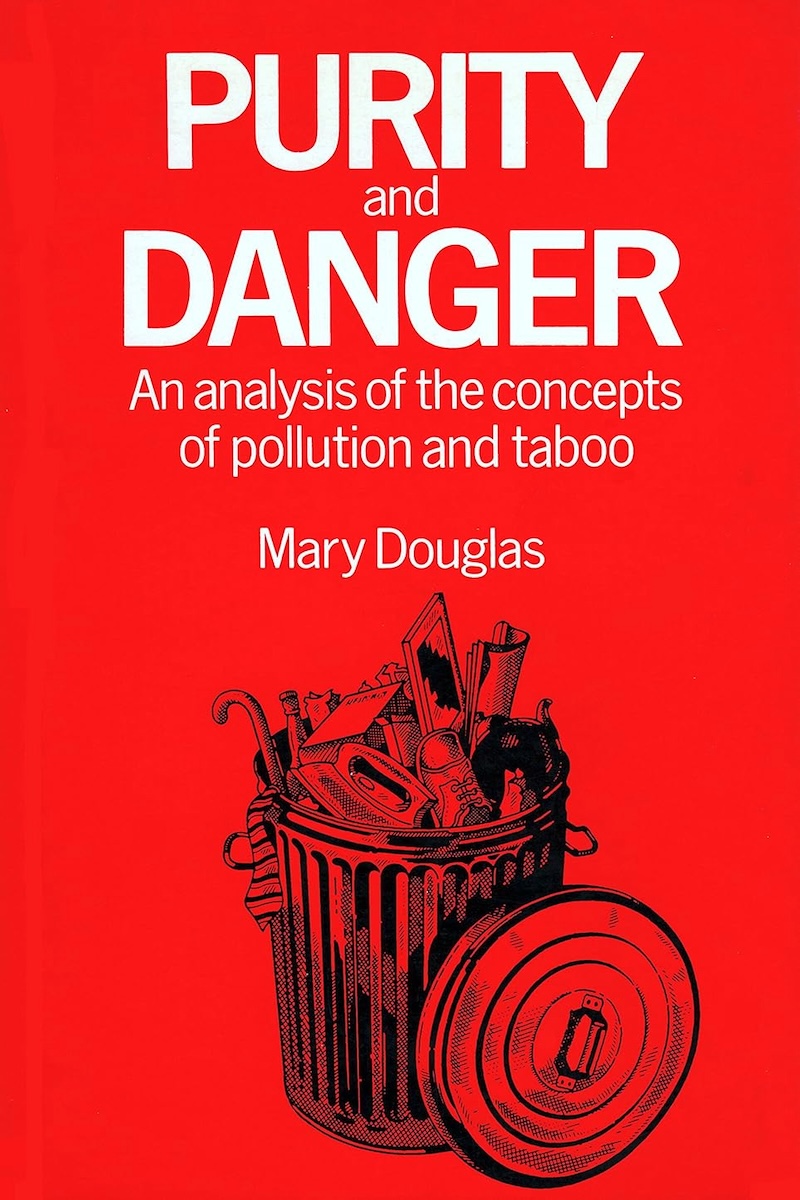
Purity and Danger: An Analysis of Concepts of Pollution and Taboo
Author: Mary Douglas
A groundbreaking anthropological analysis of concepts of purity, pollution, and taboo that examines how societies create and maintain social boundaries through symbolic classification systems, introducing the influential concept that "dirt is matter out of place."
Buy this book on Amazon
Purity and Danger: An Analysis of Concepts of Pollution and Taboo - Mary Douglas
By purchasing through this link, we may receive a small commission at no extra cost to you. Thank you for your support!
Citation
Douglas, M. (1966). Purity and Danger: An Analysis of Concepts of Pollution and Taboo. Routledge & Kegan Paul.
Intellectual and Historical Context
Purity and Danger was written during the 1960s when anthropology was experiencing a shift toward symbolic and structural approaches to understanding culture. Mary Douglas, influenced by Émile Durkheim's work on classification and Claude Lévi-Strauss's structural anthropology, sought to understand how societies use concepts of purity and pollution to maintain social order and cultural boundaries.
The book emerged at a time when anthropologists were moving beyond functionalist explanations to explore the symbolic dimensions of culture. Douglas's work contributed to the development of symbolic anthropology and provided new insights into how humans use categorization systems to make sense of their world and maintain social structure.
Argument Statement
Douglas argues that concepts of purity and pollution are not primarily about hygiene or physical cleanliness, but serve as symbolic systems that societies use to maintain social order and cultural boundaries. Her famous thesis that "dirt is matter out of place" demonstrates how pollution concepts reflect underlying classification systems and social structures rather than objective cleanliness concerns.
Core Concepts
Dirt as Matter Out of Place
Douglas's central insight that dirt and pollution are not absolute categories but rather items that violate classification systems - things that are "out of place" within a society's symbolic order.
Pollution and Social Boundaries
The way societies use pollution beliefs to maintain social boundaries, reinforce hierarchies, and exclude or control dangerous elements that threaten social order.
Symbolic Classification Systems
How human societies organize their understanding of the world through symbolic categories that separate pure from impure, safe from dangerous, and inside from outside.
Anomaly and Ambiguity
The role of anomalous or ambiguous entities in classification systems and how societies deal with things that don't fit neatly into established categories.
Ritual Purity
The function of purification rituals in restoring order and managing the transition between different states of being or social positions.
Social Structure and Symbolism
The relationship between a society's symbolic systems and its social structure, showing how pollution beliefs reflect and reinforce social organization.
Chapter Summaries
Chapter 1: Ritual Uncleanness
Douglas introduces the concept that ritual uncleanness is not about physical dirt but about symbolic disorder, challenging Western assumptions about hygiene and cleanliness.
Chapter 2: Secular Defilement
Examination of how modern secular society maintains its own forms of pollution avoidance and purity concepts, showing continuity with traditional societies.
Chapter 3: The Abominations of Leviticus
Analysis of the dietary laws in Leviticus as a coherent symbolic system rather than arbitrary taboos, demonstrating how classification systems work.
Chapter 4: Magic and Miracle
Exploration of how pollution beliefs relate to concepts of supernatural power and the maintenance of cosmic order.
Chapter 5: Primitive Worlds
Discussion of pollution concepts in various traditional societies and their role in maintaining social boundaries and group identity.
Chapter 6: Powers and Dangers
Analysis of how pollution beliefs both protect and endanger, serving as sources of both social control and social power.
Chapter 7: External Boundaries
Examination of how pollution concepts mark boundaries between social groups and maintain group identity against outsiders.
Chapter 8: Internal Lines
Analysis of how pollution beliefs operate within societies to maintain internal hierarchies and social distinctions.
Chapter 9: The System at War with Itself
Discussion of how pollution systems can become sources of conflict and change rather than just stability.
Chapter 10: The System Shattered and Renewed
Exploration of how pollution systems adapt to social change and how new classification systems emerge.
Critical Analysis
Theoretical Innovation
Douglas's work revolutionized anthropological understanding of pollution and purity by shifting focus from functional explanations to symbolic analysis, showing how these concepts serve as cognitive tools for social organization.
Influence on Symbolic Anthropology
The book became foundational for symbolic anthropology, influencing how scholars understand the relationship between symbols, meaning, and social structure.
Interdisciplinary Impact
Douglas's insights influenced fields beyond anthropology, including sociology, religious studies, psychology, and cultural studies, particularly in understanding how societies construct and maintain boundaries.
Methodological Contributions
The work demonstrated how careful symbolic analysis could reveal underlying cultural patterns and social structures, providing a model for interpretive anthropological research.
Contemporary Relevance
Douglas's framework continues to be relevant for understanding contemporary issues of social boundaries, cultural classification, and the symbolic dimensions of social conflict.
Real-World Applications
Medical Anthropology
Douglas's insights inform understanding of health beliefs, medical classifications, and the cultural construction of disease and healing practices.
Environmental Studies
The framework helps analyze how societies classify environmental threats and construct boundaries between nature and culture.
Social Policy Analysis
Understanding of how pollution concepts operate in contemporary debates about social problems, immigration, and cultural boundaries.
Religious Studies
Application to understanding ritual practices, religious taboos, and the role of purity concepts in religious traditions.
Significance and Impact
Purity and Danger is considered one of the most influential anthropological works of the 20th century, listed by the Times Literary Supplement as one of the hundred most influential non-fiction books published since 1945. The book established Mary Douglas as a major theoretical voice in anthropology and helped shape the development of symbolic anthropology.
The work's influence extends far beyond anthropology, contributing to understanding of how all human societies use symbolic classification systems to organize social life. Douglas's insights about the relationship between symbolic systems and social structure continue to inform research across multiple disciplines.
Key Quotations
Dirt is essentially disorder. There is no such thing as absolute dirt: it exists in the eye of the beholder.
This quotation captures Douglas's central insight about the relative nature of pollution concepts and their relationship to classification systems.
Ideas about separating, purifying, demarcating and punishing transgressions have as their main function to impose system on an inherently untidy experience.
Here, Douglas explains how pollution concepts serve cognitive and social organizing functions rather than practical hygiene purposes.
Pollution behaviour is the reaction which condemns any object or idea likely to confuse or contradict cherished classifications.
This statement illustrates how pollution beliefs protect existing symbolic and social orders by rejecting anomalous elements.
Conclusion
Purity and Danger remains a masterwork of anthropological analysis that successfully demonstrates how symbolic systems operate in human societies to maintain order and meaning. Douglas's insight that pollution concepts are tools for social and cognitive organization rather than responses to objective threats fundamentally changed how scholars understand the relationship between symbolism and social structure.
The book's enduring significance lies in its demonstration that seemingly irrational taboos and pollution beliefs actually represent sophisticated symbolic systems that serve essential social functions. This understanding has profound implications for how we interpret cultural practices, social boundaries, and the symbolic dimensions of human behavior.
Through her careful analysis of pollution concepts across cultures, Douglas provided anthropology with powerful tools for understanding how humans use symbolic classification to create meaning and maintain social order, establishing a framework that continues to influence research and theory in anthropology and related fields.
Book Information
- Subject Category
- Anthropology
- Academic Level
- Graduate
- Publisher
- Routledge & Kegan Paul
- Publication Year
- 1966
Support This Project
Help us maintain and expand this global academic resource platform.
Buy Me a Coffee