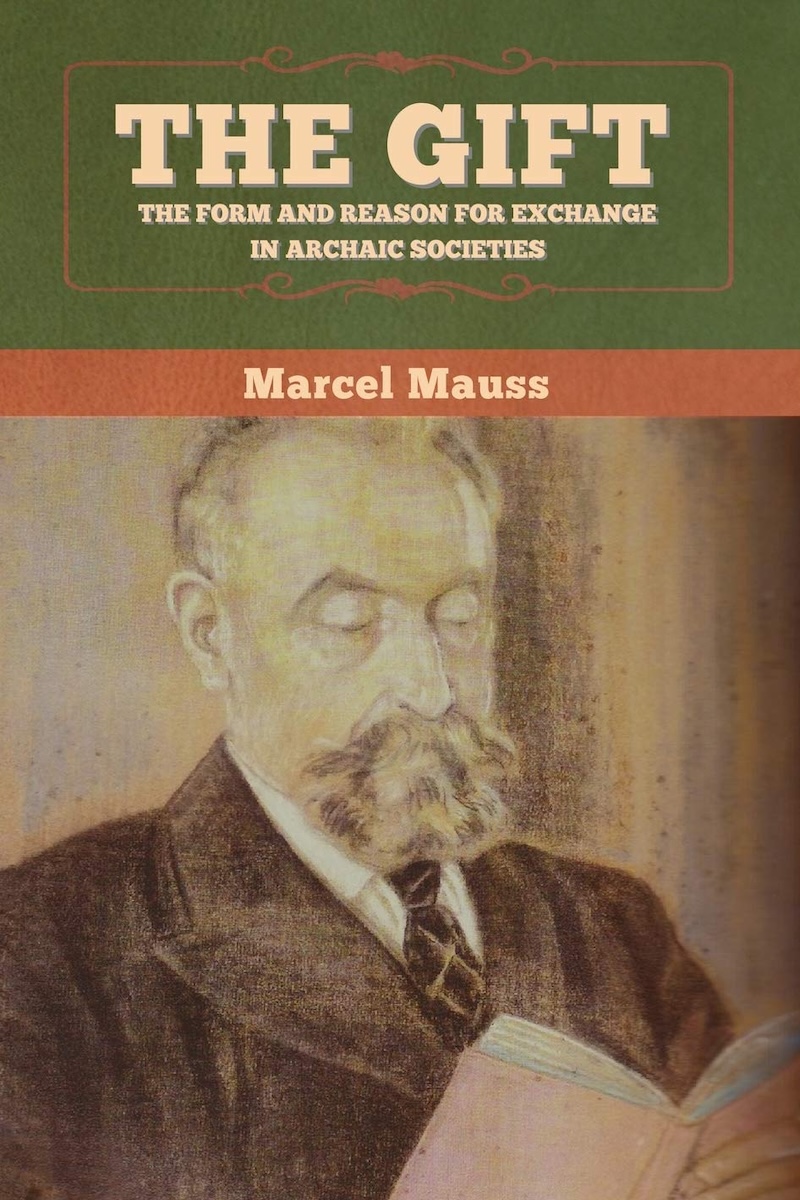
The Gift: The Form and Reason for Exchange in Archaic Societies
Author: Marcel Mauss
A foundational work in economic anthropology that analyzes gift exchange systems to reveal the social, moral, and spiritual dimensions of economic transactions, challenging Western assumptions about individual economic behavior.
Buy this book on Amazon
The Gift: The Form and Reason for Exchange in Archaic Societies - Marcel Mauss
By purchasing through this link, we may receive a small commission at no extra cost to you. Thank you for your support!
Citation
Mauss, M. (1925). The Gift: The Form and Reason for Exchange in Archaic Societies. Routledge. (Originally published as "Essai sur le don" in L'Année Sociologique)
Intellectual & Historical Context
The Gift was written by Marcel Mauss, a student and nephew of Émile Durkheim, during the early development of French sociology and anthropology. Published in 1925, the work emerged from Mauss's extensive study of ethnographic materials from the Pacific Northwest, Melanesia, and other regions where gift exchange systems were prominent.
The book was written in response to utilitarian economic theory that viewed human behavior as primarily motivated by individual self-interest. Mauss sought to demonstrate that economic exchange in many societies is embedded in social relationships and moral obligations rather than driven by market logic.
Thesis Statement
Mauss argues that gift exchange in "archaic" societies operates according to a triple obligation: to give, to receive, and to reciprocate. This system creates and maintains social bonds, establishes hierarchy and status, and integrates religious, economic, and social dimensions of life in ways that pure market exchange cannot achieve.
Key Concepts
The Triple Obligation
The three interconnected duties that govern gift exchange: the obligation to give (demonstrating wealth and status), the obligation to receive (acknowledging the giver's status), and the obligation to reciprocate (maintaining the relationship and one's own honor).
Total Social Phenomenon
Mauss's concept describing how gift exchange simultaneously involves economic, legal, moral, aesthetic, religious, and mythological dimensions, making it a "total" social institution.
Hau and the Spirit of the Gift
Drawing from Maori concepts, Mauss discusses how gifts carry the spiritual essence of the giver, creating ongoing connections and obligations between exchange partners.
Potlatch
The ceremonial gift-giving and competitive feast system of Pacific Northwest peoples, used by Mauss as a key example of how gift exchange creates and destroys social relationships.
Kula Ring
The ceremonial exchange system of the Trobriand Islands, analyzed as an example of how gift exchange creates extensive social networks across geographical boundaries.
Reciprocity
The principle that gifts create obligations for counter-gifts, establishing ongoing social relationships rather than discrete economic transactions.
Chapter Summaries
Introduction: Gift Exchange and Primitive Economics
Mauss outlines his critique of utilitarian economics and introduces the concept of gift exchange as a fundamental form of social relationship in non-market societies.
Chapter 1: Gifts and the Obligation to Return Gifts
Examination of the basic principles governing gift exchange, focusing on the moral and social obligations created by giving and receiving gifts.
Chapter 2: The Extension of This System - Liberality, Honour, Money
Analysis of how gift exchange systems extend beyond material objects to include hospitality, honor, and even early forms of money.
Chapter 3: Survivals of These Principles in Ancient Law and Ancient Economics
Historical analysis showing how gift exchange principles influenced legal and economic systems in ancient Rome, Germanic societies, and other historical contexts.
Chapter 4: Conclusions
Synthesis of findings and discussion of their implications for understanding economic behavior, social solidarity, and modern society.
Critical Analysis
Theoretical Innovation
Mauss's work fundamentally challenged economic anthropology by showing that economic behavior cannot be separated from social, moral, and religious considerations in many societies.
Methodological Contributions
The concept of "total social phenomena" provided a framework for holistic analysis that influenced subsequent anthropological theory and methodology.
Influence on Exchange Theory
The work established gift exchange as a major theoretical focus in anthropology, influencing scholars from Claude Lévi-Strauss to Marshall Sahlins.
Critique of Western Economics
Mauss's analysis provided powerful tools for critiquing the assumptions of market capitalism and individual economic rationality.
Contemporary Relevance
The work continues to inform studies of alternative economic systems, social movements, and critiques of neoliberalism.
Real-World Applications
Development Anthropology
Mauss's insights have informed understanding of how development interventions interact with local exchange systems and social relationships.
Gift Economy Studies
The work has influenced analysis of contemporary gift economies, including online sharing, volunteer work, and alternative economic movements.
Consumer Culture Analysis
Mauss's framework has been applied to understanding modern consumer culture, advertising, and the social dimensions of consumption.
Corporate Social Responsibility
The concept of total social phenomena has informed analysis of corporate gift-giving and relationship-building in business contexts.
Significance & Impact
The Gift is considered one of the foundational texts in economic anthropology and has profoundly influenced multiple disciplines including anthropology, sociology, economics, and philosophy. The work established gift exchange as a major area of anthropological research and theoretical development.
The book's influence extends beyond academia to social movements, alternative economic practices, and critiques of market capitalism. Mauss's insights about the social embeddedness of economic relationships continue to inform contemporary debates about economic alternatives.
Key Quotes
The gift that is not returned can make the man who offered it inferior, just as the man who accepts it without returning or repaying it can become inferior.
This quote captures the power dynamics and status implications inherent in gift exchange relationships.
There is no free gift.
Here, Mauss emphasizes that all gifts create obligations and social relationships, challenging notions of disinterested generosity.
It is by opposing reason to emotion, will to instinct, that peoples have succeeded in thinking, that is to say, in opposing instinct to reason.
This statement reflects Mauss's critique of Western rationalism and his argument for understanding the emotional and moral dimensions of social life.
Conclusion
The Gift remains a foundational work that successfully demonstrated the social and moral dimensions of economic exchange, challenging utilitarian assumptions about human behavior. Mauss's analysis of gift exchange systems revealed the complex ways in which economic, social, religious, and political relationships are intertwined in human societies.
The work's enduring significance lies in its demonstration that economic relationships are always embedded in broader social contexts and moral frameworks. This insight has profound implications for understanding both traditional societies and contemporary economic arrangements, providing tools for critiquing market fundamentalism and imagining alternative economic possibilities.
Through its sophisticated analysis of ethnographic materials and theoretical innovation, The Gift established economic anthropology as a vital field of study while contributing essential concepts that continue to inform social scientific understanding of exchange, reciprocity, and social solidarity.
Book Information
- Subject Category
- Anthropology
- Academic Level
- Graduate
- Publisher
- L'Année Sociologique
- Publication Year
- 1925
Support This Project
Help us maintain and expand this global academic resource platform.
Buy Me a Coffee