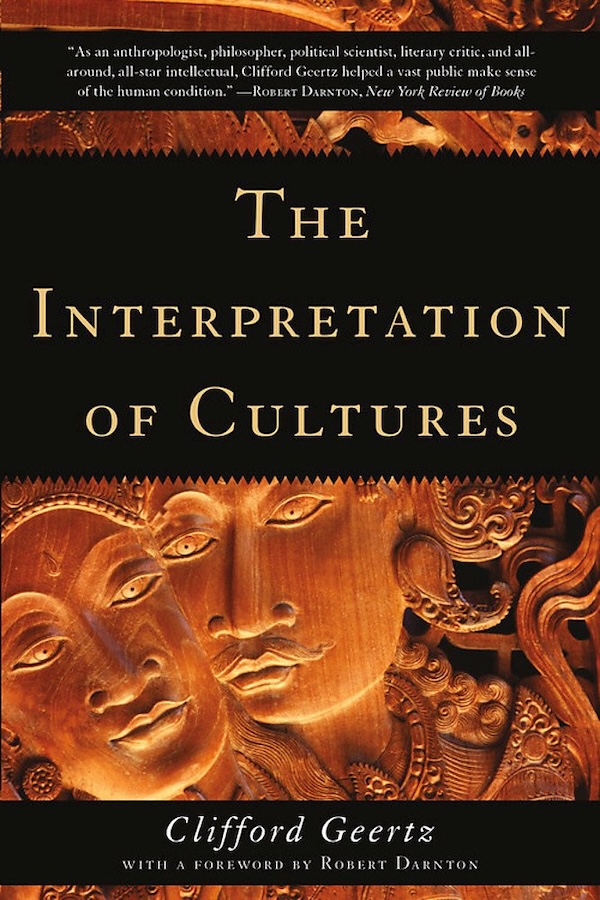
The Interpretation of Cultures
Author: Clifford Geertz
A foundational work in interpretive anthropology that introduces the concept of thick description and argues for understanding culture as webs of meaning that humans themselves have spun, fundamentally reshaping anthropological methodology.
Buy this book on Amazon
The Interpretation of Cultures - Clifford Geertz
ISBN: 978-0-465-09719-7
By purchasing through this link, we may receive a small commission at no extra cost to you. Thank you for your support!
Citation
Geertz, C. (1973). The Interpretation of Cultures. Basic Books.
Intellectual & Historical Context
The Interpretation of Cultures was written during a pivotal period in anthropological theory during the 1960s and early 1970s, when the discipline was moving away from functionalist and structuralist approaches toward more interpretive methods. Geertz, influenced by philosophers like Ludwig Wittgenstein and Paul Ricoeur, developed his approach while conducting fieldwork in Java, Bali, and Morocco.
The book emerged as anthropology grappled with questions of objectivity, representation, and the nature of cultural understanding. Geertz's work challenged the positivist tradition that dominated social science, arguing instead for an interpretive approach that recognized the inherently meaningful nature of human action.
Thesis Statement
Geertz argues that culture consists of webs of significance that humans themselves have spun, and that anthropology should be an interpretive science focused on understanding these meanings rather than discovering universal laws. The anthropologist's task is to provide "thick description" that captures the layered meanings embedded in cultural practices.
Key Concepts
Culture as Webs of Meaning
Culture is not a concrete entity but rather a system of inherited conceptions expressed in symbolic forms by which people communicate, perpetuate, and develop their knowledge about and attitudes toward life.
Thick Description
A methodological approach borrowed from philosopher Gilbert Ryle that involves detailed, contextual interpretation of cultural phenomena, distinguishing between surface behaviors and their deeper cultural meanings.
Interpretive Anthropology
An approach to anthropological study that emphasizes understanding the meanings that people attach to their actions and symbols rather than seeking to explain behavior through universal laws or structures.
Symbolic Systems
The networks of symbols and meanings that constitute culture, including rituals, myths, art, and everyday practices that carry significance for cultural participants.
Ethnographic Authority
The question of how anthropologists can legitimately interpret and represent other cultures, recognizing the inherent challenges of cross-cultural understanding.
Cultural Relativism
The principle that cultural practices and beliefs should be understood within their own context rather than judged by external standards.
Chapter Summaries
Chapter 1: Thick Description: Toward an Interpretive Theory of Culture
Geertz introduces his famous concept of "thick description" and outlines his interpretive approach to anthropology. He distinguishes between thin description (mere behavior) and thick description (behavior embedded with meaning).
Chapter 2: The Impact of the Concept of Culture on the Concept of Man
This chapter explores how anthropological understandings of culture have transformed concepts of human nature, arguing against both relativist and universalist extremes.
Chapter 3: The Growth of Culture and the Evolution of Mind
Geertz examines the relationship between cultural development and human cognitive evolution, arguing that culture and mind co-evolved rather than culture being simply layered over a fixed human nature.
Chapter 4: Religion as a Cultural System
One of Geertz's most influential essays, this chapter presents religion as a system of symbols that provides both models of reality and models for reality, helping people make sense of their world.
Chapter 5: Ethos, World View, and the Analysis of Sacred Symbols
This chapter analyzes how sacred symbols integrate a people's ethos (their moral and aesthetic values) with their worldview (their cognitive understanding of reality).
Chapter 6: Ritual and Social Change: A Javanese Example
Geertz provides a detailed ethnographic analysis of a Javanese funeral that went wrong, demonstrating how ritual failures can reveal underlying social tensions and cultural changes.
Chapter 7: The Cerebral Savage: On the Work of Claude Lévi-Strauss
A critical engagement with structuralism, particularly Lévi-Strauss's approach to myth and kinship, arguing for the importance of meaning over formal structure.
Chapter 8: Person, Time, and Conduct in Bali
An ethnographic study of Balinese concepts of personhood and temporality, showing how cultural categories shape social interaction and individual identity.
Chapter 9: Deep Play: Notes on the Balinese Cockfight
Perhaps Geertz's most famous ethnographic essay, analyzing cockfighting in Bali as a text that reveals deep structures of Balinese social hierarchy and cultural meaning.
Critical Analysis
Methodological Innovation
Geertz's introduction of interpretive methods fundamentally changed anthropological practice, emphasizing the importance of contextual understanding and reflexive analysis.
Literary Turn
His emphasis on culture as text and anthropology as interpretation contributed to the "literary turn" in social sciences, influencing fields beyond anthropology.
Critique of Scientific Positivism
Geertz's work challenged the dominance of scientific models in anthropology, arguing for the distinctiveness of cultural interpretation from natural scientific explanation.
Influence on Contemporary Theory
His concepts have influenced postmodern anthropology, cultural studies, and interpretive sociology, though they have also been critiqued for potential relativism and subjectivism.
Limitations
Critics argue that Geertz's approach can lead to cultural essentialism and may underemphasize power relations and historical change.
Real-World Applications
Ethnographic Research
Geertz's methods have become standard in anthropological fieldwork, emphasizing the importance of detailed cultural interpretation and reflexivity.
Cultural Analysis
His approach has been applied in various fields including sociology, political science, and cultural studies for analyzing symbolic systems and cultural meanings.
Cross-Cultural Understanding
The interpretive framework has informed approaches to intercultural communication and cross-cultural psychology.
Educational Anthropology
Geertz's methods have been used to understand educational systems as cultural phenomena with deep symbolic meanings.
Significance & Impact
The Interpretation of Cultures is considered one of the most influential works in 20th-century anthropology. It established interpretive anthropology as a major theoretical approach and influenced the development of symbolic anthropology, cultural studies, and postmodern ethnography.
The book's impact extends beyond anthropology to fields such as sociology, literary criticism, and religious studies. Geertz's concept of thick description has become a standard methodological tool across the social sciences.
Key Quotes
The concept of culture I espouse... is essentially a semiotic one. Believing, with Max Weber, that man is an animal suspended in webs of significance he himself has spun, I take culture to be those webs.
This quote encapsulates Geertz's fundamental understanding of culture as meaningful systems created by humans themselves.
What we call our data are really our own constructions of other people's constructions of what they and their compatriots are up to.
Here, Geertz acknowledges the interpretive nature of anthropological knowledge and the multiple layers of cultural construction involved in ethnographic work.
Anthropology is not an experimental science in search of law but an interpretive one in search of meaning.
This statement clearly distinguishes Geertz's interpretive approach from positivist social science methods.
Conclusion
The Interpretation of Cultures fundamentally transformed anthropological theory and practice by establishing culture as a symbolic system requiring interpretive rather than explanatory analysis. Geertz's emphasis on thick description and cultural meaning has provided anthropologists with powerful tools for understanding human diversity while respecting the complexity and autonomy of different cultural systems.
The book's enduring relevance lies in its sophisticated approach to cultural interpretation that avoids both crude relativism and ethnocentric universalism. As anthropology continues to grapple with questions of representation, reflexivity, and cross-cultural understanding, Geertz's insights remain central to contemporary theoretical debates.
Through its integration of philosophical sophistication with ethnographic richness, The Interpretation of Cultures demonstrates that anthropological understanding requires both empirical engagement and interpretive sensitivity, establishing a methodological foundation that continues to influence the discipline today.
Book Information
- Subject Category
- Anthropology
- Academic Level
- Graduate
- Publisher
- Basic Books
- Publication Year
- 1973
- ISBN
- 978-0-465-09719-7
Support This Project
Help us maintain and expand this global academic resource platform.
Buy Me a Coffee