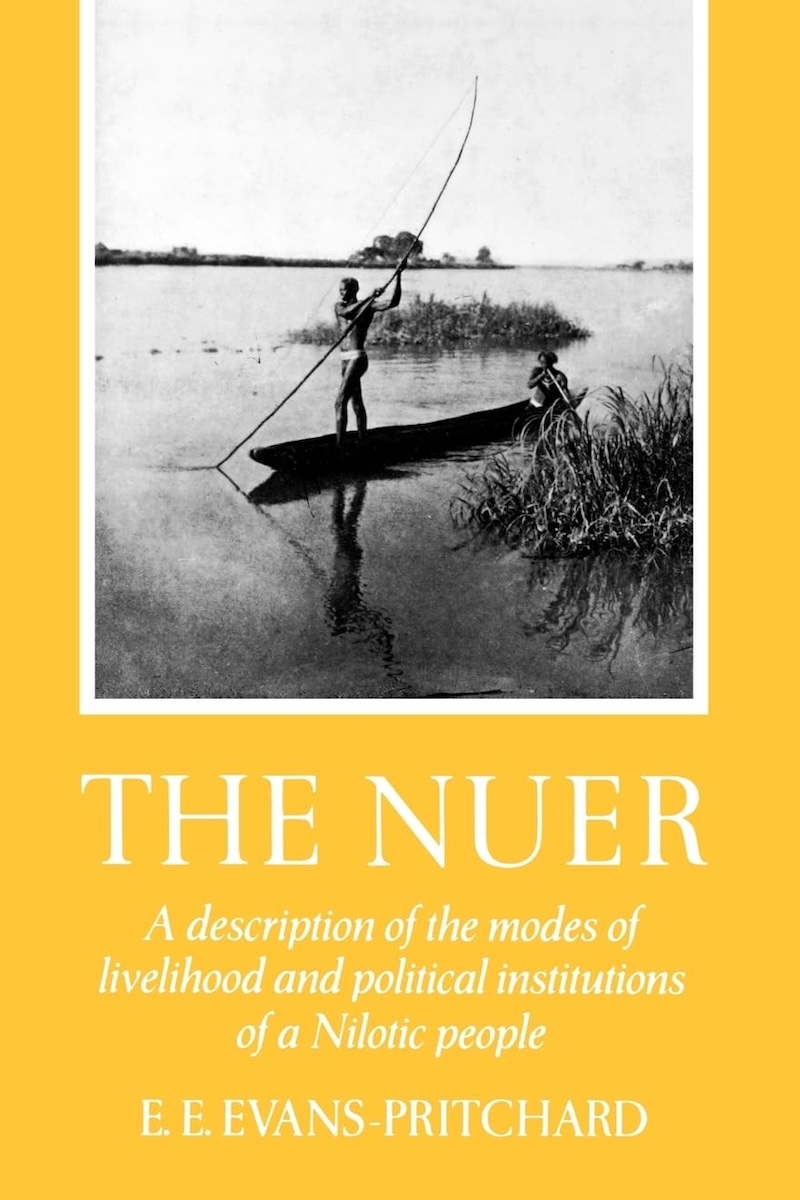
The Nuer: A Description of the Modes of Livelihood and Political Institutions of a Nilotic People
Author: E.E. Evans-Pritchard
A foundational ethnographic study of the Nuer people of southern Sudan that revolutionized understanding of acephalous societies and political organization, demonstrating how societies can maintain order without centralized government or formal political institutions.
Buy this book on Amazon
The Nuer: A Description of the Modes of Livelihood and Political Institutions of a Nilotic People - E.E. Evans-Pritchard
By purchasing through this link, we may receive a small commission at no extra cost to you. Thank you for your support!
Citation
Evans-Pritchard, E.E. (1940). The Nuer: A Description of the Modes of Livelihood and Political Institutions of a Nilotic People. Oxford University Press.
Intellectual and Historical Context
The Nuer was written during the height of British social anthropology when the discipline was developing rigorous ethnographic methods and theoretical frameworks for understanding non-Western societies. Evans-Pritchard conducted fieldwork among the Nuer people of southern Sudan in the 1930s, under difficult conditions during a period of colonial administration.
The book emerged during a time when anthropologists were moving beyond evolutionary assumptions to understand societies on their own terms. Evans-Pritchard's work represented a new standard for ethnographic research, combining detailed observational data with sophisticated theoretical analysis of social organization and political systems.
Argument Statement
Evans-Pritchard argues that the Nuer maintain social order and political organization without centralized government through a sophisticated system of segmentary lineages, age-sets, and ecological adaptations. He demonstrates that societies can be highly organized and maintain internal peace without formal political institutions, challenging Western assumptions about the necessity of centralized authority for social order.
Core Concepts
Segmentary Lineage System
A kinship-based organizational system where social groups segment and unite according to genealogical distance and contextual opposition, creating flexible alliances and maintaining social order without centralized authority.
Structural Distance
The concept that social relationships are determined by genealogical distance within the lineage system, affecting obligations, alliances, and patterns of conflict and cooperation.
Complementary Opposition
The principle whereby groups that oppose each other at one level unite against more distant groups at a higher level of segmentation, creating nested hierarchies of loyalty and opposition.
Ecological Adaptation
How the Nuer's pastoral lifestyle and seasonal migrations between permanent villages and cattle camps shapes their social organization and political structures.
Age-Set System
A system of age-grades that cuts across lineage divisions and provides alternative forms of social organization and authority, complementing the kinship-based structure.
Political Ecology
The relationship between environmental conditions, economic activities, and political organization in shaping Nuer society and inter-group relations.
Chapter Summaries
Chapter 1: The Nuer and Their Country
Introduction to Nuer territory, environment, and the basic parameters of their pastoral way of life, establishing the ecological context for understanding their social organization.
Chapter 2: Livelihood
Detailed analysis of Nuer economic activities, particularly cattle herding and its central importance in their social and cultural life, including seasonal migration patterns.
Chapter 3: Time and Space
Examination of how the Nuer conceptualize time and space in relation to their pastoral activities and social organization, showing the integration of temporal and spatial concepts.
Chapter 4: The Political System
Analysis of how the Nuer maintain political order through segmentary lineage organization without formal government or centralized political institutions.
Chapter 5: The Lineage System
Detailed examination of how lineage relationships structure Nuer society, including genealogical principles and their practical applications in daily life.
Chapter 6: Age-Sets
Description of the age-set system and its role in cutting across lineage divisions to create alternative forms of social solidarity and organization.
Chapter 7: Tribal Boundaries and Tribal Sentiment
Analysis of how tribal identity is maintained and expressed, including the role of territorial boundaries and collective identity in Nuer political organization.
Chapter 8: The Leopard-Skin Chief
Examination of the role of ritual specialists who mediate conflicts and maintain peace without formal political authority, showing alternative forms of leadership.
Chapter 9: Feuds and Other Disputes
Analysis of conflict resolution mechanisms and how disputes are managed within the segmentary lineage system without formal legal institutions.
Chapter 10: Law
Discussion of how legal principles operate in Nuer society through customary practices and social pressure rather than formal legal institutions.
Critical Analysis
Ethnographic Innovation
Evans-Pritchard's meticulous fieldwork and detailed ethnographic description set new standards for anthropological research, demonstrating the importance of long-term participant observation.
Theoretical Contributions
The book revolutionized understanding of political organization by showing how sophisticated political systems could operate without centralized government, influencing political anthropology for decades.
Methodological Impact
Evans-Pritchard's approach to ethnographic analysis, combining detailed description with theoretical interpretation, became a model for anthropological research methods.
Influence on African Studies
The work established a framework for understanding African political systems and influenced subsequent research on segmentary societies across Africa and beyond.
Contemporary Relevance
The book's insights into acephalous political organization continue to inform understanding of alternative forms of governance and social organization.
Real-World Applications
Political Anthropology
The segmentary lineage model has been applied to understanding political organization in many other societies, particularly in Africa and the Middle East.
Conflict Resolution
Evans-Pritchard's analysis of Nuer conflict resolution mechanisms has informed approaches to understanding and managing conflicts in acephalous societies.
Development Studies
Understanding of how traditional political systems function has informed development policies and interventions in societies with similar organizational structures.
Governance Studies
The book contributes to understanding alternative forms of governance and social organization beyond Western models of centralized government.
Significance and Impact
The Nuer is considered one of the classics of British social anthropology and helped establish Evans-Pritchard as one of the most influential anthropologists of the 20th century. The book's analysis of segmentary lineage systems became a foundational model in political anthropology and influenced understanding of political organization worldwide.
The work's impact extends beyond anthropology to political science, African studies, and development studies. Evans-Pritchard's demonstration that sophisticated political systems could operate without centralized authority challenged Western assumptions about political organization and contributed to more nuanced understanding of human social organization.
Key Quotations
The Nuer have no government, and their state might be described as an ordered anarchy.
This quotation captures Evans-Pritchard's central insight about how the Nuer maintain social order without formal government institutions.
A man is a member of a political group by virtue of his non-membership of other groups of the same type.
Here, Evans-Pritchard explains the principle of complementary opposition that underlies segmentary lineage organization.
The structure of a lineage is not constant but varies according to the situation.
This statement illustrates the flexible and contextual nature of Nuer social organization and its adaptation to different circumstances.
Conclusion
The Nuer remains a masterwork of ethnographic analysis that fundamentally changed anthropological understanding of political organization and social structure. Evans-Pritchard's demonstration that the Nuer maintained sophisticated political organization without centralized government challenged Western assumptions about the necessity of formal political institutions for social order.
The book's enduring significance lies in its detailed analysis of how kinship, ecology, and social principles combine to create effective political systems. This understanding has profound implications for how we think about governance, conflict resolution, and social organization beyond Western models.
Through his meticulous ethnographic work and theoretical analysis, Evans-Pritchard provided anthropology with powerful insights into alternative forms of political organization, establishing concepts and analytical frameworks that continue to influence research in political anthropology and related fields today.
Book Information
- Subject Category
- Anthropology
- Academic Level
- Graduate
- Publisher
- Oxford University Press
- Publication Year
- 1940
Support This Project
Help us maintain and expand this global academic resource platform.
Buy Me a Coffee