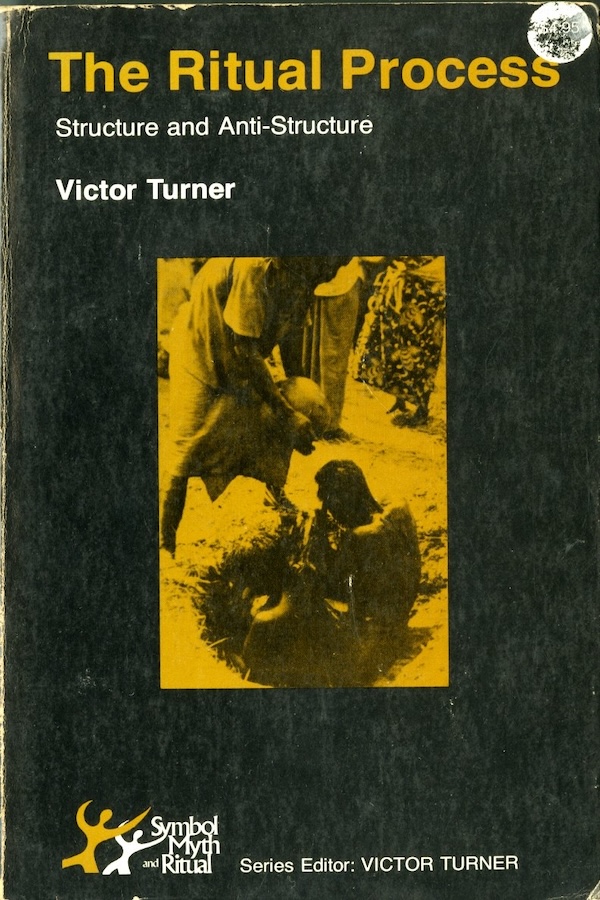
The Ritual Process: Structure and Anti-Structure
Author: Victor Turner
A seminal work in ritual studies that explores the concept of liminality and communitas in rites of passage, demonstrating how rituals serve as spaces for social transformation and the temporary dissolution of social hierarchies.
By purchasing through this link, we may receive a small commission at no extra cost to you. Thank you for your support!
Citation
Turner, V. (1969). The Ritual Process: Structure and Anti-Structure. Aldine Publishing Company.
Intellectual and Historical Context
The Ritual Process was written during the late 1960s when anthropology was experiencing renewed interest in symbolic analysis and the cultural dimensions of social life. Victor Turner, drawing from his extensive fieldwork among the Ndembu people of Zambia, developed his theoretical framework during a period of social upheaval and cultural questioning in Western societies.
The book built upon Arnold van Gennep's earlier work on rites of passage while extending these insights to broader questions of social process and transformation. Turner's work emerged during the rise of symbolic anthropology and contributed to understanding ritual as a dynamic force in social life rather than merely a conservative mechanism for maintaining tradition.
Argument Statement
Turner argues that rituals, particularly rites of passage, create liminal spaces where normal social structures are temporarily suspended, allowing for the emergence of communitas - a mode of social relationship characterized by equality, solidarity, and shared humanity. These ritual processes serve as crucial mechanisms for social transformation and renewal, providing alternatives to hierarchical social structure.
Core Concepts
Liminality
The threshold state in rituals where participants exist between social categories, suspended from normal social structure and open to transformation and new forms of social relationship.
Communitas
A temporary condition of equality, solidarity, and shared humanity that emerges in liminal spaces, characterized by the dissolution of normal social hierarchies and the experience of common humanity.
Structure and Anti-Structure
The dialectical relationship between normal social organization (structure) and the temporary dissolution of hierarchy in ritual contexts (anti-structure), both necessary for social vitality.
Ritual Symbols
Multi-vocal symbols that condense multiple meanings and emotions, serving as vehicles for expressing and transforming social relationships and cultural values.
Social Drama
Turner's model for understanding social process through phases of breach, crisis, redressive action, and reintegration or schism, showing how societies handle conflicts and change.
Normative and Existential Communitas
Different types of communitas, from spontaneous experiences of equality to institutionalized forms that attempt to preserve the communitas spirit.
Chapter Summaries
Chapter 1: Liminality and Communitas
Introduction of Turner's central concepts through analysis of Ndembu initiation rituals, showing how liminal states generate experiences of communitas and social transformation.
Chapter 2: Liminal Entities
Examination of the characteristics of people in liminal states, including their ambiguous status, heightened receptivity to instruction, and temporary existence outside normal social categories.
Chapter 3: Communitas: Model and Process
Analysis of different forms and expressions of communitas, from spontaneous experiences to structured attempts to maintain communitas over time.
Chapter 4: Communitas: Spontaneous, Normative, and Ideological
Detailed exploration of three types of communitas and how they relate to social structure and historical change.
Chapter 5: Humility and Hierarchy
Examination of how liminal experiences of equality and humility relate to normal hierarchical social organization and the role of both in social life.
Chapter 6: Ritual's Social Function
Analysis of how rituals serve broader social functions beyond individual transformation, including their role in social integration and change.
Chapter 7: Betwixt and Between
Exploration of liminal states as spaces of creativity and possibility, where new social forms and cultural innovations can emerge.
Chapter 8: Liminality, Marginality, and Structural Inferiority
Discussion of how liminal experiences relate to permanent marginal positions in society and the insights these provide into social structure.
Chapter 9: The Ritual Process: Structure and Anti-Structure
Synthesis of Turner's theoretical framework and its implications for understanding social process and cultural dynamics.
Critical Analysis
Theoretical Innovation
Turner's concepts of liminality and communitas revolutionized anthropological understanding of ritual, showing how these practices serve as mechanisms for both social stability and transformation.
Influence on Ritual Studies
The book established ritual studies as a major field within anthropology and influenced scholars across disciplines to recognize the transformative potential of ritual practices.
Symbolic Analysis
Turner's approach to analyzing ritual symbols as multi-vocal and emotionally charged provided new tools for understanding how cultural meanings are created and transmitted.
Social Process Theory
Turner's model of social drama provided a framework for understanding how societies process conflicts and changes, influencing studies of social movements and political processes.
Contemporary Applications
Turner's concepts have been applied to understanding everything from religious revivals to political movements, countercultural phenomena, and therapeutic practices.
Real-World Applications
Religious Studies
Turner's framework helps understand religious experiences, pilgrimage, and the role of ritual in spiritual transformation and community formation.
Performance Studies
The concepts of liminality and communitas have influenced understanding of theater, performance art, and other cultural performances as transformative practices.
Social Movement Analysis
Turner's ideas help analyze how social movements create liminal spaces for challenging existing structures and generating new forms of social organization.
Therapeutic Applications
The understanding of liminal processes has informed therapeutic practices and healing rituals that facilitate personal and social transformation.
Significance and Impact
The Ritual Process is considered one of the most influential works in anthropological ritual studies and has acquired the status of a small classic since its publication in 1969. Turner's concepts of liminality and communitas have become fundamental tools for understanding ritual, social process, and cultural transformation across multiple disciplines.
The book's influence extends far beyond anthropology to fields including religious studies, performance studies, psychology, and sociology. Turner's insights into the transformative potential of ritual have informed understanding of everything from religious experiences to political movements and therapeutic practices.
Key Quotations
Liminal entities are neither here nor there; they are betwixt and between the positions assigned and arrayed by law, custom, convention, and ceremonial.
This quotation captures the essence of Turner's concept of liminality as a threshold state between social categories.
Communitas emerges where social structure is not.
Here, Turner explains the relationship between communitas and the temporary suspension of normal social hierarchy.
In liminality, new ways of acting, new combinations of symbols, are tried out, to be discarded or accepted.
This statement illustrates how liminal spaces serve as laboratories for social and cultural innovation.
Conclusion
The Ritual Process remains a foundational work that fundamentally changed anthropological understanding of ritual and social process. Turner's demonstration that rituals serve as spaces for both social reproduction and transformation provided new insights into the dynamic relationship between structure and change in human societies.
The book's enduring significance lies in its recognition that rituals are not simply conservative mechanisms for maintaining tradition, but dynamic processes that enable societies to adapt, innovate, and transform. This understanding has profound implications for how we interpret religious practices, social movements, and processes of cultural change.
Through his analysis of Ndembu rituals and development of concepts like liminality and communitas, Turner provided anthropology and related fields with powerful tools for understanding how humans use ritual practices to navigate social transformation and create new forms of community and meaning.
Book Information
- Subject Category
- Anthropology
- Academic Level
- Graduate
- Publisher
- Aldine Publishing Company
- Publication Year
- 1969
Support This Project
Help us maintain and expand this global academic resource platform.
Buy Me a Coffee