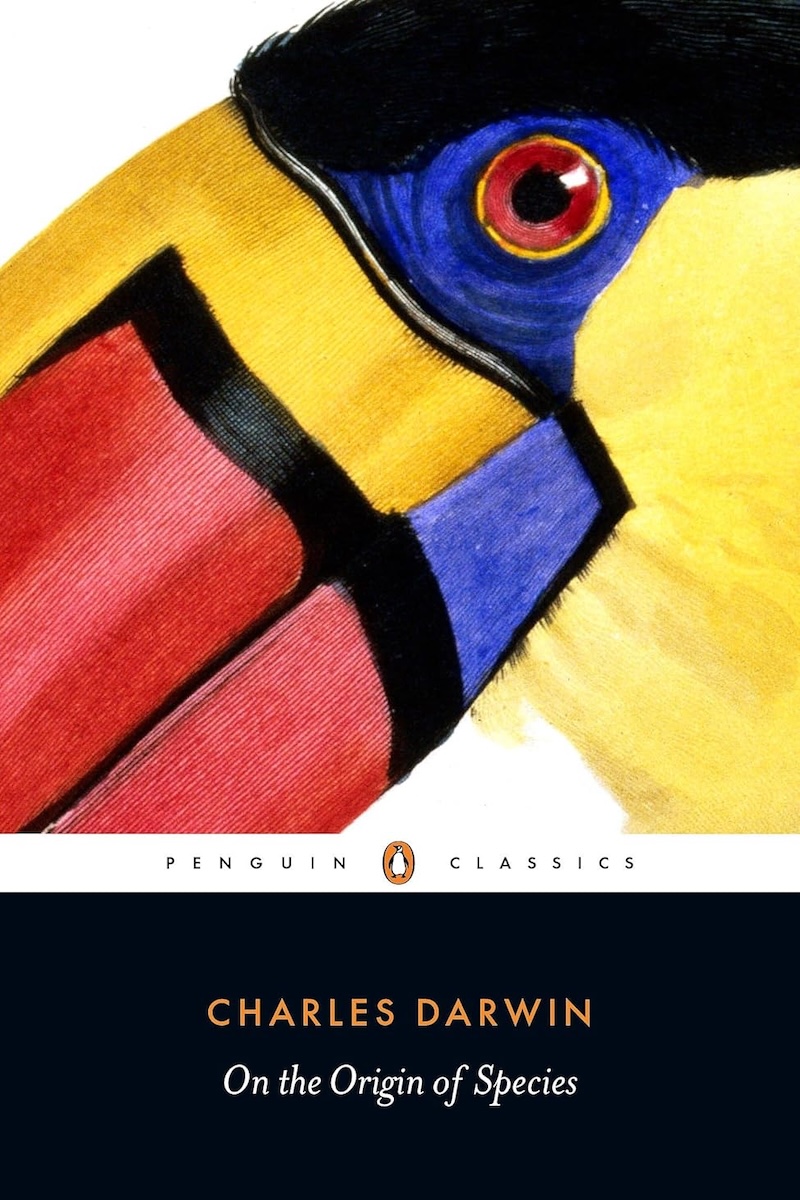
On the Origin of Species by Means of Natural Selection
Author: Charles Darwin
The foundational work of evolutionary biology that introduced the scientific theory of evolution through natural selection, revolutionizing our understanding of life on Earth and establishing evolution as the unifying principle of biology.
Buy this book on Amazon
On the Origin of Species by Means of Natural Selection - Charles Darwin
By purchasing through this link, we may receive a small commission at no extra cost to you. Thank you for your support!
Citation
Darwin, C. (1859). On the Origin of Species by Means of Natural Selection, or the Preservation of Favoured Races in the Struggle for Life. John Murray.
Intellectual & Historical Context
On the Origin of Species was published on November 24, 1859, during a period of intense scientific and social change in Victorian England. Darwin had spent over 20 years developing his theory, gathering evidence from his voyage on HMS Beagle (1831-1836), extensive correspondence with fellow scientists, and meticulous observations of domestic breeding and natural history.
The book emerged from Darwin's growing understanding that species were not immutable creations but evolved through natural processes. Influenced by Thomas Malthus's essay on population and Charles Lyell's geological uniformitarianism, Darwin synthesized these ideas with his own observations to propose a mechanism for evolutionary change.
Central Thesis
Darwin argued that all species descended from common ancestors through a process he termed "natural selection." This mechanism operates through the differential survival and reproduction of individuals with favorable variations, leading to gradual changes in species over time.
Key Arguments
Variation Under Domestication
Darwin began by examining artificial selection in domestic plants and animals, demonstrating how breeders could produce remarkable changes through selective breeding. This provided a familiar analogy for understanding natural selection.
Variation Under Nature
Species in nature exhibit continuous variation, with no clear boundaries between varieties and species. This variation provides the raw material for evolutionary change.
Struggle for Existence
Drawing from Malthus, Darwin argued that organisms produce more offspring than can survive, creating competition for limited resources. This struggle is the driving force of natural selection.
Natural Selection
Individuals with favorable variations are more likely to survive and reproduce, passing these advantageous traits to their offspring. Over time, this process leads to evolutionary change.
Laws of Variation
Darwin discussed various sources of variation, including use and disuse of organs, correlation of growth, and the effects of external conditions, though he lacked knowledge of genetics.
Supporting Evidence
Biogeography
The geographic distribution of species supports common descent, with closely related species found in adjacent regions and island species resembling nearby mainland forms.
Geological Record
Despite its imperfection, the fossil record shows progression from simpler to more complex forms and reveals extinct species related to living ones.
Embryology
Similarities in embryonic development across different species indicate common ancestry, with embryos often more similar than adult forms.
Morphology
Homologous structures across species reveal underlying unity of plan despite functional differences, supporting common descent.
Classification
The hierarchical nature of biological classification reflects the branching pattern of evolutionary relationships.
Methodological Approach
Inductive Reasoning
Darwin assembled vast amounts of evidence from multiple fields to support his theory, following the inductive method advocated by Francis Bacon.
Comparative Analysis
Systematic comparison of species, structures, and processes across different groups to identify patterns and relationships.
Analogical Thinking
Use of domestic breeding as an analogy for natural processes, making abstract concepts more comprehensible.
Hypothetico-Deductive Framework
Proposing testable predictions and examining whether evidence supports or contradicts the theory.
Major Concepts
Descent with Modification
All species are related through common ancestry, with differences arising through accumulated changes over time.
Branching Evolution
Evolution proceeds through a branching pattern, with new species arising from existing ones rather than through linear progression.
Gradualism
Evolutionary change occurs gradually through small, incremental modifications rather than sudden transformations.
Adaptive Significance
Many characteristics of organisms can be understood as adaptations to environmental challenges.
Unity and Diversity
Evolution explains both the fundamental unity of life (common descent) and its remarkable diversity (adaptive radiation).
Reception and Impact
Scientific Revolution
The book fundamentally transformed biology by providing a unifying principle that explained the diversity and relationships of living organisms.
Religious and Social Controversy
Darwin's theory challenged prevailing religious beliefs about special creation, sparking intense debate that continues today.
Influence on Other Fields
Evolutionary thinking influenced psychology, anthropology, philosophy, and other disciplines beyond biology.
Modern Synthesis
Darwin's insights were later integrated with genetics to form the modern evolutionary synthesis in the 20th century.
Limitations and Developments
Mechanism of Inheritance
Darwin lacked knowledge of genetics and proposed an incorrect theory of inheritance (pangenesis).
Source of Variation
The ultimate source of variation remained mysterious until the discovery of mutations and genetic recombination.
Mathematical Framework
Population genetics later provided mathematical models for evolutionary processes.
Molecular Evidence
DNA and protein sequences have provided overwhelming support for common descent and evolutionary relationships.
Contemporary Relevance
Conservation Biology
Understanding evolutionary processes is crucial for preserving biodiversity and managing endangered species.
Medicine
Evolution explains antibiotic resistance, vaccine design, and the emergence of new diseases.
Agriculture
Evolutionary principles guide crop improvement and pest management strategies.
Biotechnology
Understanding evolutionary relationships informs genetic engineering and synthetic biology applications.
Educational Significance
Scientific Literacy
Evolution is fundamental to understanding biology and serves as an excellent example of scientific reasoning.
Critical Thinking
Evaluating evidence for evolution develops skills in analyzing complex arguments and evidence.
Historical Perspective
The book illustrates how scientific ideas develop and change over time.
Interdisciplinary Connections
Evolution connects biology with geology, chemistry, physics, and other sciences.
Philosophical Implications
Nature of Science
Darwin's work exemplifies how science progresses through observation, hypothesis formation, and evidence evaluation.
Materialistic Explanation
Evolution provides natural explanations for biological phenomena without invoking supernatural causes.
Human Origins
The theory implies that humans are part of the natural world and subject to evolutionary processes.
Meaning and Purpose
Evolution raises questions about teleology and purpose in nature.
Conclusion
On the Origin of Species stands as one of the most important scientific works ever published, fundamentally changing our understanding of life on Earth. Darwin's careful argumentation, extensive evidence, and compelling logic established evolution as the central organizing principle of biology.
The book's influence extends far beyond science, affecting philosophy, religion, psychology, and society. While our understanding of evolutionary mechanisms has advanced considerably since Darwin's time, his basic insights about common descent and natural selection remain valid and continue to guide biological research.
Darwin's achievement lies not only in proposing the theory of evolution but in marshaling the evidence to support it and presenting it in a way that transformed scientific thinking. On the Origin of Species remains essential reading for anyone seeking to understand the history of science and the nature of life itself, demonstrating how careful observation and logical reasoning can reveal profound truths about the natural world.
Book Information
- Subject Category
- Biology
- Academic Level
- Undergraduate
- Publisher
- John Murray
- Publication Year
- 1859
Support This Project
Help us maintain and expand this global academic resource platform.
Buy Me a Coffee