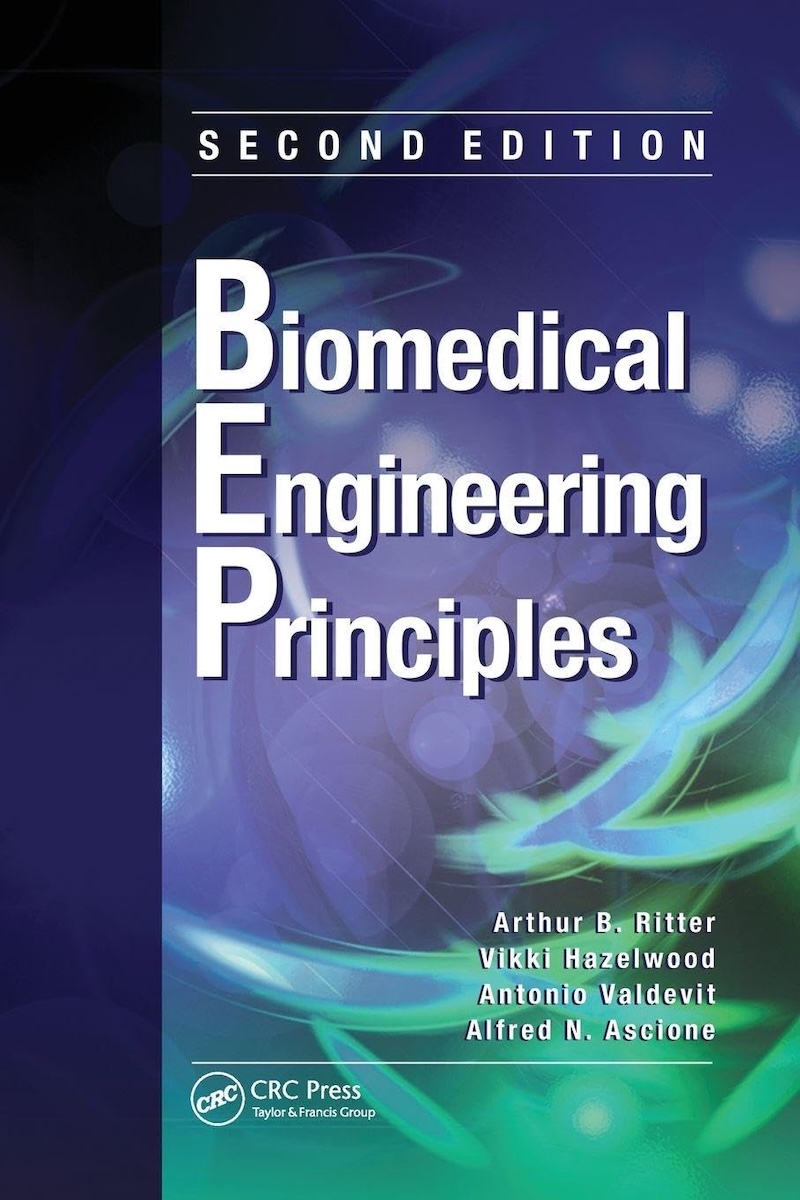
01 / Classic Textbook Recommendation
Classic Textbook Recommendation
Citation
Ritter, A. B., Reisman, S., Hazelwood, V., Michniak, B. B., Valdevit, A., & Ascione, A. N. (2011). Biomedical Engineering Principles (2nd ed.). CRC Press.
Knowledge and Historical Background
Biomedical Engineering Principles represents an advanced approach to biomedical engineering education that emphasizes rigorous application of engineering principles to biological and medical systems. Developed by experienced biomedical engineering educators, the textbook reflects the maturation of the field and the need for more sophisticated analytical approaches.
The textbook emerged from recognition that biomedical engineering requires not just interdisciplinary knowledge, but deep understanding of how to apply engineering methodology to complex biological systems. It represents the evolution toward more quantitative and systematic approaches in biomedical engineering.
Teaching Philosophy
The textbook emphasizes that biomedical engineering is fundamentally an engineering discipline that applies rigorous analytical methods to biological problems. It teaches students to approach biological systems with engineering mindset while respecting the complexity and uniqueness of living systems.
Core Concepts
Engineering Fundamentals
Core engineering principles including thermodynamics, fluid mechanics, heat transfer, and materials science as applied to biological systems and medical devices.
Systems Analysis
Application of systems engineering approaches to biological systems, including feedback control, stability analysis, and system identification methods.
Quantitative Physiology
Mathematical modeling of physiological processes including cardiovascular dynamics, respiratory mechanics, and neural signal processing.
Transport Phenomena
Mass, momentum, and heat transfer in biological systems, including diffusion, convection, and reaction kinetics in living tissues.
Mechanical Analysis
Application of solid and fluid mechanics to biological structures, including stress analysis of bones, blood flow dynamics, and tissue mechanics.
Electrical Properties
Bioelectrical phenomena including membrane potentials, action potentials, and electrical properties of tissues for diagnostic and therapeutic applications.
Control Systems
Application of control theory to biological systems, including physiological regulation, medical device control, and prosthetic device design.
Signal Processing
Advanced signal processing techniques for biomedical applications, including filtering, spectral analysis, and pattern recognition in biological signals.
Optimization
Engineering optimization methods applied to medical device design, treatment protocols, and biological system analysis.
Regulatory Science
Engineering approaches to medical device regulation, quality assurance, and risk management in biomedical engineering applications.
Significance and Impact
Biomedical Engineering Principles has influenced biomedical engineering education by demonstrating how rigorous engineering analysis can be applied to biological systems. Its quantitative approach has helped establish higher analytical standards in the field.
The textbook's emphasis on engineering methodology has prepared students for advanced research and development roles in biomedical engineering, contributing to more sophisticated medical technologies.
Conclusion
Biomedical Engineering Principles provides advanced foundation for applying engineering analysis to biological and medical systems. Its rigorous approach prepares students for complex problem-solving while developing the analytical skills required for biomedical engineering research and development.
The textbook's demonstration that engineering principles can provide deep insights into biological systems makes it invaluable for students pursuing advanced biomedical engineering careers, showing how systematic engineering analysis leads to innovative medical technologies and improved understanding of biological processes.