01 / Classic Textbook Recommendation
Classic Textbook Recommendation
Citation
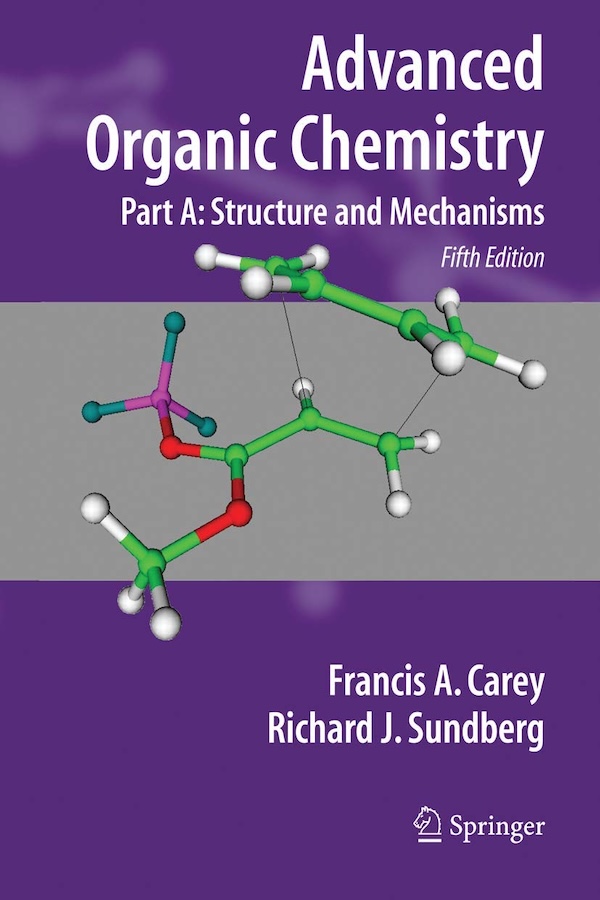
Carey, F. A., & Sundberg, R. J. (2007). Advanced Organic Chemistry: Part A - Structure and Mechanisms (5th ed.). Springer.
Knowledge and Historical Background
"Advanced Organic Chemistry" by Carey and Sundberg has been the definitive graduate-level textbook in organic chemistry since its first publication in the 1970s. The two-part series was developed to provide comprehensive coverage of advanced topics in organic chemistry for graduate students and practicing chemists.
Part A focuses on fundamental principles of structure and mechanism, while Part B covers synthetic methods. The book reflects decades of research in physical organic chemistry and mechanistic studies, incorporating both experimental and theoretical approaches to understanding organic reactions.
Teaching Philosophy
The textbook emphasizes the importance of understanding reaction mechanisms and the physical principles that govern organic reactions. It combines experimental observations with theoretical analysis, showing how modern techniques in physical organic chemistry provide insight into reaction pathways and selectivity.
Core Concepts
Molecular Structure and Bonding
Advanced treatment of chemical bonding, including molecular orbital theory, aromaticity, and the relationship between electronic structure and reactivity.
Stereochemistry and Conformational Analysis
Detailed analysis of stereochemical principles, including dynamic stereochemistry, conformational effects on reactivity, and asymmetric synthesis.
Reaction Mechanisms and Kinetics
Comprehensive coverage of reaction mechanisms, including methods for mechanistic investigation, kinetic isotope effects, and linear free energy relationships.
Pericyclic Reactions
Frontier molecular orbital theory and its application to understanding cycloadditions, electrocyclic reactions, and sigmatropic rearrangements.
Photochemistry
Electronic excited states and photochemical reactions, including mechanistic principles and synthetic applications of photochemistry.
Acid-Base Chemistry
Advanced treatment of acidity and basicity in organic systems, including non-aqueous solvents and superacids.
Oxidation and Reduction
Mechanisms of oxidation and reduction reactions, including selectivity principles and the design of new oxidizing and reducing agents.
Organometallic Chemistry
Structure and bonding in organometallic compounds and their role in catalysis and organic synthesis.
Significance and Impact
"Advanced Organic Chemistry" has defined the standard for graduate education in organic chemistry, influencing how advanced topics are taught and understood. The book's emphasis on mechanistic understanding and physical principles has shaped the training of organic chemists worldwide.
The textbook's comprehensive coverage and rigorous approach have made it an essential reference for practicing organic chemists in academia and industry. Its influence extends to research methodology, with many mechanistic studies building on principles established in the text.
Conclusion
This textbook remains the gold standard for advanced organic chemistry education, providing the theoretical foundation necessary for independent research in organic chemistry. Its comprehensive treatment of structure and mechanism makes it invaluable for graduate students and researchers seeking to understand the fundamental principles governing organic reactions.
The collaborative expertise of Carey and Sundberg ensures that both synthetic and mechanistic perspectives are represented, making the text valuable for diverse research interests in organic chemistry. For students and researchers pursuing advanced work in organic chemistry, this book provides the conceptual framework and detailed analysis necessary for success in modern chemical research.