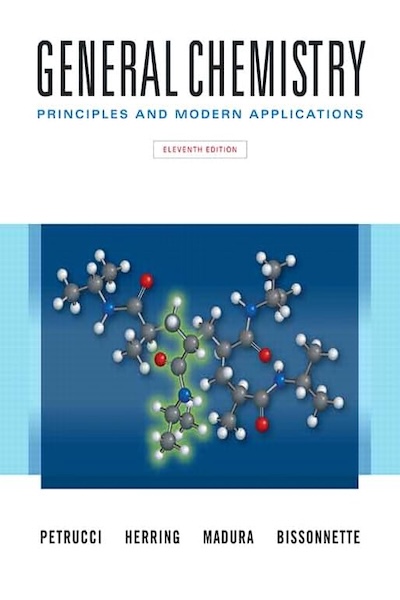
01 / Classic Textbook Recommendation
Classic Textbook Recommendation
Citation
Petrucci, R. H., Herring, F. G., Madura, J. D., & Bissonnette, C. (2022). General Chemistry: Principles and Modern Applications (12th ed.). Pearson.
Knowledge and Historical Background
"General Chemistry: Principles and Modern Applications" has been a leading introductory chemistry textbook for decades, first published in the 1970s. The text was developed by Ralph Petrucci to provide a rigorous yet accessible introduction to chemical principles for undergraduate students.
The book has evolved through multiple editions to incorporate advances in chemistry education research, emphasizing conceptual understanding alongside mathematical problem-solving. It represents the collaborative effort of chemistry educators who sought to create a comprehensive resource that bridges fundamental principles with contemporary applications.
Teaching Philosophy
The textbook is built on the principle that chemistry is best learned through active engagement with problems and applications. It emphasizes the development of critical thinking skills and the ability to apply chemical principles to real-world situations, making chemistry relevant and accessible to students across various disciplines.
Core Concepts
Atomic Structure and Periodicity
Understanding the structure of atoms and how periodic properties emerge from electronic configuration, providing the foundation for all chemical behavior.
Chemical Bonding and Molecular Structure
Comprehensive coverage of ionic, covalent, and metallic bonding, along with molecular geometry and intermolecular forces that determine material properties.
Stoichiometry and Chemical Calculations
Quantitative aspects of chemistry, including mole concepts, balanced equations, and yield calculations essential for chemical analysis.
Thermodynamics and Energetics
Energy changes in chemical reactions, including enthalpy, entropy, and free energy concepts that determine reaction spontaneity.
Chemical Equilibrium
Dynamic equilibrium in chemical systems, including acid-base equilibria, solubility equilibria, and complex ion formation.
Kinetics and Reaction Mechanisms
Rates of chemical reactions and the molecular-level processes that control how fast reactions occur.
Electrochemistry
Oxidation-reduction reactions, galvanic and electrolytic cells, and their applications in technology and biological systems.
Significance and Impact
"General Chemistry: Principles and Modern Applications" is widely recognized for its balanced approach to chemical education, combining theoretical rigor with practical applications. The textbook has influenced chemistry education by demonstrating how fundamental principles connect to modern technological and environmental challenges.
Its emphasis on problem-solving methodology and critical thinking has helped establish standards for introductory chemistry education. The book's comprehensive coverage and clear explanations make it valuable for students planning careers in chemistry, engineering, medicine, and related fields.
Conclusion
This textbook continues to serve as a foundational resource for general chemistry education, successfully bridging the gap between high school chemistry and advanced undergraduate courses. Its enduring popularity reflects its effectiveness in teaching chemical principles while maintaining scientific accuracy and relevance to contemporary issues.
The collaborative approach of its authors ensures that multiple perspectives and teaching strategies are incorporated, making the text adaptable to diverse learning styles and educational contexts. For students beginning their study of chemistry, this book provides both the conceptual framework and practical skills necessary for success in advanced chemistry courses and scientific careers.