01 / Classic Textbook Recommendation
Classic Textbook Recommendation
Citation
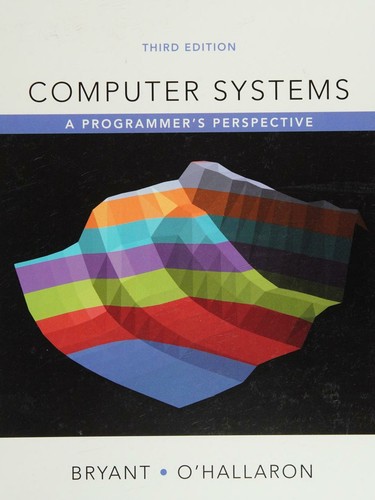
Bryant, R. E., & O'Hallaron, D. R. (2015). Computer Systems: A Programmer's Perspective (3rd ed.). Pearson.
Why It Matters
This book connects the code a programmer writes with the hardware and operating-system mechanisms that make it run. It fills the systems layer between introductory programming and advanced work in architecture, compilers, operating systems, and networks.
Core Ideas
Data Has Machine-Level Meaning
Integers, floating-point values, pointers, and strings are represented by finite bit patterns. Understanding those representations explains overflow, precision, portability, and many security failures.
Programs Become Processes
Compilation, linking, loading, exceptions, signals, and processes form a continuous story. A programmer who understands that story can reason about performance and behavior rather than treating the operating system as a black box.
Memory Is a Hierarchy
Caches, virtual memory, and locality shape the cost of computation. The book makes performance a consequence of program structure, not just processor speed.
Concurrency Changes the Rules
Threads, synchronization, and shared state introduce interleavings that ordinary sequential reasoning cannot capture. The examples show why correctness requires explicit coordination.
Reading Lens
Trace one small C program from source code to machine instructions, then follow its memory accesses and process state. The goal is not to memorize assembly, but to learn which abstractions remain visible when performance or correctness matters.
Conclusion
Computer Systems: A Programmer's Perspective is a bridge text for computer science. It gives programmers the systems intuition needed to design faster, safer, and more portable software.