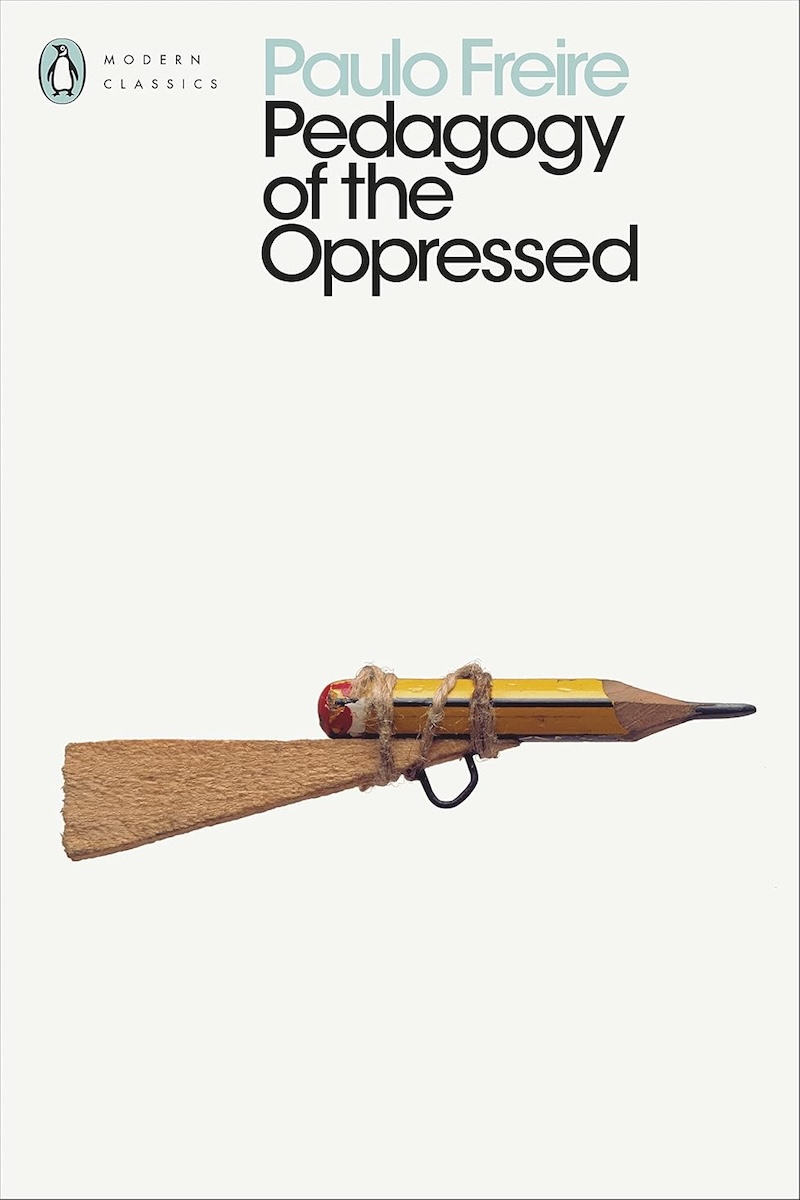
01 / Classic Textbook Recommendation
Classic Textbook Recommendation
Citation
Freire, P. (2018). Pedagogy of the Oppressed (50th Anniversary Edition). Bloomsbury Academic.
Intellectual & Historical Context
Pedagogy of the Oppressed emerged from Paulo Freire's work with illiterate peasants in Brazil during the 1960s, a period marked by significant social and political upheaval in Latin America. The book was written during Freire's exile in Chile following the 1964 military coup in Brazil. This work represents a revolutionary approach to education that challenges the traditional "banking concept" of education, where knowledge is deposited into passive students.
The book is situated within the broader context of liberation theology, Marxist theory, and anti-colonial movements of the 20th century. Freire's educational philosophy was deeply influenced by his Christian faith, existentialism, and dialectical thinking, creating a unique synthesis that has profoundly impacted educational theory worldwide.
Thesis Statement
Freire argues that traditional education serves as an instrument of oppression by treating students as empty vessels to be filled with knowledge, while critical pedagogy enables both teachers and students to become critical co-investigators of reality and their own liberation. Education must be understood as either domestication or liberation, with no neutral ground between these opposing forces.
Key Concepts
The Banking Concept of Education
Freire critiques the traditional educational model where teachers deposit information into passive student-receptacles. This approach perpetuates oppression by discouraging critical thinking and maintaining existing power structures.
Problem-Posing Education
An alternative educational approach that encourages critical dialogue between teachers and students. Both parties become co-investigators of reality, leading to mutual humanization and liberation.
Critical Consciousness (Conscientização)
The development of critical awareness of one's social reality through reflection and action. This process enables individuals to transform both themselves and their world.
Praxis
The cycle of reflection and action upon the world in order to transform it. Praxis represents the integration of theory and practice in the pursuit of liberation.
Dialogue
Authentic dialogue requires love, humility, faith, hope, and critical thinking. It serves as the foundation for problem-posing education and democratic participation.
Humanization vs. Dehumanization
Education should promote humanization by developing critical consciousness and the capacity for transformation, rather than dehumanizing people by treating them as objects.
Cultural Invasion
The process by which dominant groups impose their values and worldview on oppressed peoples, often through educational institutions that serve the interests of the oppressors.
Chapter Summaries
Chapter 1: The Justification for a Pedagogy of the Oppressed
Freire establishes the fundamental premise that education is never neutral—it either functions as domestication or liberation. He introduces the concept of humanization as the central goal of education and discusses how traditional education serves to maintain oppressive structures.
Chapter 2: The "Banking" Concept of Education vs. Problem-Posing Education
This chapter provides a detailed critique of the banking model of education, contrasting it with problem-posing education. Freire demonstrates how the banking concept serves the interests of oppressors while problem-posing education promotes liberation through critical dialogue.
Chapter 3: Dialogics—The Essence of Education as the Practice of Freedom
Freire explores dialogue as the fundamental methodology of critical pedagogy. He discusses the conditions necessary for authentic dialogue and how it differs from manipulation or conquest through false generosity.
Chapter 4: Antidialogics and Dialogics as Matrices of Opposing Theories of Cultural Action
The final chapter examines how cultural action can serve either domination or liberation. Freire analyzes the characteristics of antidialogical action (conquest, divide and rule, manipulation, cultural invasion) versus dialogical action (cooperation, unity, organization, cultural synthesis).
Critical Analysis
Theoretical Contributions
Freire's work represents a paradigm shift in educational theory by connecting pedagogy directly to politics and social justice. His critique of the banking concept has influenced educational practices worldwide, promoting more participatory and critical approaches to learning.
Practical Applications
The book has been applied in various contexts, from adult literacy programs to university curricula. Its influence extends beyond formal education to community organizing, social work, and international development programs.
Contemporary Relevance
In an era of increasing inequality and social polarization, Freire's insights about education as either domestication or liberation remain highly relevant. His work continues to inform discussions about educational equity, multicultural education, and critical pedagogy.
Limitations and Criticisms
Some critics argue that Freire's binary opposition between oppressor and oppressed oversimplifies complex social relationships. Others question the practical applicability of his methods in diverse cultural contexts or formal educational institutions.
Real-World Applications
Adult Literacy Programs
Freire's methods have been successfully implemented in literacy programs worldwide, particularly in developing countries where traditional approaches had failed to address the educational needs of marginalized populations.
Teacher Education
Many teacher preparation programs now incorporate Freire's principles to help educators develop critical consciousness and understand their role in either perpetuating or challenging educational inequalities.
Community Organizing
Social movements and community organizations have adopted Freire's approach to popular education as a tool for consciousness-raising and collective action.
Higher Education
Universities have integrated critical pedagogy into curriculum design, promoting more democratic classroom practices and encouraging students to critically examine their social reality.
Significance & Impact
Pedagogy of the Oppressed has been translated into numerous languages and has sold millions of copies worldwide. It is considered one of the most influential educational texts of the 20th century, fundamentally changing how educators understand the relationship between education and social change.
The book's impact extends far beyond education, influencing fields such as social work, theology, psychology, and political science. Freire's concepts have become central to discussions of social justice, human rights, and democratic participation.
Key Quotes
Education either functions as an instrument of conformity or as the practice of freedom.
This quote encapsulates Freire's central argument that education is inherently political and must be understood in terms of its social consequences.
The oppressed, having internalized the image of the oppressor and adopted his guidelines, are fearful of freedom.
Here, Freire explains how oppression becomes internalized, making liberation a complex psychological and social process.
No one teaches another, nor is anyone self-taught. People teach each other, mediated by the world.
This statement reflects Freire's understanding of education as a mutual process of discovery and transformation.
Conclusion
Pedagogy of the Oppressed remains a revolutionary text that challenges educators to examine their role in either perpetuating or dismantling systems of oppression. Freire's vision of education as the practice of freedom continues to inspire movements for educational and social transformation worldwide.
The book's enduring relevance lies in its fundamental insight that education cannot be separated from questions of power, justice, and human dignity. As educational systems worldwide grapple with issues of inequality and social division, Freire's call for critical pedagogy offers both a framework for analysis and a path toward liberation.
Through its integration of theory and practice, Pedagogy of the Oppressed demonstrates that authentic education must engage with the real-world conditions of students' lives while fostering the critical consciousness necessary for social transformation. This approach to education as both personal and collective liberation remains as relevant today as it was when first published over fifty years ago.