01 / Classic Textbook Recommendation
Classic Textbook Recommendation
Citation
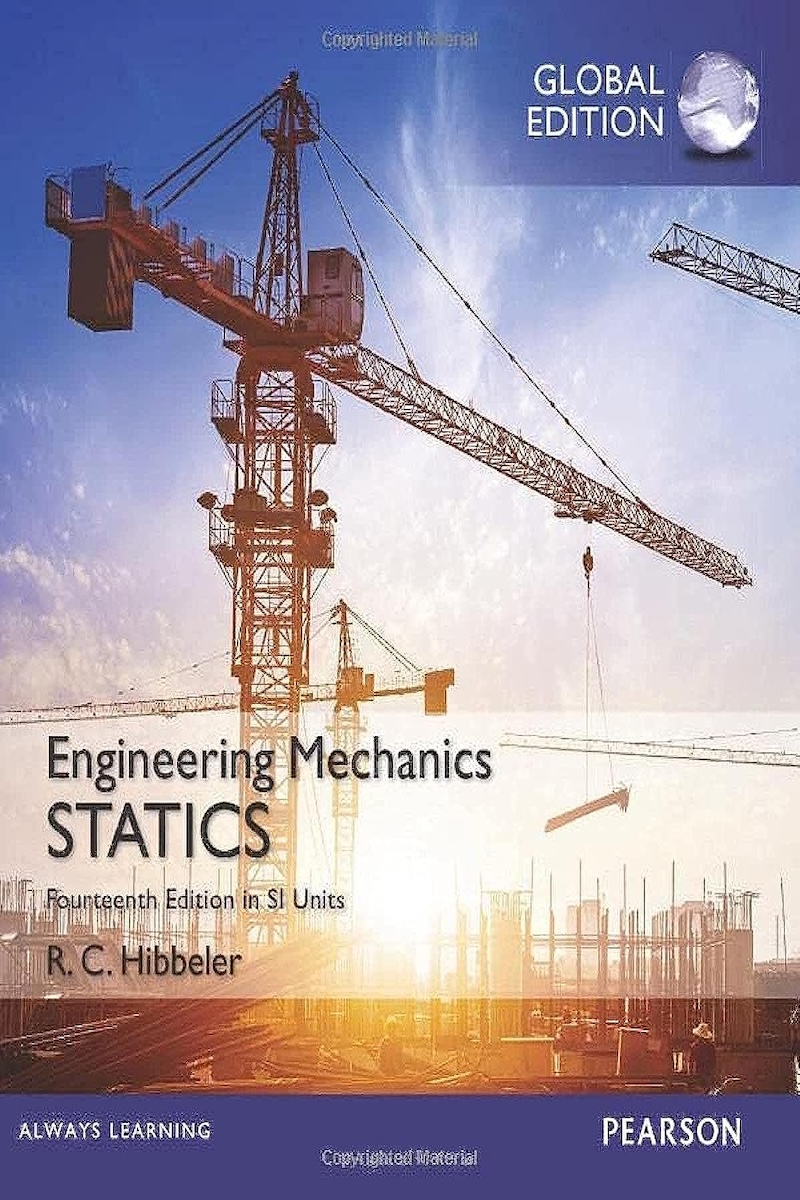
Hibbeler, R. C. (2023). Engineering Mechanics: Statics (15th ed.). Pearson.
Knowledge and Historical Context
Engineering mechanics forms the foundation of all engineering disciplines, with statics being the branch that deals with bodies at rest or in constant motion. The principles of statics were first formalized by ancient Greek mathematicians and engineers, with significant contributions from Archimedes and later developed by Renaissance engineers.
Russell Hibbeler's textbook has been the standard for engineering mechanics education for over four decades. First published in the 1970s, it has continuously evolved to incorporate modern teaching methods while maintaining rigorous mathematical foundations essential for engineering analysis.
Educational Philosophy
The textbook emphasizes that mastery of statics requires both conceptual understanding and mathematical proficiency. It teaches students to approach problems systematically, starting with clear free-body diagrams and applying fundamental principles of equilibrium to solve complex engineering problems.
Core Concepts
Force Vectors and Systems
Vector analysis applied to force systems, including addition, resolution, and representation of forces in two and three dimensions.
Equilibrium of Particles
Analysis of particles in equilibrium under the action of concurrent force systems, including two and three-dimensional problems.
Force System Resultants
Methods for reducing complex force systems to equivalent simpler systems, including couples and distributed loads.
Equilibrium of Rigid Bodies
Analysis of rigid bodies in equilibrium under general force systems, including the development and application of equilibrium equations.
Structural Analysis
Analysis of trusses, frames, and machines using method of joints, method of sections, and equilibrium principles.
Internal Forces
Determination of internal forces in beams and cables, including shear and moment diagrams for structural design.
Friction
Analysis of systems involving dry friction, including static and kinetic friction in engineering applications.
Center of Gravity and Centroid
Location of centers of gravity for bodies and centroids for areas, lines, and volumes using integration and composite methods.
Significance and Impact
This textbook has shaped the education of millions of engineers worldwide by providing the analytical tools essential for structural, mechanical, aerospace, and civil engineering. Its systematic problem-solving approach has become the standard methodology taught in engineering schools globally.
The book's influence extends beyond education into professional practice, where the principles and methods it teaches form the foundation for structural design, machine analysis, and safety evaluation in engineering systems.
Conclusion
Engineering Mechanics: Statics remains the definitive textbook for learning the fundamental principles of static analysis. Its comprehensive coverage, clear explanations, and extensive problem sets provide students with the theoretical knowledge and practical skills essential for advanced engineering coursework.
The textbook's enduring success reflects its ability to make complex mathematical concepts accessible while maintaining the rigor necessary for professional engineering practice. For students entering any engineering discipline, mastery of the principles in this text is essential for success in advanced courses and professional practice.