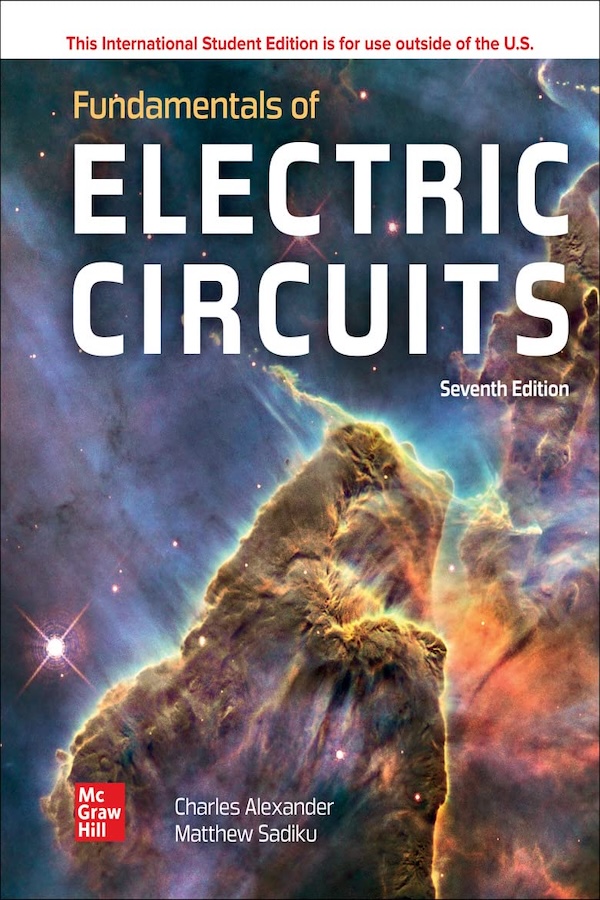
01 / Classic Textbook Recommendation
Classic Textbook Recommendation
Citation
Alexander, C. K., Sadiku, M. N. O., & Musa, S. M. (2024). Fundamentals of Electric Circuits (8th ed.). McGraw-Hill.
Knowledge and Historical Context
Electric circuit theory developed from fundamental discoveries in electricity and magnetism by scientists like Coulomb, Ampère, and Faraday in the 18th and 19th centuries. The formalization of circuit analysis techniques emerged with the work of Kirchhoff, Thévenin, and Norton, whose theorems remain central to modern circuit analysis.
This textbook has been a cornerstone of electrical engineering education for over two decades. Charles Alexander and Matthew Sadiku developed this comprehensive approach to make circuit analysis accessible while maintaining mathematical rigor essential for electrical engineering practice.
Educational Philosophy
The book emphasizes that circuit analysis is both a mathematical discipline and a practical engineering skill. It teaches students to develop intuition about circuit behavior while mastering analytical techniques that form the foundation for advanced electrical engineering topics.
Core Concepts
Basic Concepts and Circuit Laws
Fundamental concepts including current, voltage, power, and energy, along with Ohm's law and Kirchhoff's voltage and current laws.
Basic Nodal and Mesh Analysis
Systematic methods for analyzing circuits using nodal analysis and mesh analysis techniques for solving complex circuit networks.
Circuit Theorems
Network theorems including Thévenin's, Norton's, superposition, and maximum power transfer theorems for simplifying circuit analysis.
Operational Amplifiers
Analysis of ideal and practical operational amplifiers in various configurations including inverting, non-inverting, and differential amplifiers.
Capacitors and Inductors
Energy storage elements, their mathematical models, and behavior in DC circuits including transient analysis.
First-Order Circuits
Analysis of RC and RL circuits, including step response, natural response, and complete response using classical methods.
Second-Order Circuits
RLC circuits, characteristic equations, overdamped, critically damped, and underdamped responses in time domain analysis.
AC Steady-State Analysis
Phasor analysis, impedance concepts, and AC circuit analysis using complex algebra for sinusoidal steady-state conditions.
Significance and Impact
This textbook has shaped electrical engineering education by providing a systematic approach to circuit analysis that bridges theoretical concepts with practical applications. Its problem-solving methodology has become the standard for teaching electrical engineering fundamentals worldwide.
The book's influence extends to professional practice, where the analytical techniques and problem-solving approaches it teaches are essential for designing electronic systems, power systems, and communication networks.
Conclusion
Fundamentals of Electric Circuits remains the leading textbook for undergraduate circuit analysis education. Its comprehensive coverage, clear explanations, and extensive problem sets provide students with the theoretical foundation and practical skills essential for advanced electrical engineering coursework.
The textbook's systematic approach to circuit analysis, combined with modern computational tools and real-world applications, prepares students for the challenges of contemporary electrical engineering practice. For students pursuing careers in electrical, computer, or electronics engineering, mastery of the principles in this text is fundamental to professional success.