01 / Classic Textbook Recommendation
Classic Textbook Recommendation
Citation
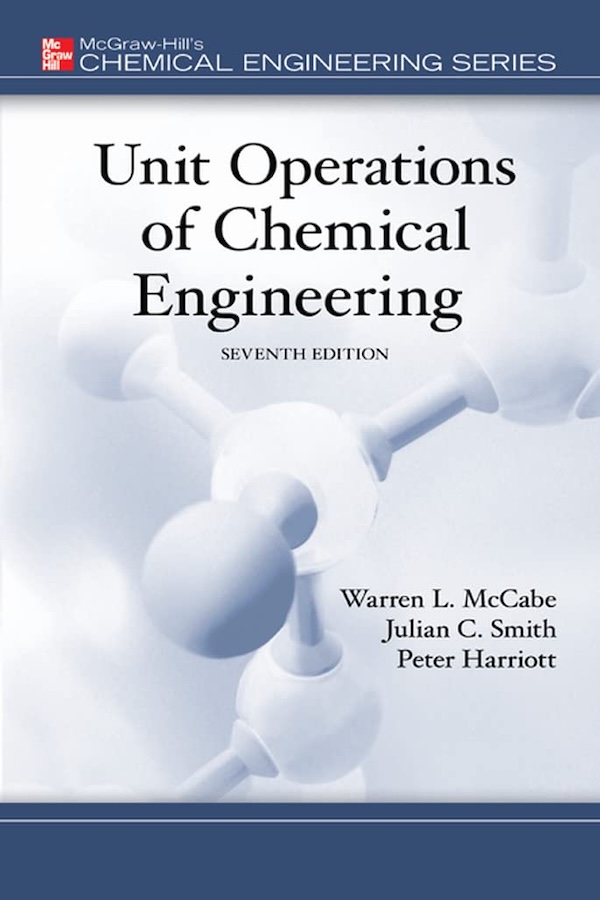
McCabe, W. L., Smith, J. C., & Harriott, P. (2024). Unit Operations of Chemical Engineering (8th ed.). McGraw-Hill.
Knowledge and Historical Context
Chemical engineering emerged as a distinct discipline in the early 20th century, building upon principles from chemistry, physics, and mathematics to design and operate industrial chemical processes. The concept of unit operations, introduced by Arthur Little at MIT, revolutionized the field by identifying common physical and chemical processes across different industries.
Warren McCabe's textbook, first published in the 1950s, established the foundation for chemical engineering education by systematically presenting unit operations and transport phenomena. The book has continuously evolved to incorporate advances in process technology, environmental considerations, and computational methods.
Educational Philosophy
The textbook emphasizes that chemical engineering combines fundamental scientific principles with practical engineering applications. It teaches students to approach problems systematically using mass and energy balances while understanding the physical phenomena underlying chemical processes.
Core Concepts
Introduction to Chemical Processes
Overview of chemical engineering principles, process flow sheets, and the role of chemical engineers in industry and society.
Mass and Energy Balances
Fundamental conservation principles applied to chemical processes, including steady-state and unsteady-state systems.
Fluid Flow
Principles of fluid statics and dynamics, pipe flow, pumps, and flow measurement in chemical process equipment.
Heat Transfer
Conduction, convection, and radiation heat transfer with applications to heat exchangers and thermal process equipment.
Mass Transfer
Diffusion, convective mass transfer, and interphase mass transfer with applications to absorption, distillation, and extraction.
Mechanical Separations
Size reduction, screening, filtration, centrifugation, and other mechanical separation processes for particle systems.
Distillation
Principles and design of distillation columns for liquid-liquid separations, including binary and multicomponent systems.
Gas Absorption and Stripping
Design and operation of packed and tray columns for gas-liquid contacting operations in chemical processes.
Significance and Impact
This textbook has shaped chemical engineering education for over seven decades by establishing the fundamental approach to analyzing and designing chemical processes. Its systematic treatment of unit operations has become the standard methodology used throughout the chemical process industries.
The book's influence extends beyond education to professional practice, where the principles and calculation methods it teaches form the basis for process design, plant operation, and safety analysis in chemical, petroleum, pharmaceutical, and related industries.
Conclusion
Introduction to Chemical Engineering remains the definitive textbook for undergraduate chemical engineering education. Its comprehensive coverage of unit operations, transport phenomena, and process principles provides students with the fundamental knowledge essential for chemical engineering practice.
The textbook's enduring success reflects its ability to present complex engineering concepts in a logical, systematic manner while maintaining relevance to contemporary industrial practice. For students pursuing careers in chemical engineering, process engineering, or related fields, this text provides the essential foundation for advanced coursework and professional success.