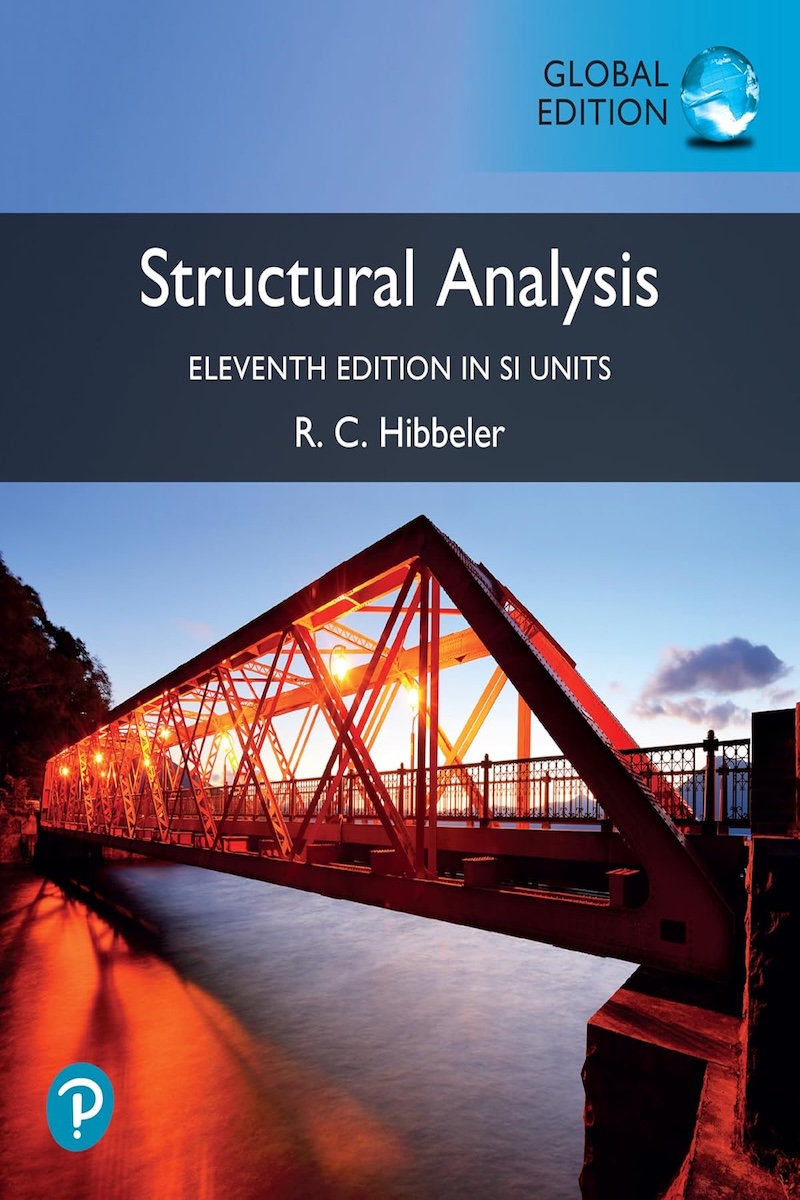
01 / Classic Textbook Recommendation
Classic Textbook Recommendation
Citation
Hibbeler, R. C. (2024). Structural Analysis (11th ed.). Pearson.
Knowledge and Historical Context
Structural analysis evolved from practical needs in construction and engineering, with early developments by engineers like Euler, Castigliano, and Mohr in the 18th and 19th centuries. The field advanced significantly with the introduction of matrix methods and computer analysis in the mid-20th century.
Russell Hibbeler's structural analysis textbook builds upon his successful engineering mechanics series, providing a comprehensive treatment of both classical and modern analysis methods. The book reflects decades of teaching experience and incorporates advances in computational analysis while maintaining focus on fundamental principles.
Educational Philosophy
The textbook emphasizes that structural analysis requires both mathematical rigor and engineering judgment. It teaches students to understand structural behavior through fundamental principles while developing practical skills for analyzing real engineering structures.
Core Concepts
Types of Structures and Loads
Classification of structural systems, load types, and structural idealization for analysis purposes in civil and structural engineering.
Analysis of Statically Determinate Structures
Analysis methods for beams, frames, and trusses using equilibrium equations and principles of statics.
Deflections of Beams and Frames
Methods for calculating deflections including moment-area method, conjugate-beam method, and virtual work principles.
Analysis of Statically Indeterminate Structures
Force method, displacement method, and slope-deflection method for analyzing indeterminate beams and frames.
Moment Distribution Method
Iterative method for analyzing continuous beams and rigid frames without solving simultaneous equations.
Influence Lines
Construction and application of influence lines for determinate and indeterminate structures to determine critical loading conditions.
Matrix Methods of Analysis
Stiffness method and flexibility method using matrix formulation for computer-aided structural analysis.
Analysis of Arches and Cables
Special analysis techniques for arch structures and cable-supported systems including suspension bridges.
Significance and Impact
This textbook has been instrumental in training structural engineers worldwide by providing comprehensive coverage of both classical hand-calculation methods and modern computer-based techniques. Its systematic approach has shaped how structural analysis is taught in engineering schools globally.
The book's influence extends to professional practice, where the fundamental principles and analysis methods it teaches form the basis for structural design codes and engineering software used in the design of buildings, bridges, and other infrastructure.
Conclusion
Structural Analysis continues to be the definitive textbook for undergraduate structural engineering education. Its comprehensive coverage of analysis methods, clear explanations, and extensive problem sets provide students with the theoretical knowledge and practical skills essential for structural engineering practice.
The textbook's integration of traditional analysis methods with modern computational approaches prepares students for contemporary structural engineering practice, where both conceptual understanding and computational skills are essential for safe and efficient structural design.