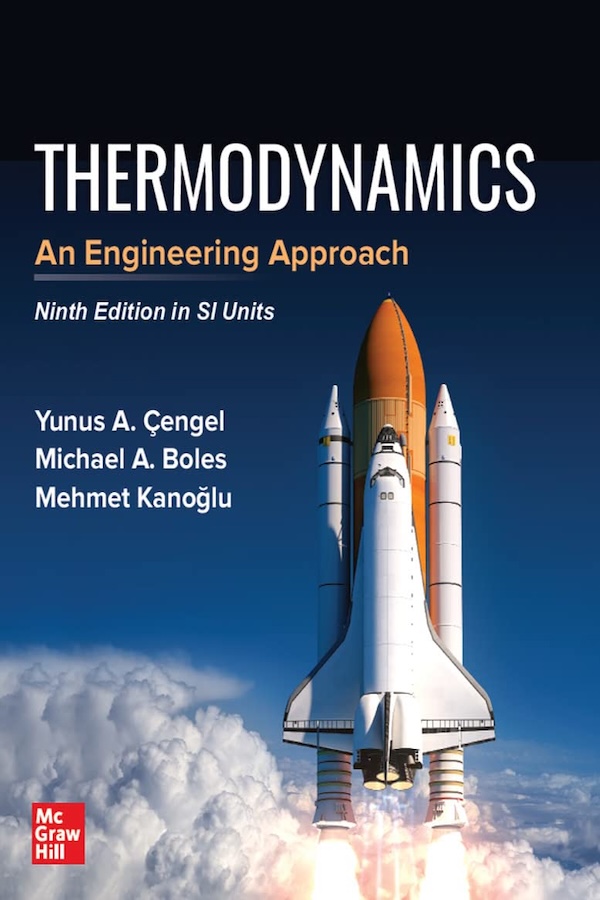
01 / Classic Textbook Recommendation
Classic Textbook Recommendation
Citation
Cengel, Y. A., Boles, M. A., & Kanoglu, M. (2024). Thermodynamics: An Engineering Approach (10th ed.). McGraw-Hill.
Knowledge and Historical Context
Thermodynamics emerged in the 19th century from practical engineering needs during the Industrial Revolution, particularly the development of steam engines. The field was formalized through the work of scientists like Carnot, Clausius, and Kelvin, who established the fundamental laws governing energy transformations.
Yunus Cengel's textbook, first published in the 1990s, revolutionized thermodynamics education by making complex concepts accessible through clear explanations, practical examples, and intuitive approaches. The book has become the global standard for undergraduate thermodynamics education.
Educational Philosophy
The textbook emphasizes that thermodynamics should be taught as an engineering tool rather than abstract theory. It focuses on developing physical insight and problem-solving skills through practical applications, helping students understand how thermodynamic principles apply to real engineering systems.
Core Concepts
Basic Concepts and Definitions
Fundamental concepts including systems, properties, processes, and cycles that form the foundation of thermodynamic analysis.
Properties of Pure Substances
Behavior of pure substances in different phases, property tables, and equations of state for engineering calculations.
Energy and the First Law
Conservation of energy principle, internal energy, enthalpy, and application to closed and open systems in various engineering processes.
Entropy and the Second Law
Entropy concept, reversibility, irreversibility, and the second law of thermodynamics with applications to heat engines and refrigerators.
Gas Power Cycles
Analysis of ideal and actual gas power cycles including Otto, Diesel, Brayton, and combined cycles for power generation.
Vapor Power Cycles
Steam power cycles, Rankine cycle analysis, and modifications for improved efficiency in power plants.
Refrigeration Cycles
Vapor-compression and gas refrigeration cycles, heat pumps, and coefficient of performance analysis.
Gas Mixtures and Psychrometrics
Properties of gas mixtures, psychrometric processes, and air conditioning applications for environmental control systems.
Significance and Impact
This textbook has transformed thermodynamics education worldwide by demonstrating how fundamental principles apply to practical engineering problems. Its approach has influenced how thermal sciences are taught, emphasizing conceptual understanding over mathematical complexity.
The book's impact extends to professional practice, where its problem-solving methodology and practical insights help engineers design and analyze thermal systems including power plants, refrigeration systems, and HVAC equipment.
Conclusion
Thermodynamics: An Engineering Approach continues to be the leading textbook for undergraduate thermodynamics education. Its comprehensive coverage, clear explanations, and practical focus provide students with both theoretical understanding and practical skills essential for thermal system design.
The textbook's enduring popularity reflects its success in making thermodynamics accessible and relevant to engineering students. For those pursuing careers in mechanical, chemical, aerospace, or energy engineering, this text provides the fundamental knowledge and problem-solving skills essential for professional success.