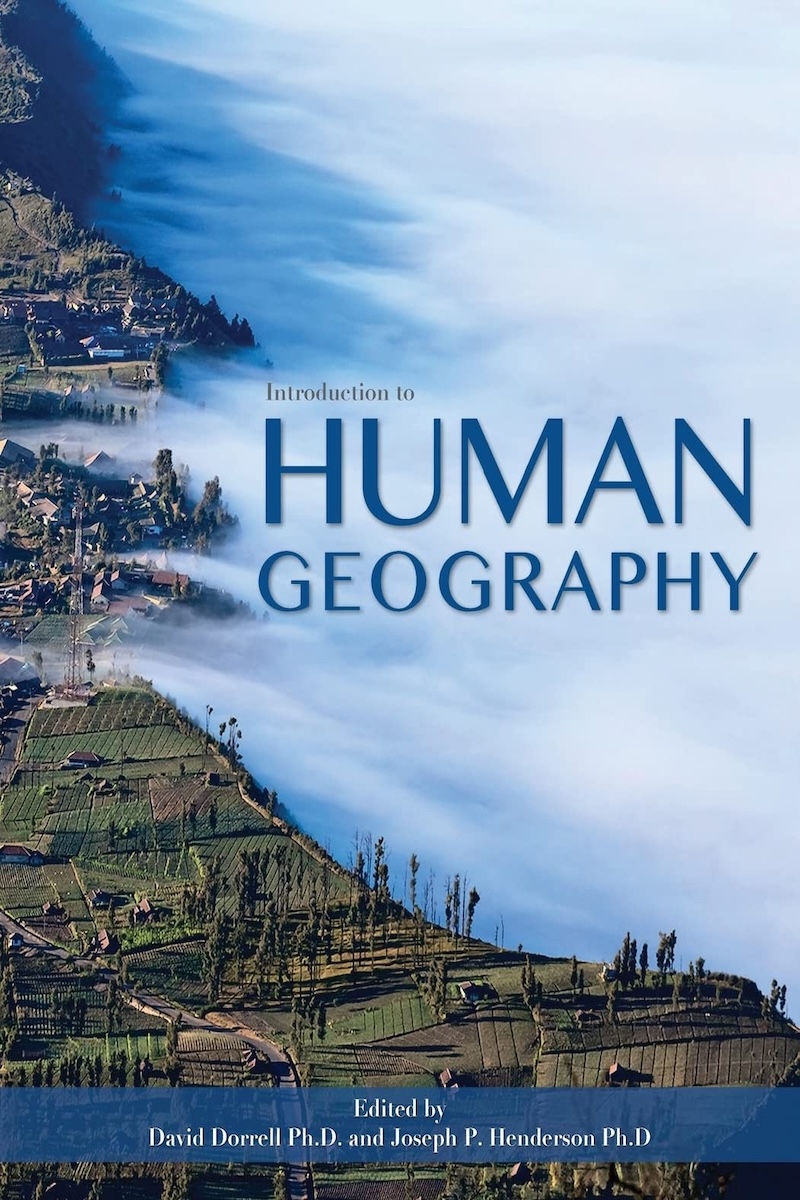
01 / Classic Textbook Recommendation
Classic Textbook Recommendation
Citation
Dorrell, D., Henderson, J., & Todd, H. (2024). Introduction to Human Geography (3rd ed.). University of North Georgia Press.
Knowledge and Historical Context
Human geography emerged as a distinct academic discipline in the late 19th and early 20th centuries, building upon the foundation of regional geography and incorporating social sciences to understand human-environment interactions. The field developed through the contributions of geographers like Carl Sauer, who emphasized cultural landscapes, and later evolved to include quantitative methods and critical theoretical perspectives.
This textbook represents the modern approach to human geography education, integrating traditional geographic concepts with contemporary issues of globalization, technology, and environmental change. It reflects decades of pedagogical development in making geography accessible and relevant to undergraduate students.
Educational Philosophy
The textbook emphasizes that human geography is fundamentally about understanding spatial relationships and how human activities are distributed across Earth's surface. It teaches students to think spatially about social, cultural, economic, and political phenomena while developing critical thinking skills about contemporary global challenges.
Core Concepts
Introduction to Geographic Thinking
Fundamental concepts including place, space, scale, and region, along with geographic tools and methods for analyzing spatial patterns and relationships.
Population and Migration
Demographic patterns, population distribution, migration flows, and the geographic implications of population change including urbanization and aging societies.
Cultural Geography
Language, religion, ethnicity, and other cultural phenomena, examining how culture shapes and is shaped by geographic space and place.
Political Geography
Territorial organization, boundaries, geopolitics, and governance from local to global scales, including nation-states, sovereignty, and supranational organizations.
Economic Geography
Spatial patterns of economic activity, globalization, development and underdevelopment, and the geography of production, consumption, and trade.
Urban Geography
Cities and urbanization processes, urban structure and land use, urban planning, and contemporary urban challenges including sustainability and inequality.
Agricultural Geography
Food systems, agricultural practices, rural landscapes, and the geographic aspects of food security and agricultural sustainability.
Geographic Information Systems
Introduction to GIS technology, spatial analysis, and cartographic representation as tools for geographic research and problem-solving.
Significance and Impact
This textbook has influenced human geography education by providing an accessible yet comprehensive introduction to the field. Its emphasis on contemporary issues and spatial thinking has helped establish standards for undergraduate geography instruction in the digital age.
The open-access availability of this text has democratized geography education, making high-quality instructional materials available to institutions and students worldwide, particularly benefiting underfunded educational programs.
Conclusion
Introduction to Human Geography serves as an essential foundation for understanding the spatial dimensions of human activity. Its comprehensive coverage of core geographic concepts, combined with contemporary examples and digital accessibility, makes it an invaluable resource for students beginning their study of geography.
The textbook's integration of traditional geographic knowledge with modern analytical tools and global perspectives prepares students for advanced geographic study and careers in fields requiring spatial thinking and cultural awareness.