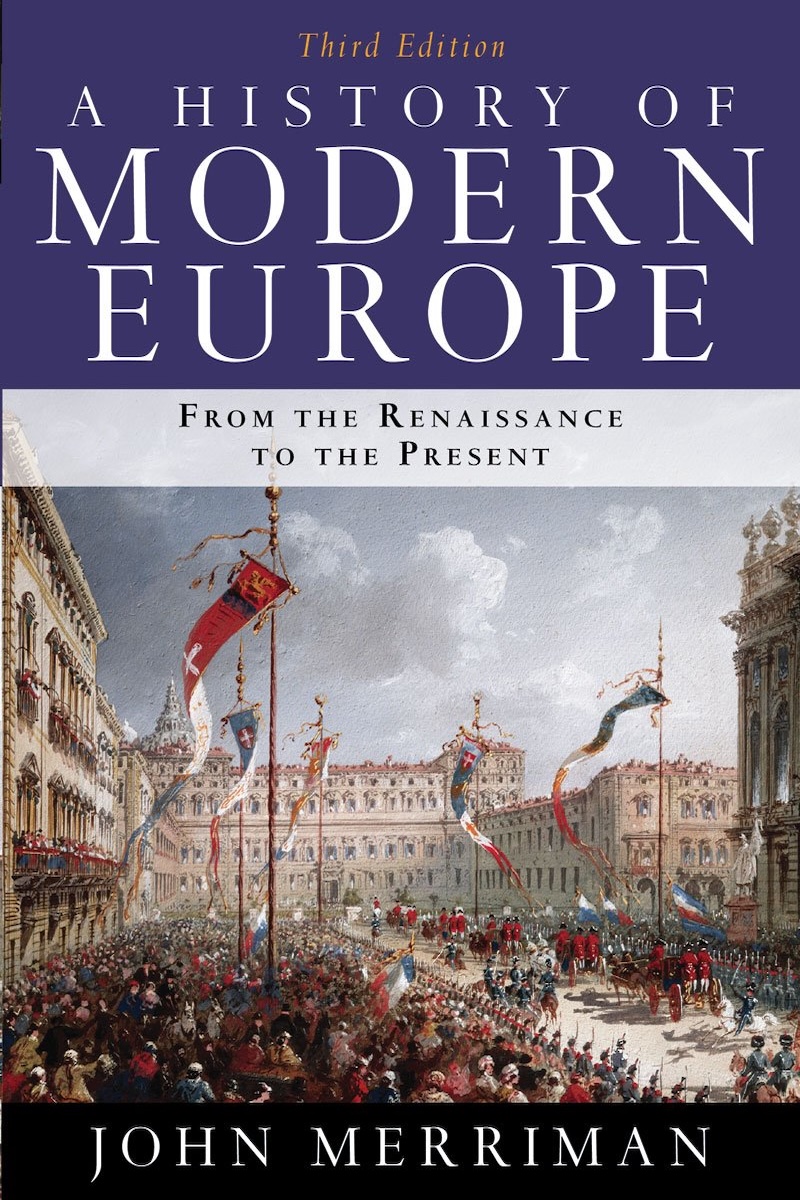
01 / Classic Textbook Recommendation
Classic Textbook Recommendation
Citation
Merriman, J. (2024). A History of Modern Europe: From the Renaissance to the Present (4th ed.). W. W. Norton & Company.
Knowledge and Historical Context
John Merriman's A History of Modern Europe reflects his expertise in French history and European social history, providing a comprehensive narrative that balances political events with social and cultural developments. The textbook emerged from decades of teaching European history and incorporates both traditional historical scholarship and newer approaches emphasizing ordinary people's experiences.
The work represents contemporary historiographical approaches that integrate political history with social history, gender history, and cultural history. It reflects the understanding that modern European history cannot be comprehended through political events alone but requires attention to social structures, cultural changes, and everyday life.
Educational Philosophy
The textbook emphasizes that modern European history should be understood as the interplay between political developments and social change. It teaches students to analyze primary sources, understand multiple perspectives on historical events, and recognize how past developments continue to influence contemporary Europe.
Core Concepts
Renaissance and Reformation
Cultural transformation, religious revolution, political fragmentation, and the emergence of early modern European states and societies.
Absolutism and Constitutional Government
Development of monarchical power, challenges to royal authority, and the emergence of constitutional limits on government.
Scientific Revolution and Enlightenment
Intellectual transformation, scientific method, rational thought, and the development of modern European political and social theory.
French Revolution and Napoleon
Revolutionary transformation, democratic ideals, nationalism, and the Napoleonic impact on European political and social order.
Industrial Revolution
Technological change, urbanization, class formation, and the transformation of European economy and society.
Nationalism and Liberalism
National movements, democratic revolutions, unification processes, and the development of modern European nation-states.
Imperial Europe
European expansion, colonialism, cultural imperialism, and the global impact of European civilization.
Crisis of European Civilization
World Wars, totalitarianism, Holocaust, and the destruction and reconstruction of European political and social order.
Significance and Impact
A History of Modern Europe has influenced European history education by providing a balanced narrative that integrates political, social, and cultural history. Its comprehensive approach has shaped how modern European history is taught in universities across the world.
The textbook's attention to social history and ordinary people's experiences has helped students understand that history involves all members of society, not just political elites and major events.
Conclusion
A History of Modern Europe provides essential knowledge for understanding the development of modern European civilization and its global impact. Its comprehensive coverage and analytical approach prepare students for advanced study in European history and related fields.
The textbook's integration of different historical approaches and emphasis on continuity and change makes it invaluable for students seeking to understand how European history connects to contemporary global developments.