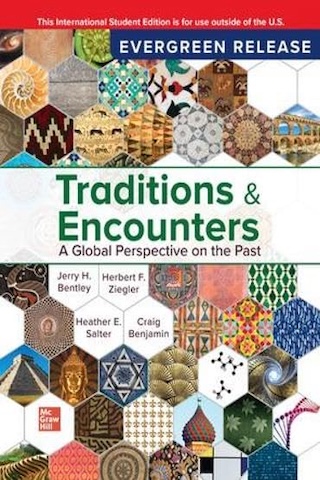
01 / Classic Textbook Recommendation
Classic Textbook Recommendation
Citation
Bentley, J. H., Ziegler, H. F., & Streets-Salter, H. E. (2024). Traditions & Encounters: A Global Perspective on the Past (8th ed.). McGraw-Hill Education.
Knowledge and Historical Context
Traditions & Encounters emerged from Jerry Bentley's expertise in world history and cross-cultural studies, reflecting the "new world history" movement that emphasizes connections rather than isolated civilizations. The textbook was designed to move beyond traditional Western-centered narratives toward a truly global approach.
The textbook incorporates insights from comparative history, environmental history, and the history of technology while emphasizing the role of trade, migration, and cultural exchange in shaping human societies. It reflects contemporary scholarship that views globalization as a long-term historical process rather than a recent phenomenon.
Educational Philosophy
The textbook emphasizes that world history is best understood through patterns of interaction between societies rather than the development of individual civilizations in isolation. It teaches students to identify connections across cultures and time periods while understanding how local traditions have been shaped by global forces.
Core Concepts
Early Complex Societies
Development of agriculture, emergence of cities, and the formation of the first complex societies in Mesopotamia, Egypt, India, China, and the Americas.
Classical Societies
Greek, Roman, Chinese, Indian, and Persian civilizations, emphasizing their cultural achievements and patterns of expansion and interaction.
Post-Classical Era
Islamic expansion, Byzantine Empire, medieval Europe, and the development of extensive trade networks connecting Eurasia and Africa.
Mongol Empire and Connectivity
Mongol conquests, Pax Mongolica, and the intensification of cultural and commercial exchanges across Eurasia.
Age of Exploration
European maritime expansion, colonization of the Americas, and the creation of the first truly global trade networks.
Early Modern World
Scientific revolution, Enlightenment, political revolutions, and the transformation of global political and economic systems.
Industrial Revolution
Technological change, social transformation, imperialism, and the creation of an increasingly interconnected world economy.
Twentieth Century
World wars, decolonization, Cold War, and the acceleration of globalization processes in the contemporary world.
Significance and Impact
Traditions & Encounters has influenced world history education by demonstrating how cross-cultural interactions have been central to historical development. Its thematic approach helps students understand patterns that transcend individual civilizations and time periods.
The textbook's emphasis on trade, technology transfer, and cultural exchange has shaped how world history is taught, encouraging students to think about global interconnections and their historical roots.
Conclusion
Traditions & Encounters provides essential knowledge for understanding world history through the lens of cross-cultural interaction and exchange. Its comprehensive coverage and thematic approach prepare students for advanced study in world history and global studies.
The textbook's emphasis on connections and patterns makes it invaluable for students seeking to understand how historical processes have created our interconnected contemporary world.