01 / Classic Textbook Recommendation
Classic Textbook Recommendation
Citation
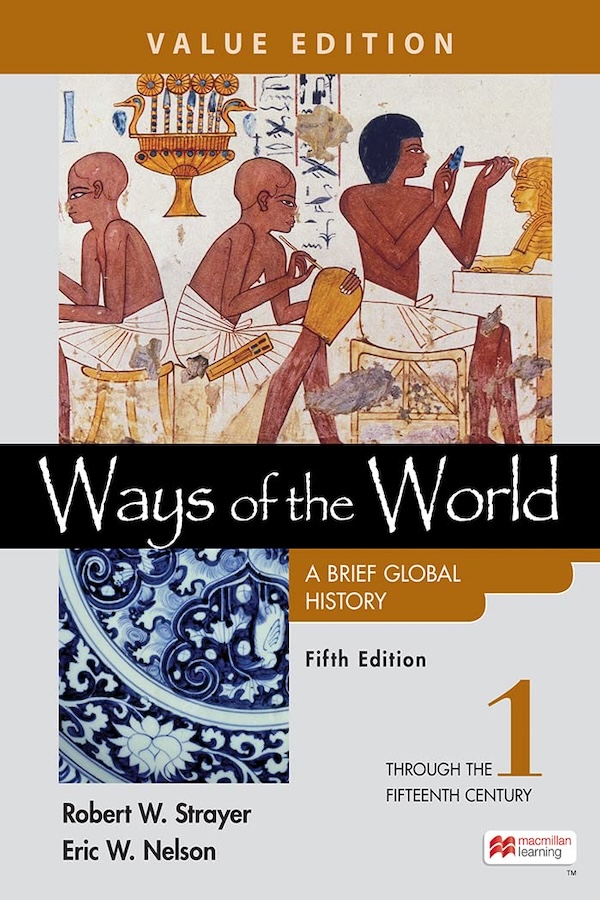
Strayer, R. W., & Nelson, E. W. (2022). Ways of the World: A Brief Global History (5th ed.). Bedford/St. Martin's.
Knowledge and Historical Context
Ways of the World emerged from the growing need for a truly global approach to world history that moves beyond Eurocentric narratives. Robert Strayer, drawing from decades of teaching experience, developed this textbook to emphasize connections between societies, comparative analysis across cultures, and patterns of change over time.
The textbook represents a shift in historical education from memorizing dates and events to understanding processes, patterns, and relationships. It reflects contemporary historiographical approaches that emphasize social history, environmental history, and the experiences of ordinary people alongside traditional political narratives.
Educational Philosophy
The textbook emphasizes that world history should be understood through themes of connection, comparison, and change. It teaches students to think historically by examining how societies have interacted, how similar challenges have produced different responses, and how human communities have transformed over time.
Core Concepts
Early Human History
The origins of humanity, agricultural revolution, and emergence of early civilizations, examining how geography and environment shaped human development.
Classical Civilizations
Comparative analysis of Greek, Roman, Chinese, Indian, and Persian civilizations, exploring political systems, cultural achievements, and patterns of expansion.
Post-Classical Era
The rise of Islam, Byzantine Empire, medieval Europe, and developments in Africa, Americas, and Asia, emphasizing cross-cultural exchanges and trade networks.
Early Modern Period
The Mongol Empire, Renaissance, Age of Exploration, and early globalization, examining how increased connectivity transformed societies worldwide.
Modern Revolutions
Political, industrial, and social revolutions from the 18th to 19th centuries, analyzing their global impacts and interconnections.
Imperialism and Its Consequences
European colonialism, resistance movements, and the transformation of Africa, Asia, and the Americas under imperial rule.
Twentieth Century
World Wars, Cold War, decolonization, and the emergence of the contemporary global order, examining causes, consequences, and continuing legacies.
Contemporary World
Globalization, environmental challenges, technological revolution, and current issues facing humanity in the 21st century.
Significance and Impact
Ways of the World has transformed world history education by providing a genuinely global perspective that gives equal attention to all world regions. Its thematic approach helps students understand historical patterns and processes rather than merely memorizing facts.
The textbook's emphasis on comparison and connection has influenced how world history is taught, encouraging students to think critically about historical developments and their contemporary relevance.
Conclusion
Ways of the World provides essential knowledge for understanding our interconnected world through historical perspective. Its comprehensive coverage of global history, combined with analytical frameworks for comparison and connection, prepares students for advanced historical study and global citizenship.
The textbook's balanced treatment of diverse civilizations and emphasis on historical thinking skills makes it invaluable for students seeking to understand how the modern world emerged from complex historical processes.