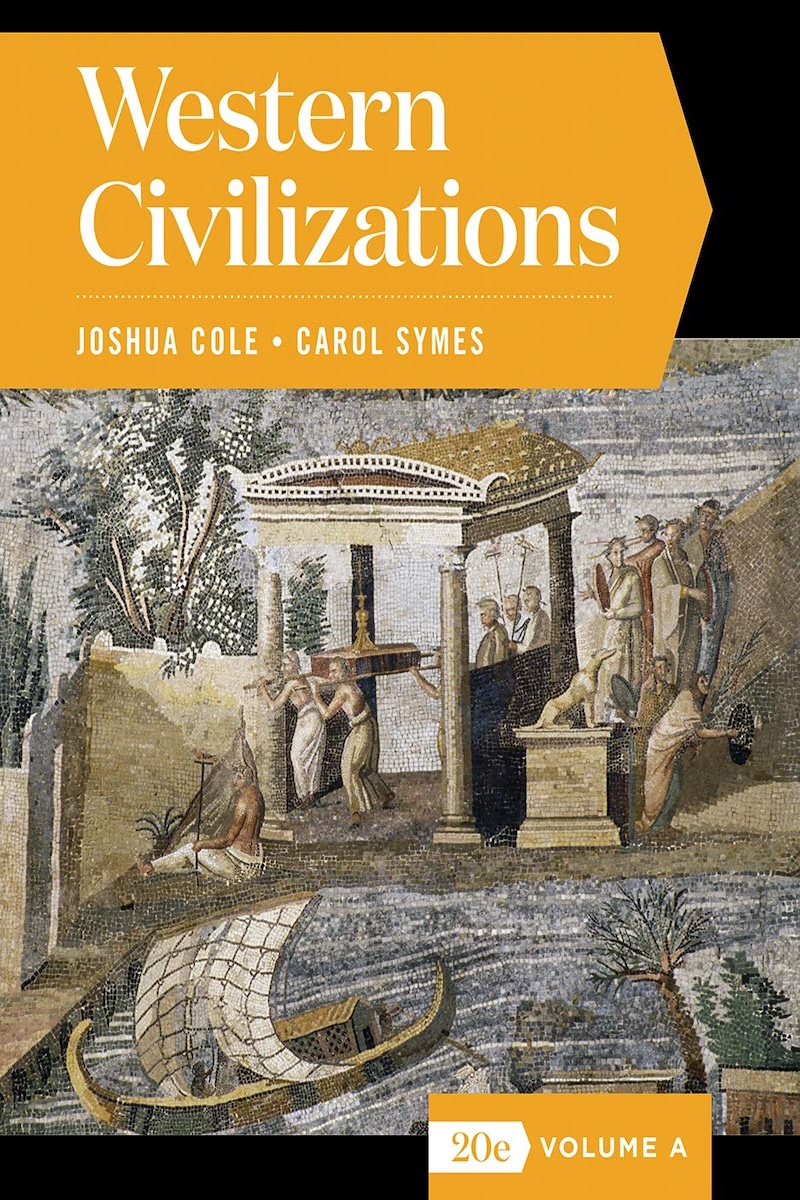
01 / Classic Textbook Recommendation
Classic Textbook Recommendation
Citation
Cole, J., & Symes, C. (2023). Western Civilizations (21st ed.). W. W. Norton & Company.
Knowledge and Historical Context
Western Civilizations has been a cornerstone of history education since Edward McNall Burns published the first edition in 1941. The current edition by Joshua Cole and Carol Symes represents decades of refinement and updating, incorporating new historical research and contemporary pedagogical approaches.
The textbook has evolved from a traditional narrative focused on political and military history to a more comprehensive examination that includes social history, gender history, environmental history, and the history of everyday life. It reflects current scholarly understanding that "Western civilization" is not a monolithic entity but a complex interaction of diverse cultures and traditions.
Educational Philosophy
The textbook emphasizes that Western civilization should be understood as a dynamic process of cultural exchange, conflict, and synthesis rather than a fixed set of values or achievements. It teaches students to analyze primary sources, think critically about historical narratives, and understand how past developments connect to contemporary issues.
Core Concepts
Ancient Near East and Mediterranean
Origins of civilization in Mesopotamia, Egypt, and the eastern Mediterranean, examining the development of writing, law, and urban life.
Classical Antiquity
Greek and Roman civilizations, including political systems, philosophy, literature, and the foundations of Western legal and governmental traditions.
Late Antiquity and Early Middle Ages
Fall of Rome, rise of Christianity, Byzantine Empire, Islamic expansion, and the formation of medieval European society.
High and Late Middle Ages
Medieval culture, Crusades, university development, Gothic architecture, and the crises of the fourteenth century including plague and war.
Renaissance and Reformation
Humanism, artistic innovation, Protestant Reformation, Catholic Counter-Reformation, and the transformation of European culture and society.
Early Modern Europe
Age of exploration, scientific revolution, absolutism and constitutionalism, Enlightenment, and the development of global trade networks.
Revolutionary Era
American Revolution, French Revolution, Industrial Revolution, and the transformation of political, social, and economic life.
Modern Europe and the World
Nationalism, imperialism, World Wars, totalitarianism, Cold War, European integration, and contemporary challenges.
Significance and Impact
Western Civilizations has shaped how generations of students understand European and Western history. Its comprehensive approach has influenced history education by demonstrating the interconnections between political, social, cultural, and economic developments.
The textbook's evolution reflects broader changes in historical scholarship, incorporating diverse perspectives and challenging traditional narratives while maintaining scholarly rigor.
Conclusion
Western Civilizations provides essential knowledge for understanding the historical development of Western societies and their global impact. Its comprehensive coverage and analytical approach prepare students for advanced historical study and critical engagement with contemporary issues.
The textbook's balanced treatment of continuity and change, combined with attention to diverse voices and experiences, makes it invaluable for students seeking to understand how historical processes have shaped the modern world.