01 / Classic Textbook Recommendation
Classic Textbook Recommendation
Citation
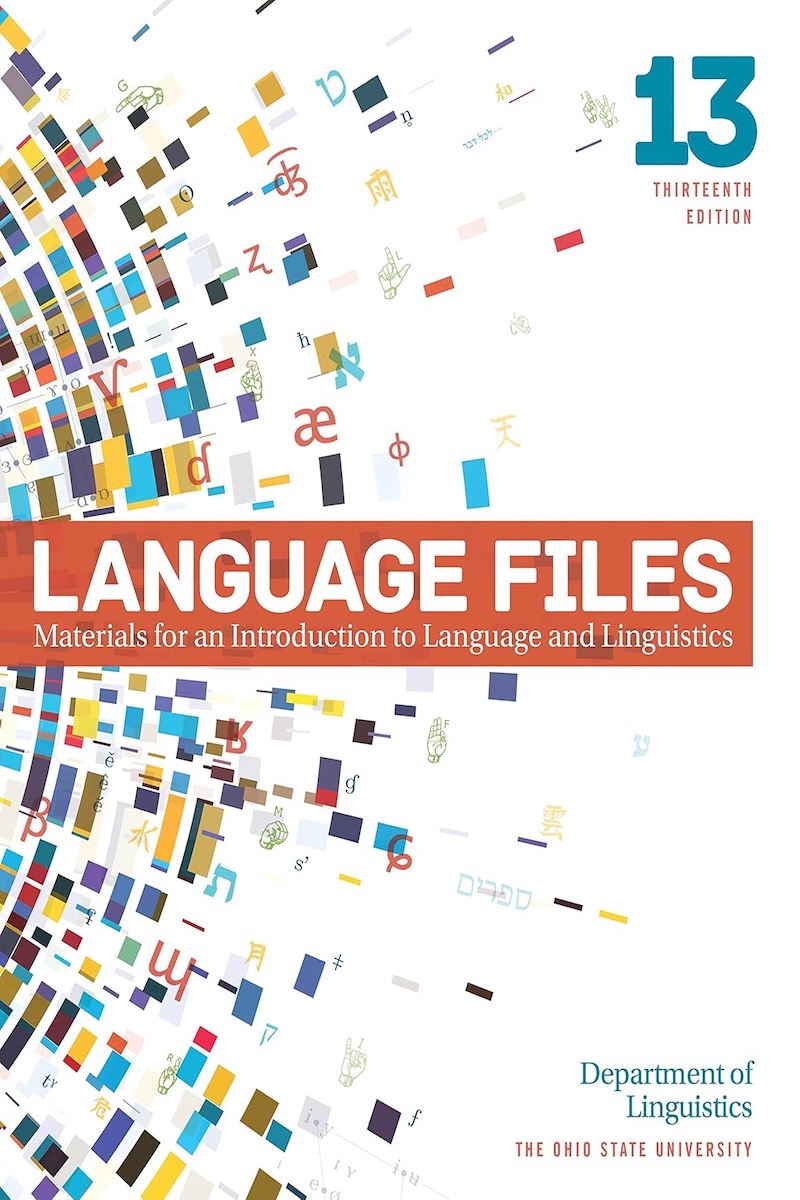
Ohio State University Department of Linguistics. (2024). Language Files: Materials for an Introduction to Language and Linguistics (13th ed.). Ohio State University Press.
Knowledge and Historical Background
"Language Files" originated in the 1980s as a collaborative effort by the Ohio State University Department of Linguistics to create comprehensive, modular materials for introductory linguistics courses. The textbook emerged from the need for flexible teaching materials that could accommodate different course structures and emphases while maintaining rigorous academic standards.
This collaborative approach reflects the collective expertise of multiple linguists, ensuring balanced coverage of all linguistic subfields. The modular design has influenced how linguistics is taught, allowing instructors to customize their courses while maintaining coherent theoretical foundations across different areas of study.
Teaching Philosophy
The textbook emphasizes linguistics as an empirical science, encouraging students to analyze data, form hypotheses, and test theoretical claims. It teaches students to approach language systematically, using scientific methods to understand the complex patterns underlying human language.
Core Concepts
Phonetics
Articulatory phonetics, acoustic phonetics, auditory phonetics, and the International Phonetic Alphabet for transcribing speech sounds across languages.
Phonology
Phonemes, allophones, phonological rules, distinctive features, and sound patterns in different languages.
Morphology
Morphemes, morphological processes, word formation, inflection, derivation, and morphophonological alternations.
Syntax
Phrase structure, syntactic categories, transformations, tree diagrams, and syntactic argumentation.
Semantics
Word meaning, sentence meaning, semantic relationships, truth conditions, and formal approaches to meaning.
Pragmatics
Context and meaning, speech acts, conversational principles, presupposition, and discourse analysis.
Sociolinguistics
Language variation, dialect differences, language contact, code-switching, and language and identity.
Historical Linguistics
Language change, comparative method, reconstruction, and the relationship between languages.
Significance and Impact
"Language Files" has shaped linguistics education through its modular organization, allowing instructors to tailor courses to specific needs while maintaining comprehensive coverage. Its emphasis on data analysis and problem-solving has influenced how linguistic concepts are taught and learned.
The textbook's collaborative authorship model has demonstrated the value of collective expertise in creating educational materials, ensuring that each section reflects current research and best practices in linguistic pedagogy.
Conclusion
"Language Files" provides essential resources for understanding language as a complex, systematic phenomenon. Its modular design and comprehensive coverage prepare students for advanced study in linguistics while developing analytical skills applicable across disciplines.
The textbook's emphasis on empirical analysis and theoretical argumentation makes it invaluable for students seeking to understand how linguists investigate language and what their findings reveal about human cognition and communication.