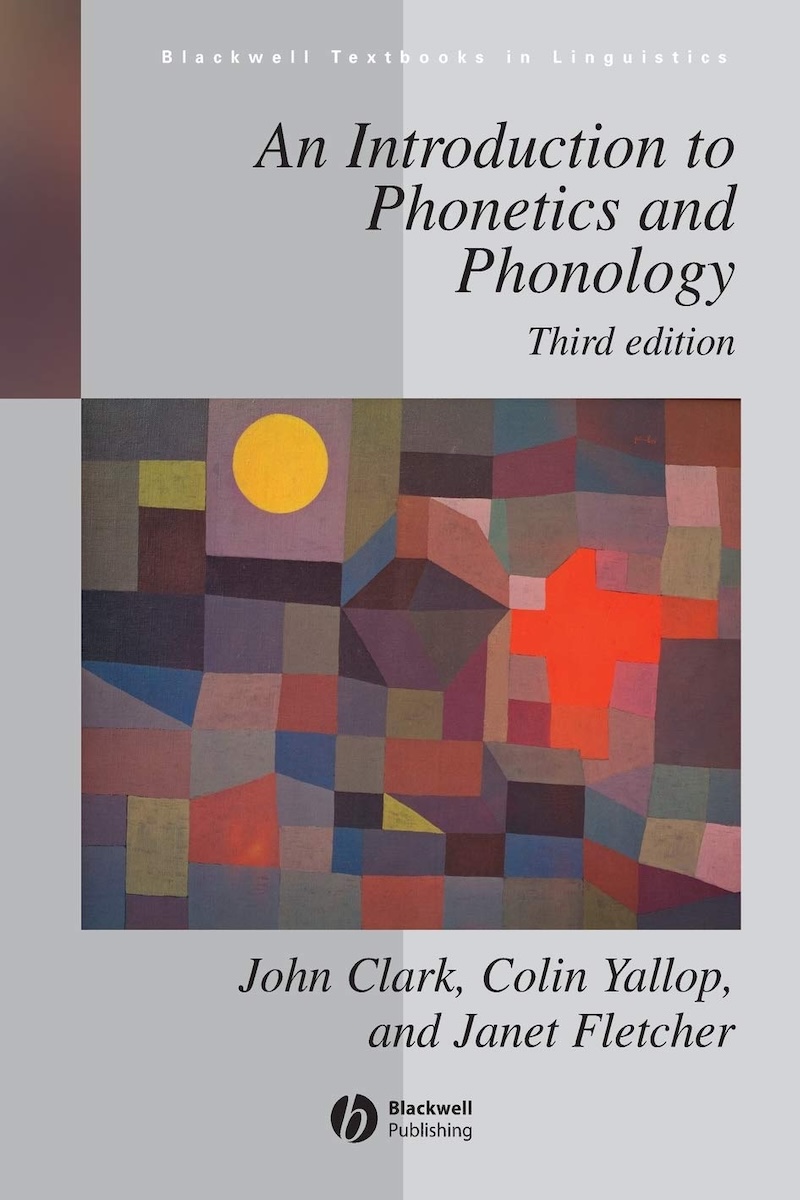
01 / Classic Textbook Recommendation
Classic Textbook Recommendation
Citation
Clark, J., Yallop, C., & Fletcher, J. (2007). An Introduction to Phonetics and Phonology (3rd ed.). Wiley-Blackwell.
Knowledge and Historical Background
"An Introduction to Phonetics and Phonology" represents an integrated approach to the study of speech sounds, combining the traditionally separate fields of phonetics and phonology. The textbook emerged from the recognition that understanding sound systems requires both detailed knowledge of speech production and perception and theoretical understanding of sound patterns.
This work reflects advances in acoustic phonetics and experimental phonology, incorporating instrumental methods and quantitative analysis alongside traditional articulatory descriptions. It represents the modern synthesis of laboratory phonetics with theoretical phonology.
Teaching Philosophy
The textbook emphasizes that phonetics and phonology are complementary approaches to understanding speech sounds. It teaches students to integrate articulatory, acoustic, and auditory perspectives while understanding how phonetic details relate to phonological patterns and generalizations.
Core Concepts
Articulatory Phonetics
Speech production mechanisms, places and manners of articulation, and the systematic description of consonants and vowels across languages.
Acoustic Phonetics
Sound waves, formants, spectrograms, and acoustic correlates of articulatory distinctions.
Auditory Phonetics
Speech perception, categorical perception, and the relationship between acoustic signals and perceptual categories.
Phonological Analysis
Phonemes and allophones, distinctive features, phonological rules, and underlying representations.
Syllable Structure
Syllable organization, phonotactics, and the role of syllables in phonological processes.
Prosody
Stress, tone, intonation, and the suprasegmental aspects of speech.
Phonological Processes
Assimilation, deletion, insertion, and other systematic sound changes in language.
Cross-linguistic Phonology
Phonological typology, universal tendencies, and the range of sound systems across languages.
Significance and Impact
"An Introduction to Phonetics and Phonology" has influenced how the sound component of language is taught by demonstrating the essential connection between phonetic details and phonological patterns. Its integrated approach has shaped curricula that combine experimental and theoretical perspectives.
The textbook's emphasis on cross-linguistic comparison and quantitative methods has helped students understand both the diversity and the systematic nature of human sound systems.
Conclusion
"An Introduction to Phonetics and Phonology" provides essential knowledge for understanding how speech sounds work as both physical phenomena and elements of linguistic systems. Its comprehensive approach prepares students for advanced work in phonetics, phonology, and related fields.
The textbook's integration of theoretical and experimental approaches makes it invaluable for students seeking to understand the full complexity of human speech sounds and their systematic organization in language.