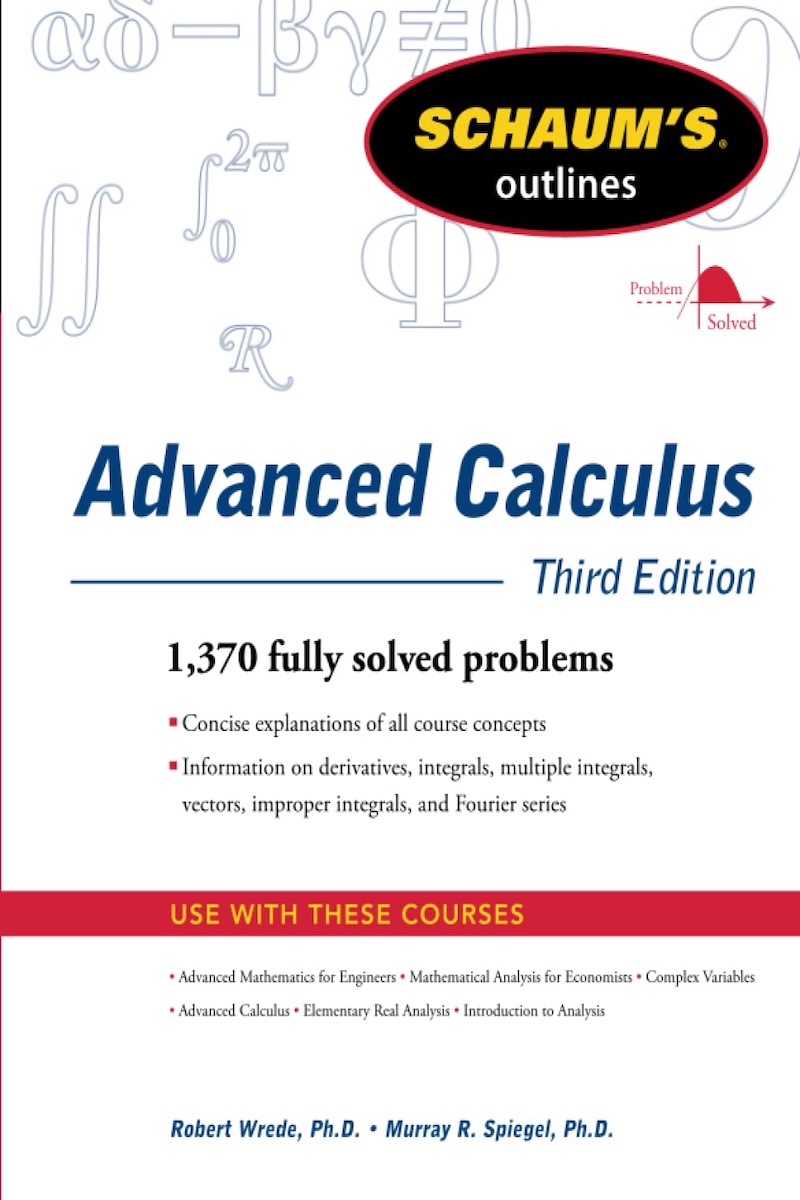
01 / Classic Textbook Recommendation
Classic Textbook Recommendation
Citation:
Wrede, R. (2010). Advanced Calculus (3rd ed.). Schaum’s Outline Series. McGraw-Hill.
Chapter Summary:
Chapter 1: Numbers
Introduction to sets, real numbers, and the fundamental operations and properties within the real number system. It covers topics like decimal representation, geometric representation, exponents, roots, logarithms, and the axiomatic foundations of the real number system.
Chapter 2: Sequences
Focuses on the definition of sequences, limits of sequences, and concepts related to infinity and boundedness, including the important Cauchy’s Convergence Criterion and discussions on infinite series.
Chapter 3: Functions, Limits, and Continuity
Explores different types of functions, limits, and the concept of continuity in detail. This chapter emphasizes the theorems related to limits and continuity, and discusses special cases of piecewise and uniform continuity.
Chapter 4: Derivatives
Delves into the derivative as a fundamental tool in calculus, covering various methods of differentiation, rules for differentiation, and applications of derivatives in practical problems.
Chapter 5: Integrals
Discusses the integral calculus, starting from the definite integral to more complex integrals and applications such as calculating areas and volumes. This chapter also touches on numerical methods for evaluating integrals.
Chapter 6: Partial Derivatives
Explains functions of multiple variables, limits, and continuity in higher dimensions, and provides a thorough discussion of partial derivatives and their applications.
Chapter 7: Vectors
Covers vector analysis in depth, discussing both algebraic and geometric properties of vectors, vector functions, and differential operations like gradient, divergence, and curl.
Chapter 8: Applications of Partial Derivatives
Applies concepts of partial derivatives to geometry and other fields, discussing methods such as Lagrange multipliers and the differentiation under the integral sign.
Chapter 9: Multiple Integrals
Further explores the concept of integration applied to functions of several variables, including double and triple integrals, and transformations.
Chapter 10: Line Integrals, Surface Integrals, and Integral Theorems
Introduces more complex integral types and important theorems in vector calculus like Green’s, Stokes', and the Divergence Theorem.
Chapter 11: Infinite Series
Discusses various types of series and their convergence properties, including power series and Taylor series.
Chapter 12: Improper Integrals
Focuses on the theory and applications of improper integrals, exploring different types of convergence and special tests for these integrals.
Chapter 13: Fourier Series
Introduces Fourier series and their properties, applications in solving boundary-value problems, and other related concepts.
Chapter 14: Fourier Integrals
Extends the ideas from Fourier series to Fourier integrals and Fourier transforms, exploring their theoretical basis and applications.
Chapter 15: Gamma and Beta Functions
Covers special functions that are crucial in various areas of mathematical analysis and their interrelations.
Chapter 16: Functions of a Complex Variable
Delves into complex analysis, exploring complex functions, integrals, series, residues, and their applications.
Key Concepts:
Chapter 1: Numbers
Sets and Real Numbers: Basic definitions and properties of sets, real numbers, including operations and the concept of countability.
Decimal and Geometric Representation: Explanation of how real numbers can be represented in decimal form and on the number line.
Exponents, Roots, and Logarithms: Fundamental rules and applications of exponents, roots, and logarithms in mathematical calculations.
Chapter 2: Sequences
Limit of a Sequence: Core concepts and theorems concerning the limits of sequences, and the introduction of the idea of convergence and divergence.
Infinite Series: Introduction to infinite series, including convergence criteria and specific types of series such as geometric and harmonic series.
Chapter 3: Functions, Limits, and Continuity
Types of Functions: Differentiation between various types of functions including polynomial, rational, and transcendental functions.
Limits and Continuity: Detailed analysis of limits and continuity, including the formal definition of a limit and conditions for continuity.
Chapter 4: Derivatives
Fundamental Theorems: Key theorems such as the Mean Value Theorem and L'Hôpital's Rule.
Applications: Practical applications of derivatives in determining rates of change and solving real-world problems.
Chapter 5: Integrals
Fundamental Theorem of Calculus: Connects differentiation and integration, showing how these two operations are inverses of each other.
Applications of Integration: Uses of integrals in calculating areas, volumes, and other physical quantities.
Chapter 6: Partial Derivatives
Functions of Multiple Variables: Extension of differential calculus to functions of more than one variable, including mixed partial derivatives and their applications.
Jacobians: Use of Jacobians in transforming variables in multiple integrals.
Chapter 7: Vectors
Vector Operations: Definitions and properties of vectors, including dot and cross products.
Vector Calculus: Application of calculus to vector fields, including divergence, gradient, and curl.
Chapter 8: Applications of Partial Derivatives
Geometric Applications: How partial derivatives are used to explore geometric properties and optimizations.
Optimization Problems: Techniques such as the method of Lagrange multipliers to find the maxima and minima of functions.
Chapter 9: Multiple Integrals
Evaluation Techniques: Methods for evaluating double and triple integrals, including change of variables.
Applications: Practical uses of multiple integrals in physics and engineering for computing volumes and centroids.
Chapter 10: Line Integrals, Surface Integrals, and Integral Theorems
Integral Theorems: Presentation of major theorems in vector calculus integral, including Green’s Theorem and Stokes's Theorem.
Chapter 11: Infinite Series
Convergence Tests: Various tests to determine the convergence of series, essential for ensuring the validity of using series to solve problems.
Power Series and Taylor Series: Expansions of functions into series that can be used to approximate functions over certain intervals.
Chapter 12: Improper Integrals
Convergence/Divergence: Criteria for determining whether improper integrals converge or diverge, an essential tool in mathematical analysis.
Chapter 13: Fourier Series
Properties and Applications: Use of Fourier series in solving differential equations and in signal processing.
Chapter 14: Fourier Integrals
Fourier Transforms: Extension of Fourier series to Fourier integrals, useful in signal analysis and other areas of applied mathematics.
Chapter 15: Gamma and Beta Functions
Properties and Uses: Exploration of these special functions and their applications in probability and statistics.
Chapter 16: Functions of a Complex Variable
Complex Analysis Fundamentals: Core concepts in complex analysis including analytic functions, complex integration, and residue theory.
Critical Analysis:
Strengths:
Depth and Breadth: Robert Wrede's Advanced Calculus thoroughly covers a wide array of topics essential for students in mathematics, engineering, and the sciences, offering a robust and comprehensive examination of each topic.
Problem-Solving Emphasis: The text includes numerous problems and examples, which are both solved and unsolved, encouraging practical application of calculus concepts and aiding in mastering complex topics through practice.
Clear Explanations and Methodologies: Each chapter provides clear explanations of concepts, supported by detailed examples and a step-by-step approach that enhances understanding, particularly beneficial for self-study.
Limitations:
Accessibility for Beginners: The text can be challenging for those without a strong mathematical foundation. The rigorous approach, while thorough, may not cater to beginners needing more foundational buildup.
Updated Examples and Applications: While the fundamental theories of calculus are timeless, more contemporary examples and applications, especially involving modern computational tools, could enhance relevance.
Visual and Graphical Representations: The book could benefit from more diagrams and visual aids to break down complex theories and aid visual learners in better understanding multi-dimensional calculus concepts.
Real-World Applications and Examples:
Real-World Applications:
Engineering: Uses of differential calculus in optimizing engineering designs and integral calculus in calculating forces and stresses in structures.
Economics: Applications of partial derivatives in optimizing production and costs, and integral calculus in economic growth models.
Physics and Chemistry: Use of multiple integrals for calculating properties over volumes and areas, and vector calculus in electromagnetism and fluid dynamics.
Environmental Science: Applications of calculus in modeling population dynamics, resource management, and environmental impact assessments.
Examples Highlighted in the Textbook:
Economic Models: Demonstrates how calculus is used to derive and solve models like the Cobb-Douglas production function, which predicts output based on different inputs.
Engineering Problems: Examples include using calculus to determine the stress on a beam under various loads, a common problem in civil engineering.
Population Genetics: Application of differential equations in predicting changes in gene frequencies within a population, an important concept in evolutionary biology.
Integration with Modern Technology:
Though the text stands strong on theoretical grounds, integrating more computational examples using software like MATLAB or Mathematica could provide students with necessary skills for tackling real-world problems that require numerical solutions.