01 / Classic Textbook Recommendation
Classic Textbook Recommendation
Citation
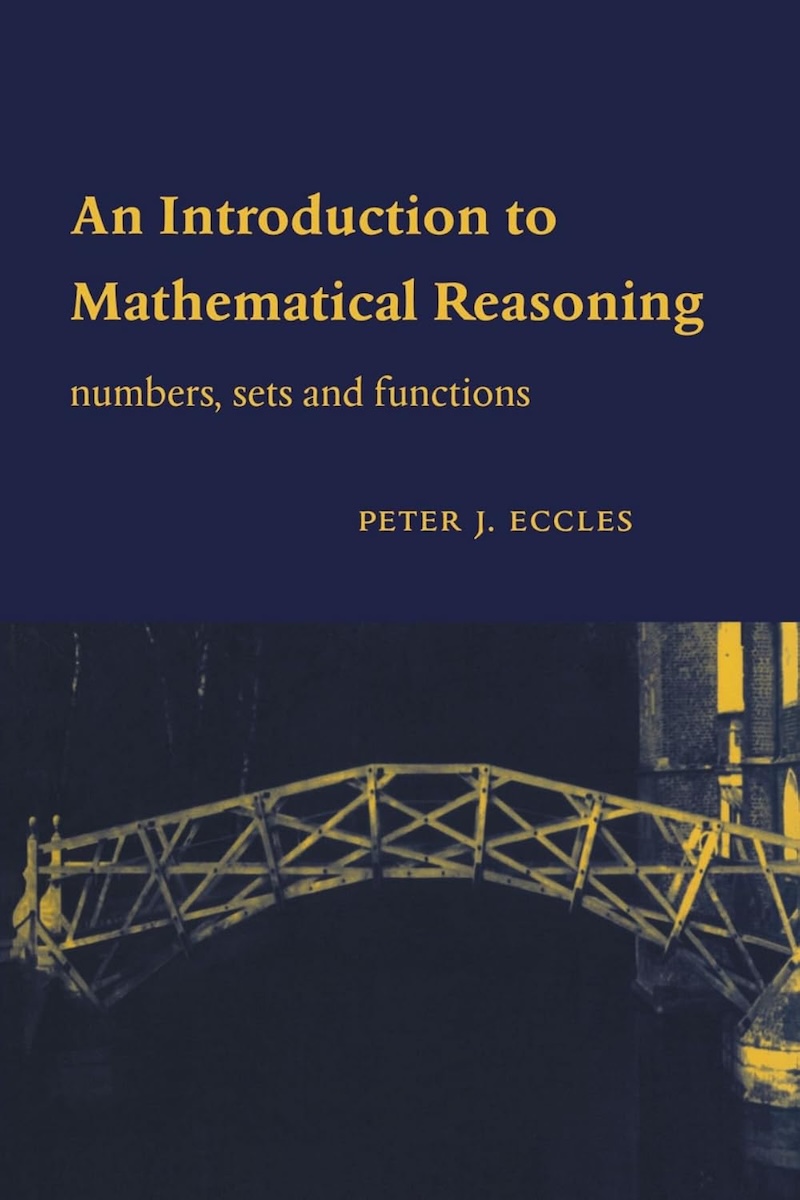
Eccles, P. J. (1997). An Introduction to Mathematical Reasoning: Numbers, Sets, and Functions. Cambridge University Press.
Chapter Summary
Part I: Mathematical Statements and Proofs
Chapter 1: The Language of Mathematics
Introduces the language and notation used in mathematical proof, focusing on what constitutes a mathematical statement and how to express logic through language.
Chapter 2: Implications
Discusses the concept of implications in proofs, illustrating how mathematical arguments are constructed from logically connected statements.
Chapter 3: Proofs
Covers various techniques of proof, including direct proof, proof by contradiction, and proof by induction.
Part II: Sets and Functions
Chapter 4: The Language of Set Theory
Explains the basic concepts and terminology in set theory, foundational to understanding functions, sequences, and more complex mathematical structures.
Chapter 5: Quantifiers
Details the use of quantifiers in mathematics, such as "for all" and "there exists", which are crucial for defining the scope of statements in proofs.
Chapter 6: Functions
Defines functions mathematically and discusses different types of functions, such as injections, surjections, and bijections.
Part III: Numbers and Counting
Chapter 7: Counting
Introduces counting techniques and principles, including permutations and combinations, essential for probability and statistics.
Chapter 8: Properties of Finite Sets
Discusses the properties and operations that can be applied to finite sets.
Chapter 9: Counting Functions and Subsets
Explores more advanced counting methods, including the use of functions and subsets in combinatorics.
Chapter 10: Number Systems
Provides a review of different number systems, emphasizing their development and practical applications.
Chapter 11: Counting Infinite Sets
Introduces the concept of infinity in mathematics, focusing on how infinite sets can be counted and compared.
Part IV: Arithmetic
Chapter 12: The Division Theorem
Discusses the division algorithm and its implications in number theory.
Chapter 13: The Euclidean Algorithm
Explains the Euclidean algorithm for finding the greatest common divisor (GCD) of two numbers.
Chapter 14: Consequences of the Euclidean Algorithm
Explores the various outcomes and extensions of the Euclidean algorithm in more complex mathematical contexts.
Chapter 15: Linear Diophantine Equations
Focuses on solving linear Diophantine equations, which have applications in various areas including cryptography and system optimization.
Key Concepts
Part I: Mathematical Statements and Proofs
Mathematical Language and Logic: Understanding the precise language used in mathematics for stating and proving propositions.
Implications and Proofs: Differentiating between necessary and sufficient conditions, and various types of proofs such as direct, contrapositive, and by contradiction.
Proof Techniques: Emphasis on constructing clear and correct proofs, including the method of induction which is fundamental for proving statements about integers and sequences.
Part II: Sets and Functions
Set Theory Fundamentals: Basic operations with sets (union, intersection, complement), and an introduction to more complex concepts such as power sets and Cartesian products.
Quantifiers in Mathematics: The role of universal and existential quantifiers in defining properties of sets and functions.
Functions and Mappings: Detailed analysis of functions, including concepts of injectivity, surjectivity, and bijectivity, which are critical for understanding mappings between sets.
Part III: Numbers and Counting
Combinatorics: Introduction to the methods and importance of counting, essential for fields such as probability and statistics.
Finite and Infinite Sets: Discussion on cardinality, including the distinction between finite, countably infinite, and uncountably infinite sets.
Number Systems: Exploration of natural numbers, integers, rationals, and reals, focusing on their properties and the arithmetic operations applicable to each.
Part IV: Arithmetic
The Division Theorem: Provides a framework for understanding division within the integer number system, introducing the concepts of quotient and remainder.
Euclidean Algorithm: A practical approach to finding the greatest common divisor of two numbers, highlighting its utility and efficiency.
Linear Diophantine Equations: Techniques for solving equations of the form ax + by = c, where a, b, and c are integers. This includes discussions on solutions’ existence and methods for finding them.
Critical Analysis
Theoretical Depth and Application
Mathematical Rigor: The textbook effectively introduces students to the rigorous demands of mathematical reasoning, providing a solid foundation in logic, set theory, and proof techniques. The thorough explanation of each topic ensures that students are not only able to follow mathematical arguments but also construct their own.
Application of Theory: While the text excels in theoretical explanations, it could benefit from more concrete applications of the mathematical principles discussed. Integrating additional real-world examples where these mathematical concepts are applied could enhance understanding and relevance.
Pedagogical Approach
Learning Progression: The structure of the book supports a progressive learning approach, beginning with basic concepts and moving to more complex topics. This methodical approach is conducive to learning but may require additional support for students new to abstract mathematical thinking.
Clarity and Accessibility: The explanations are clear and supplemented with examples and exercises which aid in the assimilation of complex ideas. However, the abstract nature of some of the content could be challenging for some students without supplementary visual aids or interactive elements.
Technological Integration
Use of Modern Tools: In today’s digital age, integrating technology into learning mathematical reasoning could provide significant benefits. The textbook could include references to software tools that aid in visualizing complex functions and sets or online platforms for practicing proof construction.
Enhancement through Multimedia: Additional resources such as video lectures or interactive modules linked to the textbook could greatly benefit students’ understanding and engagement, especially in fully grasping complex proofs and abstract concepts.
Inclusivity and Diversity
Examples from Various Fields: The text would benefit from including examples and applications from a diverse range of disciplines such as computer science, physics, and economics. This would not only show the universality of mathematical reasoning but also attract students from various backgrounds.
Supportive Materials: Offering a range of supplementary materials that cater to different learning styles, such as detailed guides on how to approach mathematical proofs, could make the material more accessible to a broader audience.
Real-World Applications and Examples
Part I: Mathematical Statements and Proofs
Computer Science: The logic and proof techniques detailed in the text are foundational in computer science, particularly in algorithm design and software development, where understanding and constructing logical arguments is crucial.
Legal Reasoning: Similarities in constructing mathematical proofs and legal arguments can help law students and professionals develop rigorous logical reasoning skills.
Part II: Sets and Functions
Economics: Set theory and functions are applied in economics to model consumer preferences, market behavior, and other economic phenomena where relationships and collections need to be clearly defined and analyzed.
Biology: Functions are used in biology for modeling population dynamics, gene expression levels, and other measurable traits that change over time or in response to different conditions.
Part III: Numbers and Counting
Cryptography: Understanding number systems and advanced counting techniques is essential in cryptography for creating secure digital communications.
Statistics: Combinatorics and counting principles are fundamental in statistics for determining the likelihood of events, which is crucial in fields ranging from marketing analytics to epidemiology.
Part IV: Arithmetic
Technology: Algorithms based on the Euclidean algorithm or Diophantine equations are used in computing for tasks such as optimizing data storage or network routing.
Engineering: Understanding linear Diophantine equations and their solutions can aid in solving problems related to materials engineering and systems design where quantifiable resources need to be distributed or allocated efficiently.
Integration with Modern Educational Technology
Interactive Learning Platforms: Utilizing interactive platforms that allow students to explore mathematical concepts through simulation and visualization could greatly enhance understanding, especially of complex abstract concepts like those found in set theory and function analysis.
Online Problem-Solving Workshops: Virtual workshops where students can work collaboratively to solve problems and construct proofs could replicate the dynamic of a classroom and provide real-time feedback, making the learning process more engaging and effective.