01 / Classic Textbook Recommendation
Classic Textbook Recommendation
Citation:
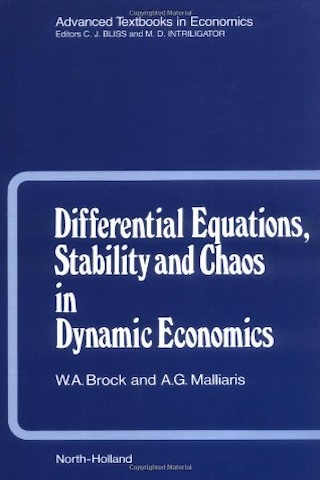
Brock, W. A., & Malliaris, A. G. (1989). Differential Equations, Stability, and Chaos in Dynamic Economics. North-Holland.
Chapter Summary:
Chapter 1: Basic Properties of Differential Equations
This chapter introduces fundamental concepts of ordinary differential equations relevant to economics, including existence, uniqueness, and behavior of solutions. It emphasizes the importance of initial conditions and parameters in determining solutions.
Chapter 2: Linear Differential Equations
Focuses on linear differential equations which are pivotal for economic modeling. The chapter explores solutions, stability, and applications of linear systems, highlighting their predictability and ease of manipulation compared to nonlinear systems.
Chapter 3: Stability Methods: An Introduction
Introduces basic stability concepts in economic dynamics, including the stability of linear systems and the Routh-Hurwitz criterion, which is crucial for determining system stability without solving the differential equation explicitly.
Chapter 4: Advanced Stability Methods
Explores more complex stability techniques such as Liapunov’s method for assessing stability in nonlinear systems, significantly relevant for economic models where small changes in initial conditions can lead to large variations in outcomes.
Chapter 5: Stability of Optimal Control
Discusses stability in the context of optimal control problems common in economics, where decisions over time are modeled dynamically to optimize certain objectives, focusing on stability results for linear and nonlinear control problems.
Chapter 6: Microeconomic Dynamics
Applies differential equation modeling to microeconomic theory, analyzing how economic agents' behaviors evolve over time under various regulatory and market conditions.
Chapter 7: Stability in Investment Theory
Analyzes stability in investment models, particularly focusing on Samuelson's Correspondence Principle which links dynamic behavior of economic models to static outcomes under stability.
Chapter 8: Macroeconomic Policies
Examines the impact of macroeconomic policies using differential equations to model complex interactions within an economy, such as policy effects on general equilibrium and dynamic stability.
Chapter 9: Stability in Capital Theory
Applies stability analysis to capital theory, exploring how capital accumulation and investment decisions impact economic stability and growth over time.
Chapter 10: Introduction to Chaos and Other Aspects of Non-Linearity
Introduces concepts of chaos and nonlinear dynamics in economic models, a crucial area for understanding unpredictable or erratic fluctuations in economic indicators.
Key Concepts:
Chapter 1: Basic Properties of Differential Equations
Existence and Uniqueness: Discusses conditions under which solutions to differential equations exist and are unique, which is crucial for predicting economic behaviors accurately.
Sensitivity to Initial Conditions: Examines how slight changes in starting points can affect the outcomes, highlighting the importance of precise data in economic modeling.
Chapter 2: Linear Differential Equations
Solution Techniques: Linear equations are relatively simpler to solve and analyze, making them fundamental in economic theory for modeling predictable scenarios.
Stability Analysis: Stability in linear systems is often easier to ascertain and provides insights into the behavior of economic models under small perturbations.
Chapter 3: Stability Methods: An Introduction
Stability of Linear Systems: Introduces basic concepts of stability which help predict the long-term behavior of economic systems.
Routh-Hurwitz Criterion: A method used to determine the stability of a system without solving the differential equations, which is useful in economic modeling.
Chapter 4: Advanced Stability Methods
Liapunov’s Methods: These methods are used for more complex, nonlinear systems common in economic dynamics, providing tools to analyze stability without directly solving system equations.
Chapter 5: Stability of Optimal Control
Optimal Control Theory: Explores how decisions (control actions) made today impact the future state of an economic system, crucial for long-term planning and policy formulation.
Chapter 6: Microeconomic Dynamics
Dynamic Optimization: Uses differential equations to model how agents optimally adjust their behavior over time in response to changes in economic environment.
Chapter 7: Stability in Investment Theory
Samuelson’s Correspondence Principle: Links dynamic stability to static outcomes, showing how transient dynamics converge to steady states in economic models.
Chapter 8: Macroeconomic Policies
Dynamic Systems in Macroeconomics: Looks at how macroeconomic policies affect economic variables over time, using differential equations to model these dynamic interactions.
Chapter 9: Stability in Capital Theory
Capital Accumulation Models: Analyzes how investment and capital accumulation affect the stability and growth of an economy, using differential equations to forecast long-term impacts.
Chapter 10: Introduction to Chaos and Other Aspects of Non-Linearity
Chaos Theory in Economics: Investigates economic models where small changes in initial conditions can lead to vastly different outcomes, challenging the predictability of economic models.
Critical Analysis:
Strengths:
Interdisciplinary Approach: The integration of advanced mathematical methods such as differential equations into economic analysis provides a rigorous foundation for modeling dynamic economic systems, enhancing the accuracy and predictive power of economic theories.
Comprehensive Coverage: The textbook offers extensive coverage of both fundamental and advanced topics in the stability of dynamic economic systems. It includes both linear and nonlinear analysis, optimal control theory, and even introduces chaos theory, which are all crucial for understanding modern economic dynamics.
Practical Applications: Each chapter connects theoretical concepts to real-world economic scenarios, making the abstract mathematical concepts accessible and relevant to economic researchers and practitioners.
Limitations:
Complexity: The mathematical rigor, while a strength, might also limit the book’s accessibility to readers without a strong background in mathematics and differential equations.
Narrow Focus on Stability: The focus on stability and chaos might overshadow other important aspects in dynamic economic analysis, such as stochastic processes and agent-based modeling, which are also vital for understanding economic dynamics.
Updates and Relevance: Given the rapid development in computational methods and economic theory, some of the examples and methods discussed might benefit from updates to include more recent advancements in economic modeling.
Real-World Applications and Examples:
Economic Policy Analysis:
Macroeconomic Policies: The book’s analysis on how macroeconomic policies affect stability and dynamics within an economy can help policymakers understand the potential long-term impacts of their decisions, facilitating better economic planning and stability.
Financial Economics:
Investment Theory: Stability analysis in investment models helps financial economists and investment firms to understand and predict market behaviors under various investment scenarios, enhancing decision-making processes.
Market Dynamics:
Microeconomic Dynamics: By modeling how individual agents adjust behaviors over time in response to changes in their economic environment, businesses and market analysts can better predict consumer behavior and market trends.
Emerging Economic Theories:
Chaos in Economic Dynamics: Introduction to chaos theory in economic contexts provides insights into how small changes can lead to unpredictable or highly sensitive outcomes, which is increasingly relevant in the highly volatile global economy.