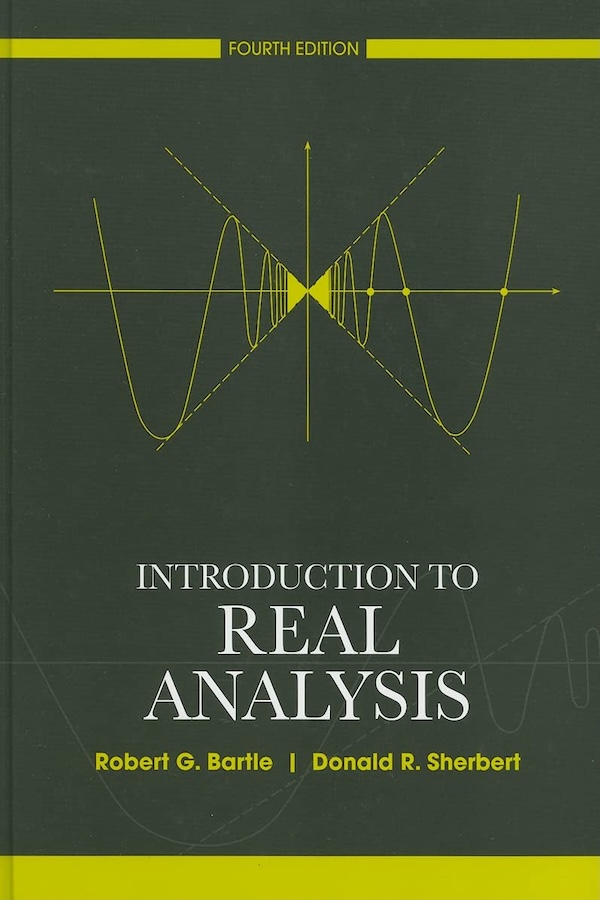
01 / Classic Textbook Recommendation
Classic Textbook Recommendation
Citation:
Bartle, R. G., & Sherbert, D. R. (2011). Introduction to Real Analysis (4th ed.). John Wiley & Sons.
Chapter Summary:
Chapter 1: Preliminaries
Introduces basic set theory and functions, focusing on concepts such as sets, subsets, unions, intersections, and the basics of functions including definitions, domain, and range. Mathematical induction is also discussed as a fundamental method for proof in analysis.
Chapter 2: The Real Numbers
Discusses properties of real numbers, including algebraic operations, order properties, and the completeness property of ℝ. Absolute values and intervals are also covered, providing foundational knowledge necessary for understanding limits and continuity.
Chapter 3: Sequences and Series
Provides a comprehensive look at sequences, their limits, and the important limit theorems. It also introduces infinite series, including convergence and divergence, providing students with the tools to deal with infinite processes.
Chapter 4: Limits
Explores the concept of limits more deeply, particularly the limits of functions. This chapter lays the groundwork for later discussions on continuity and differentiability.
Chapter 5: Continuous Functions
Focuses on continuous functions, including properties and theorems that describe their behavior, such as the Intermediate Value Theorem and properties of functions on closed intervals.
Chapter 6: Differentiation
Covers the differentiation of functions, including the Mean Value Theorem and Taylor's Theorem, exploring how derivatives represent rates of change and can be used to solve practical problems.
Chapter 7: The Riemann Integral
Defines and discusses the Riemann integral, including properties and the Fundamental Theorem of Calculus, connecting the concept of integration with that of differentiation.
Chapter 8: Sequences of Functions
Looks at sequences and series of functions, exploring concepts such as pointwise and uniform convergence and the effects these have on the limit functions' continuity and integrability.
Chapter 9: Infinite Series
Delves deeper into infinite series, discussing conditions under which series converge and techniques for evaluating the convergence of both positive and general series.
Chapter 10: The Generalized Riemann Integral
Presents the generalized Riemann integral, an extension of the Riemann integral, discussing its properties and applications in more complex scenarios.
Chapter 11: A Glimpse into Topology
Introduces basic concepts of topology relevant to real analysis, focusing on topics like open and closed sets, compactness, and metric spaces, which are crucial for understanding more abstract mathematical structures.
Key Concepts:
Foundations of Set Theory and Functions:
The book begins with a thorough introduction to set theory, defining operations and functions essential for understanding real analysis. This foundation supports all subsequent discussions of more complex topics.
Properties of Real Numbers:
Detailed exploration of the algebraic and order properties of real numbers, emphasizing the completeness property, which is crucial for the development of further analytical concepts like limits and continuity.
Sequences and Their Limits:
Sequences are fundamental to analysis, and the text focuses on their behavior, particularly the conditions under which they converge to limits, preparing the ground for series and integration.
Limits of Functions:
Limits are central to the study of calculus within real analysis. The book discusses the formal definitions and properties of limits, setting the stage for continuity and differentiability.
Continuous Functions:
Continuity is examined in-depth, with significant theorems such as the Intermediate Value Theorem and properties of continuous functions on closed intervals highlighted to demonstrate their practical implications.
Differentiation:
The concept of differentiation is covered extensively, illustrating how derivatives are used to determine rates of change and solve maxima and minima problems, foundational for physics and engineering.
The Riemann Integral:
Introduction and exploration of the Riemann integral, explaining how it is used to calculate the area under a curve, and connecting integration closely with the concept of differentiation through the Fundamental Theorem of Calculus.
Infinite Series:
Further discussion of infinite series, including tests for convergence and divergence, providing tools for analyzing functions represented as series.
Generalized Riemann Integral:
Extends the discussion of integration to more complex functions and settings, enhancing the understanding and application of integration in broader contexts.
Topology:
Basic topological concepts are introduced, such as open and closed sets and compactness, which are essential for advanced studies in analysis and other areas of mathematics.
Critical Analysis:
Strengths:
Clarity and Rigor: Bartle and Sherbert's text is known for its clarity and rigorous approach, which is critical for understanding and appreciating the nuances of real analysis. The systematic exposition of topics ensures that readers develop a solid foundation in analysis.
Comprehensive Coverage: The book covers a broad range of topics essential for a thorough understanding of real analysis, from foundational set theory and functions to advanced topics like the generalized Riemann integral and topology.
Pedagogical Features: The inclusion of detailed examples, proofs, and a large set of exercises with varying levels of difficulty helps reinforce learning and allows students to test their understanding effectively.
Connection Between Theory and Application: The text does an excellent job of linking theoretical concepts with their practical applications, particularly in the discussions on differentiation and integration, making the material more relatable and engaging.
Weaknesses:
Pacing and Density: Some students may find the text's pace and density challenging, as the material can be quite thorough and compact, which might be overwhelming for those new to real analysis.
Prerequisite Knowledge: The book assumes a considerable amount of background knowledge in mathematics, which can be a barrier for students who are not sufficiently prepared in prerequisites like advanced calculus and linear algebra.
Limited Context and History: While the book excels in technical rigor, it could benefit from more historical context about the development of real analysis to enhance the educational experience by providing more depth about the evolution of mathematical ideas.
Visual Aids: More diagrams and visual aids could help in better illustrating complex concepts, especially in topology and sequences of functions, where visual understanding can significantly aid comprehension.
Suggestions for Improvement:
Enhanced Visual Representation: Including more graphs, charts, and other visual aids would likely make the material more accessible and easier to understand, particularly for visual learners.
Supplementary Resources: Offering supplementary online resources, such as video tutorials and additional practice problems, could provide additional support for students struggling with the denser sections of the text.
Historical Insights: Incorporating brief historical notes about key figures and developments in the field of real analysis could provide a richer, more rounded learning experience.
Bridge Courses: Encouraging or providing supplementary bridge courses or preliminary chapters that review essential pre-requisites like calculus and basic algebra could make the text more accessible to a broader audience.
Real-World Applications and Examples:
Applications in Various Fields:
Engineering and Physics: The concepts of differentiation and integration are fundamental in these fields for analyzing and solving problems related to motion, forces, energy, and waves. The book’s detailed coverage of the Riemann integral and differential equations provides the necessary tools for engineering and physics calculations.
Economics and Finance: Analysis is used in economics for optimizing functions, analyzing growth models, and forecasting financial trends. The book’s exploration of sequences and series, as well as continuity and limits, are directly applicable to economic models dealing with time series data and financial forecasting.
Computer Science: Algorithms for numerical analysis, graphics, and machine learning often rely on principles from real analysis. The discussion on limits, continuity, and especially the chapters on sequences of functions, provide foundational knowledge crucial for algorithm development and complexity analysis.
Biological and Medical Sciences: Analysis helps model biological processes and understand medical data. Concepts such as rate of change and integration are used in pharmacokinetics to model drug interaction dynamics within the body.
Example Scenarios Demonstrated in the Book:
Optimization Problems in Engineering: Using calculus to find optimal solutions, such as minimizing material usage while maximizing structural integrity, relies directly on the differentiation techniques discussed.
Economic Growth Models: The book applies series and functions to model economic growth over time, demonstrating how calculus can predict future economic trends based on current data.
Data Analysis in Computer Science: The function limits and continuity discussions are applicable in machine learning for creating models that predict outcomes based on continuous input data.
Population Dynamics in Biology: Integration is used to model population growth or decline over time, helping biologists and ecologists predict changes in ecosystems or species populations.
Medicine Dosage Calculations: The principles of integration are used to calculate the correct dosage of medication that ensures the optimal therapeutic level is achieved over time.