01 / Classic Textbook Recommendation
Classic Textbook Recommendation
Citation
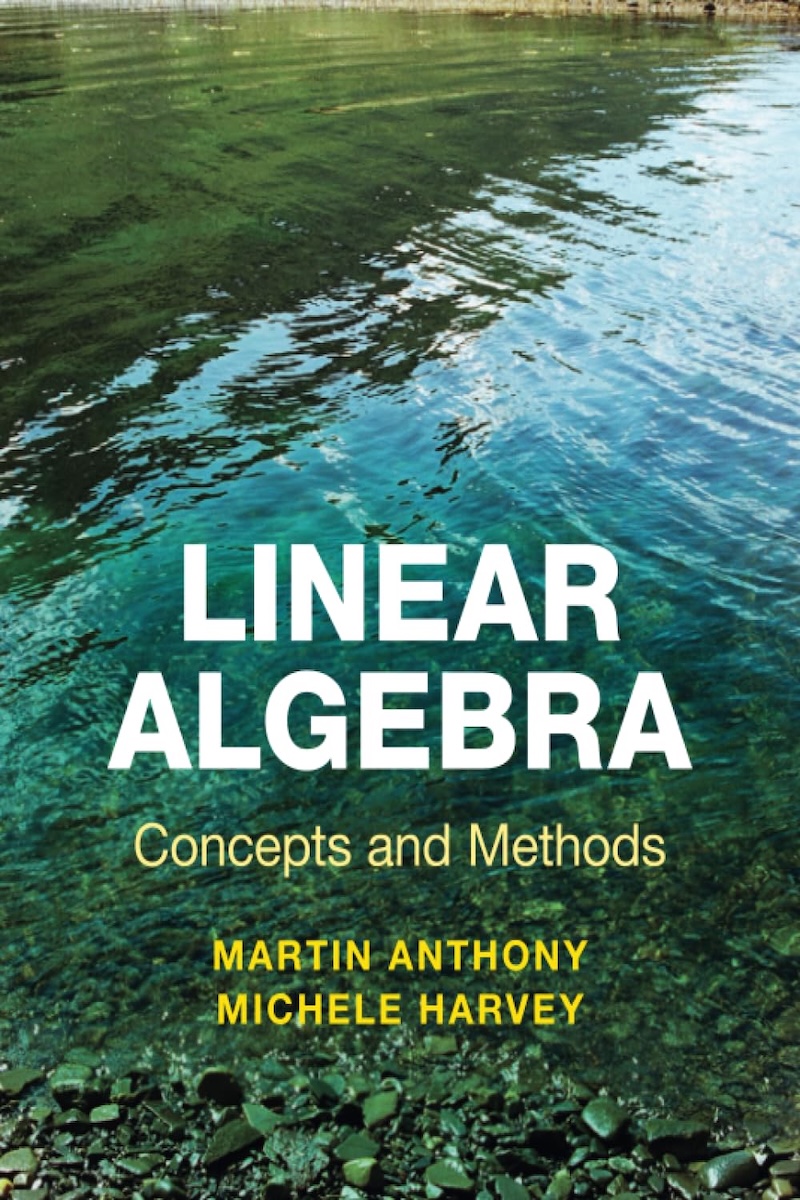
Anthony, M., & Harvey, M. (2012). Linear Algebra: Concepts and Methods. Cambridge University Press.
Chapter Summary
Chapter 1: Matrices and Vectors
Basics of Matrices: Introduction to the definition, types, and basic operations of matrices including addition, scalar multiplication, and matrix multiplication.
Special Matrices: Discussion on diagonal, identity, and zero matrices, including their properties and significance in linear algebra.
Chapter 2: Systems of Linear Equations
Solving Linear Systems: Methods for solving linear equations using row operations and Gaussian elimination. Discussion on homogeneous systems and the concept of null space.
Chapter 3: Matrix Inversion and Determinants
Inversion Techniques: Techniques for finding matrix inverses using row operations and cofactors.
Determinants: Comprehensive coverage on the calculation and properties of determinants.
Chapter 4: Rank, Range, and Linear Equations
Concepts of Rank and Range: Exploration of the rank of a matrix and its implications for the solvability of linear systems.
Applications in Linear Equations: How the concepts of rank and range apply to the analysis of linear systems.
Chapter 5: Vector Spaces
Introduction to Vector Spaces: Definitions and properties of vector spaces, subspaces, and linear spans.
Foundations for Further Study: Laying the groundwork for more advanced topics in linear algebra.
Chapter 6: Linear Independence, Bases, and Dimension
Linear Independence: Discussion on linear independence and its critical role in defining bases for vector spaces.
Dimension Theory: Examination of the dimension of a vector space and its implications for linear mappings.
Chapter 7: Linear Transformations and Change of Basis
Linear Transformations: Detailed exploration of linear transformations and their matrix representations.
Change of Basis: How transformations behave under change of basis and the concept of matrix similarity.
Chapter 8: Diagonalisation
Eigenvalues and Eigenvectors: Introduction to eigenvalues, eigenvectors, and the process of diagonalising a matrix.
Applications of Diagonalisation: Practical applications in simplifying linear transformations and solving differential equations.
Chapter 9: Applications of Diagonalisation
Advanced Applications: Utilizing diagonalisation in various contexts including systems of differential equations and power calculations for matrices.
Chapter 10: Inner Products and Orthogonality
Inner Product Spaces: Discussion on inner products, their properties, and the concept of orthogonality in vector spaces.
Gram-Schmidt Process: Techniques for orthogonalising vectors, critical for applications in signal processing and statistics.
Chapter 11: Orthogonal Diagonalisation and Its Applications
Orthogonal Matrices: Study of orthogonal matrices and their properties.
Quadratic Forms: Applications of orthogonal diagonalisation to study quadratic forms and optimize multivariable functions.
Chapter 12: Direct Sums and Projections
Subspace Decompositions: Exploration of direct sums of subspaces and their significance in linear algebra.
Projections and Least Squares: Theoretical foundation for projections and their use in least squares approximations.
Chapter 13: Complex Matrices and Vector Spaces
Complex Vector Spaces: Introduction to complex numbers in the context of linear algebra.
Hermitian and Unitary Matrices: Study of special complex matrices and their applications in quantum mechanics and signal processing.
Key Concepts
Chapter 1: Matrices and Vectors
Matrix Operations: Detailed explanations on how to perform operations like addition, multiplication, and inversion of matrices.
Types of Matrices: Introduction to various types of matrices including diagonal, identity, and zero matrices and their unique properties.
Chapter 2: Systems of Linear Equations
Gaussian Elimination: A method for solving linear systems that transforms matrices to reduced row echelon form.
Homogeneous Systems: Exploration of systems with zero constant terms and their solutions characterized by the null space.
Chapter 3: Matrix Inversion and Determinants
Matrix Inversion: Techniques for finding the inverse of a matrix if it exists, emphasizing the importance of the determinant.
Determinants: The computation of determinants and their critical role in determining the invertibility of a matrix and the volume scaling factor in transformations.
Chapter 4: Rank, Range, and Linear Equations
Rank of a Matrix: Discussion on the concept of rank as the maximum number of linearly independent column vectors in a matrix.
Range (Column Space): The set of all possible outputs of the matrix when multiplied by vectors, essential for understanding the solutions of linear equations.
Chapter 5: Vector Spaces
Definition and Properties: Basic properties of vector spaces and subspaces critical for the structure of linear algebra.
Linear Span: The set of all linear combinations of a set of vectors, crucial for understanding the coverage of vector spaces.
Chapter 6: Linear Independence, Bases, and Dimension
Bases and Dimension: Introduction to bases as a set of vectors that linearly independent and span the vector space, and how the dimension measures the size of the vector space.
Chapter 7: Linear Transformations and Change of Basis
Matrix Representation of Transformations: How transformations between vector spaces can be represented by matrices.
Change of Basis: The change of basis and its effect on matrix representations, highlighting the concept of similarity.
Chapter 8: Diagonalisation
Eigenvalues and Eigenvectors: Concepts and calculations that lead to the simplification of matrix operations and understanding of dynamics in systems modeled by matrices.
Practical Diagonalisation: Applications in solving linear differential equations and power methods for matrices.
Chapter 9: Applications of Diagonalisation
Systems of Differential Equations: Use of diagonalisation to simplify the solution process for linear systems of differential equations.
Matrix Powers: Applications in computing large powers of matrices efficiently, important for algorithm design and network theory.
Chapter 10: Inner Products and Orthogonality
Orthogonality: The condition under which two vectors are orthogonal and its significance in simplifying computations and understanding geometric and functional relationships.
Orthogonal Matrices: Properties of orthogonal matrices, which preserve lengths and angles, important in computer graphics and numerical analysis.
Chapter 11: Orthogonal Diagonalisation and Its Applications
Quadratic Forms: Applications in optimizing and understanding quadratic forms through diagonalisation, important in optimization and statistics.
Chapter 12: Direct Sums and Projections
Least Squares Approximation: The method of least squares as a projection problem, fundamental in statistics and data fitting.
Direct Sum Decompositions: Understanding how vector spaces can be decomposed into direct sums, enhancing the structure analysis in linear algebra.
Chapter 13: Complex Matrices and Vector Spaces
Complex Numbers in Linear Algebra: The role of complex numbers in extending vector spaces and matrices, key in systems that oscillate or rotate.
Spectral Decompositions: Study of matrices through their eigenvalues and eigenvectors in complex spaces, crucial for quantum mechanics and signal processing.
Critical Analysis
Depth and Coherence of Mathematical Concepts
Clarity and Depth: The textbook offers a rigorous introduction to the foundational concepts of linear algebra, systematically building from basic definitions to more complex ideas such as vector spaces, linear transformations, and diagonalization. The sequence of topics is logically structured, promoting a deeper understanding of how various concepts interrelate.
Mathematical Rigor: The use of formal proofs and precise mathematical language strengthens the theoretical framework. However, this approach might be challenging for students new to abstract mathematical reasoning, potentially necessitating supplementary instructional materials.
Teaching and Learning Features
Examples and Exercises: The inclusion of numerous examples and exercises enhances understanding by allowing students to apply theoretical concepts to practical problems. The problems are well-designed to reinforce learning but could benefit from more varied real-world applications to broaden the context and appeal of linear algebra.
Learning Outcomes and Summaries: Each chapter includes learning outcomes and summaries that are helpful for students to track their progress and review key concepts, aiding in self-assessment and revision.
Applications and Real-World Relevance
Interdisciplinary Applications: The textbook effectively demonstrates the application of linear algebra in various fields such as economics, physics, and engineering. These applications underscore the versatility of linear algebra but could be expanded to include more contemporary areas such as data science and machine learning, which are of high interest.
Technology Integration: Although the textbook incorporates some discussions on computational tools, a more integrated approach to using software tools like MATLAB or Python for matrix computations could enhance learning, reflecting modern practices in industry and academia.
Accessibility and Inclusivity
Level of Accessibility: While the text is comprehensive and detailed, the high level of abstraction and mathematical formality might limit accessibility for some students. Additional resources like video tutorials or interactive modules could help mitigate this.
Support Materials: The textbook could benefit from more extensive support materials, including online resources, detailed guides on using mathematical software, and forums for discussion and help, which would make the learning experience more engaging and supportive.
Real-World Applications and Examples
Chapter 1: Matrices and Vectors
Economics and Business: Uses matrices to represent and solve systems of equations that model economic transactions, pricing strategies, and resource allocations.
Physics and Engineering: Applies matrix operations to solve linear systems that arise in structural engineering, electronics, and mechanics.
Chapter 2: Systems of Linear Equations
Network Theory: Uses systems of linear equations to analyze network flows and connectivity, important in telecommunications and transportation planning.
Environmental Science: Applies linear systems to model interactions in ecological systems, optimizing conservation strategies.
Chapter 3: Matrix Inversion and Determinants
Computer Graphics: Utilizes matrix inversion and determinants in algorithms for rendering 3D graphics and animations, crucial in video games and virtual reality.
Cryptography: Employs determinants and matrix inverses in developing encryption algorithms for secure communication.
Chapter 4: Rank, Range, and Linear Equations
Data Analysis: Uses rank and range to determine the solvability and stability of datasets in statistics, helping to validate regression models.
Signal Processing: Applies concepts of rank and nullity in the analysis of signals to optimize the information transmitted over various media.
Chapter 5: Vector Spaces
Machine Learning: Vector spaces underpin algorithms in machine learning, particularly in classification and clustering of high-dimensional data.
Quantum Mechanics: Relies on vector spaces for the formulation of states and observables in quantum systems.
Chapter 6: Linear Independence, Bases, and Dimension
Robotics: Uses bases and dimensions to describe the configuration space of robots, optimizing movements and tasks.
Geometric Modelling: Applies concepts of linear independence and dimension in designing and testing complex geometrical shapes in architecture and industrial design.
Chapter 7: Linear Transformations and Change of Basis
Artificial Intelligence: Linear transformations are foundational in neural networks, particularly in the transformations applied within deep learning architectures.
Finance: Uses change of basis in risk management to transform problems into simpler, more tractable forms.
Chapter 8: Diagonalisation
Population Genetics: Diagonalisation helps in studying population genetics models by simplifying the analysis of genetic distributions over time.
Dynamic Systems: Applies diagonalisation to simplify the understanding of dynamic systems in engineering, such as control systems in automation.
Chapter 9: Applications of Diagonalisation
Epidemiology: Uses matrix powers and diagonalisation in modeling the spread of diseases to predict and control outbreaks effectively.
Economic Forecasting: Employs diagonalisation techniques in macroeconomic models to predict economic growth and fluctuations.
Chapter 10: Inner Products and Orthogonality
Audio Processing: Uses orthogonality principles in noise reduction techniques and in the separation of audio signals.
Sports Science: Applies inner product concepts in biomechanics to analyze movements and improve athletic performance.
Chapter 11: Orthogonal Diagonalisation and Its Applications
Chemistry: Orthogonal diagonalisation is used in molecular chemistry for studying the symmetrical properties of molecules.
Information Theory: Applies orthogonal transformations to optimize signal representation and compression in communication systems.
Chapter 12: Direct Sums and Projections
Meteorology: Utilizes projections and least squares to model climate data, enhancing predictive meteorology.
Astronomy: Applies direct sums in the processing and analysis of large datasets from telescopes and space probes.
Chapter 13: Complex Matrices and Vector Spaces
Electrical Engineering: Complex matrices are crucial in the study and design of electrical circuits, particularly in signal processing.
Physics: Employs complex vector spaces in the formulation of theories in quantum physics, enhancing the understanding of particle behaviors.