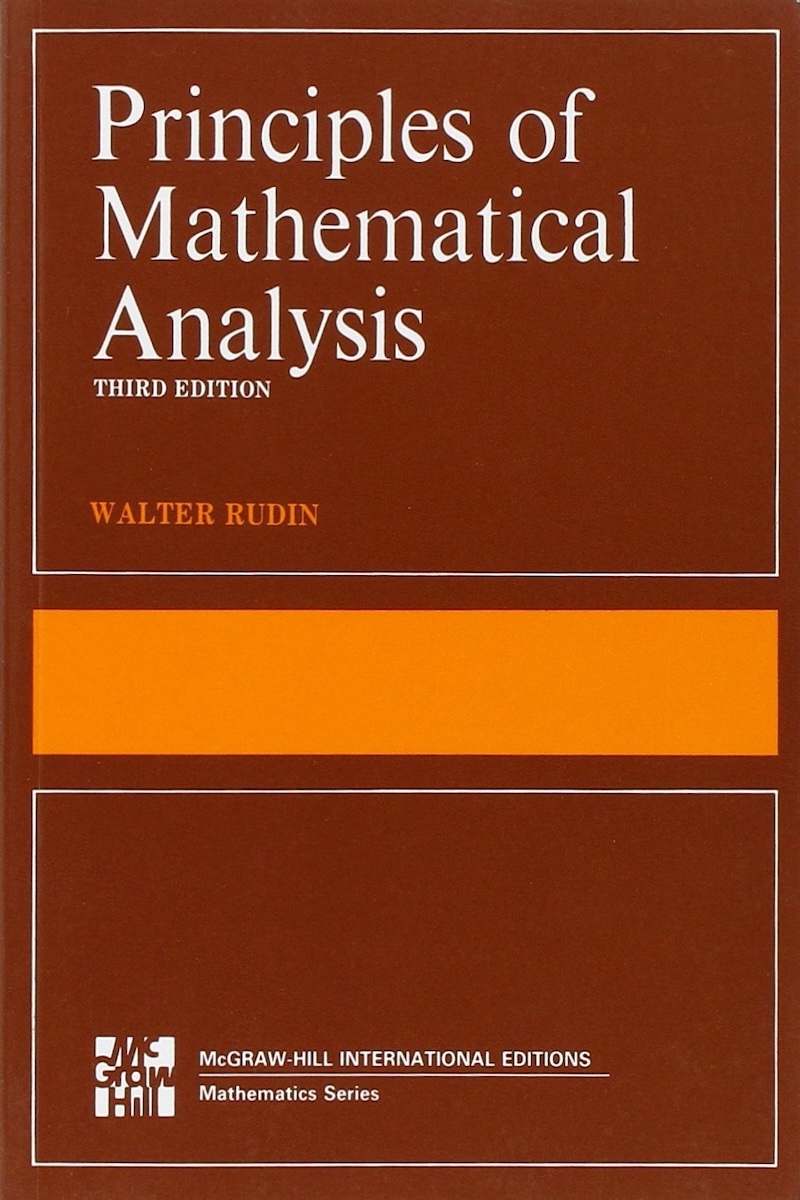
01 / Classic Textbook Recommendation
Classic Textbook Recommendation
Citation:
Rudin, W. (1976). Principles of Mathematical Analysis (3rd ed.). New York: McGraw-Hill, Inc.
Chapter Summary:
Chapter 1: The Real and Complex Number Systems
Introduces real and complex numbers, focusing on their properties, operations, and the concept of ordered sets. Discusses fields, the importance of the least upper bound property, and the construction of real numbers from rationals.
Chapter 2: Basic Topology
Explores topics in topology such as sets (finite, countable, uncountable), metric spaces, compact sets, perfect sets, and connected sets. It aims to establish a foundational understanding of the topology of number sets.
Chapter 3: Numerical Sequences and Series
Delves into sequences and series, including convergent sequences, subsequences, and special sequences. Emphasizes series concepts like absolute and conditional convergence.
Chapter 4: Continuity
Focuses on the limits and continuity of functions, exploring different types of discontinuities and properties of continuous functions on compact and connected sets.
Chapter 5: Differentiation
Covers the differentiation of functions, including theorems like the Mean Value Theorem and L'Hôpital's Rule, and discusses higher derivatives and their significance.
Chapter 6: The Riemann-Stieltjes Integral
Introduces the Riemann-Stieltjes integral, discussing its definition, properties, and applications, particularly in the context of rectifiable curves.
Chapter 7: Sequences and Series of Functions
Examines uniform convergence and its implications for continuity, integration, and differentiation, introducing concepts like equicontinuity and the Stone-Weierstrass Theorem.
Chapter 8: Some Special Functions
Discusses special functions like exponential, logarithmic, and trigonometric functions, and extends to complex functions emphasizing their algebraic completeness.
Chapter 9: Functions of Several Variables
Covers differentiation and integration in multiple dimensions, including theorems on linear transformations and derivatives.
Chapter 10: Integration of Differential Forms
Explores deeper topics in multivariable calculus including differential forms, partitions of unity, and theorems like Stokes' Theorem.
Chapter 11: The Lebesgue Theory
Introduces Lebesgue integration, measure theory, and discusses the fundamentals of measurable functions and integration of complex functions.
Key Concepts:
Chapter 1: The Real and Complex Number Systems
Real and Complex Numbers: Fundamental properties and operations.
Ordered Sets: Definition and examples, crucial for understanding the structure of real numbers.
Fields: Axioms and properties, essential for algebraic structures in mathematics.
Chapter 2: Basic Topology
Metric Spaces: Introduction and significance in defining distance in mathematical spaces.
Compact Sets: Important for understanding boundedness and closedness in topological spaces.
Connected Sets: Critical for analyzing properties that depend on path connectivity in spaces.
Chapter 3: Numerical Sequences and Series
Convergent Sequences: Central to the understanding of limits and foundational in calculus and analysis.
Cauchy Sequences: Importance in defining completeness in a metric space.
Series Convergence Tests: Tools like the root and ratio tests, essential for determining the convergence of series.
Chapter 4: Continuity
Continuous Functions: Definitions and implications, crucial for mapping properties and function analysis.
Discontinuities: Types and their impact on function behavior.
Compactness and Continuity: Theorems relating these concepts, fundamental in mathematical analysis.
Chapter 5: Differentiation
Mean Value Theorems: Core theorems in calculus that provide a link between derivatives and integrals.
L'Hôpital's Rule: A method for evaluating limits involving indeterminate forms.
Higher Order Derivatives: Their roles in approximations and curvature analysis.
Chapter 6: The Riemann-Stieltjes Integral
Definition and Properties: Expansion on traditional Riemann integration, accommodating functions with discontinuities.
Applications to Physics and Engineering: Especially in calculating work done by a variable force.
Chapter 7: Sequences and Series of Functions
Uniform Convergence: Its critical role in ensuring continuity and integrability of limit functions.
Stone-Weierstrass Theorem: A powerful approximation theorem crucial in analysis.
Chapter 8: Some Special Functions
Exponential and Logarithmic Functions: Their properties and the crucial roles they play in mathematical models.
Trigonometric Functions: Basis for periodic phenomena modeling in sciences and engineering.
Chapter 9: Functions of Several Variables
Multiple Integration: Techniques and applications, essential for volume and area calculations in higher dimensions.
Implicit and Inverse Function Theorems: Foundational for solving equations involving multiple variables.
Chapter 10: Integration of Differential Forms
Differential Forms and Their Integration: Extends integral calculus into more abstract and higher-dimensional spaces.
Stokes' Theorem: A generalization of several classical theorems in vector calculus, integral in modern physics.
Chapter 11: The Lebesgue Theory
Lebesgue Measure and Integration: More powerful than Riemann integration, especially in handling functions with discontinuities.
Functions of Class ( L^2 ): Pertinent to the study of square-integrable functions, with implications in quantum mechanics and signal processing.
Critical Analysis:
Strengths:
Rigor and Depth: Rudin's "Principles of Mathematical Analysis" is renowned for its rigorous approach, providing a solid mathematical foundation that is thorough and precise. This depth is particularly beneficial for students who intend to pursue research or advanced studies in mathematics.
Comprehensive Coverage: The textbook covers a broad spectrum of topics essential for a deep understanding of mathematical analysis, including both fundamental and advanced topics which are articulated with clear proofs and logical coherence.
Clarity in Presentation: Despite the complexity of topics, Rudin manages to maintain a level of clarity that is appreciated by those with a strong foundational knowledge in mathematics. His proofs and explanations are concise and often accompanied by necessary examples and illustrations.
Limitations:
Accessibility for Beginners: The textbook's high level of rigor and assumption of prior knowledge can make it inaccessible and challenging for beginners or those without a strong background in advanced mathematics.
Lack of Applied Examples: While the book excels in theoretical rigor, it could be improved by including more examples of real-world applications of the concepts discussed. This would enhance the practical understanding and relevance of the material for students, especially those in applied fields.
Pedagogical Approach: The text is sometimes criticized for its dense and compact style, which might not cater well to a broader audience or facilitate self-study without additional resources or guidance.
Real-World Applications and Examples:
Mathematical Analysis in Various Fields:
Physics and Engineering: The concepts of differentiation and integration are fundamental in solving problems in mechanics, electromagnetism, and quantum physics. The Riemann-Stieltjes integral is particularly useful in calculating the work done in a system where forces vary.
Economics and Finance: Techniques from numerical sequences and series are employed in econometrics for modeling economic data over time. Limits and continuity find applications in optimizing models and algorithms in financial markets.
Computer Science: Algorithms for numerical analysis and computational methods often rely on principles such as convergence and error estimation covered in the book, crucial for machine learning and data analysis.
Specific Examples from Textbook:
Applications of Compactness and Connectedness: These concepts are crucial in topology, which has implications in theoretical computer science, particularly in algorithm design where problems are often decomposed into simpler, manageable subproblems.
Differentiation and the Mean Value Theorem: These are used in creating and solving models that describe rates of change in natural and social sciences.
Lebesgue Integration: This is used in probability theory and statistics, especially in dealing with random variables, enabling more effective handling of expectation and variance calculations.