01 / Classic Textbook Recommendation
Classic Textbook Recommendation
Citation:
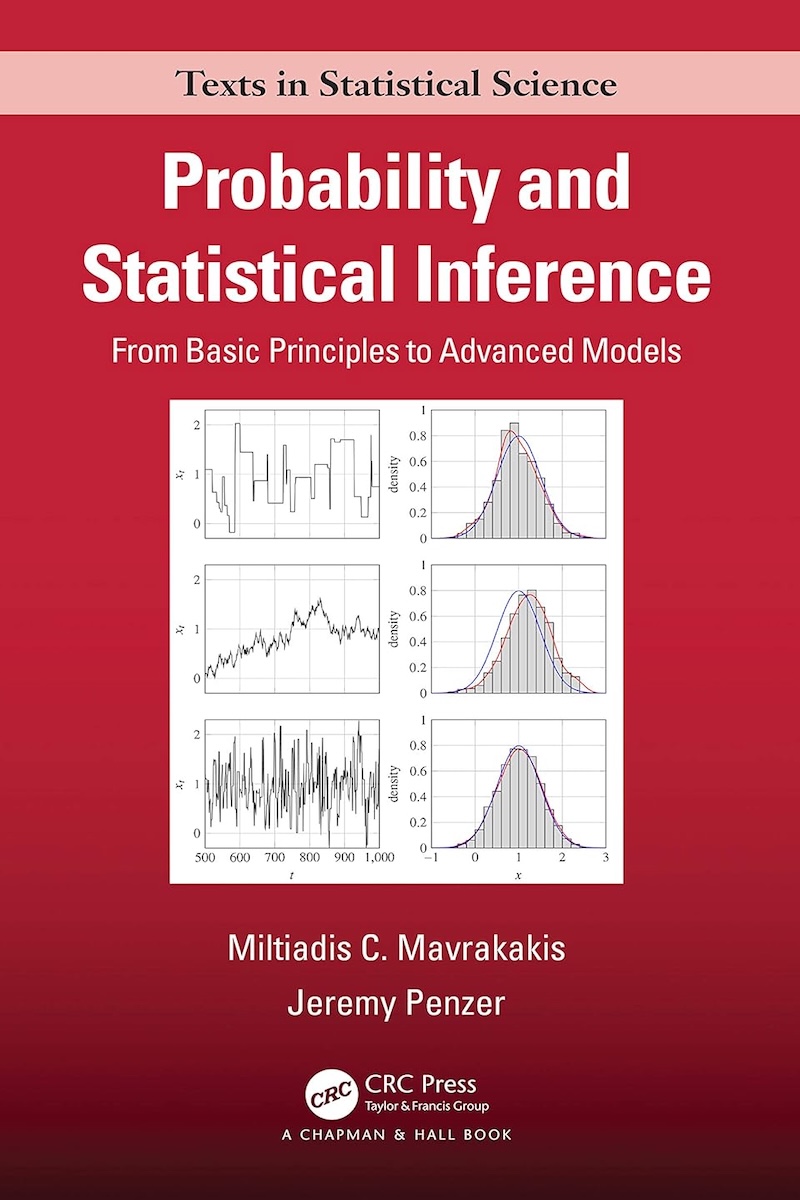
Mavrakakis, M. C., & Penzer, J. (2022). Probability and Statistical Inference: From Basic Principles to Advanced Models. CRC Press.
Chapter Summary:
Chapter 1: Introduction
Introduces the fundamental ideas of statistical inference, emphasizing the importance of a theoretical understanding to properly analyze and model data. Discusses the role of probability in making inferences from data sets.
Chapter 2: Probability
Covers basic and mathematical probability, including measure theory, intuitive probability, and the formal definition of probability measures. Explains methods for counting outcomes and the foundational principles of conditional probability and independence.
Chapter 3: Random Variables and Univariate Distributions
Discusses mapping outcomes to real numbers, defining and using cumulative distribution functions, and the distinctions between discrete and continuous random variables. Details expectations, variances, generating functions, and the treatment of random variable functions.
Chapter 4: Multivariate Distributions
Explores joint, marginal, and conditional distributions, the concepts of covariance and correlation, and the transformations of random variables.
Chapter 5: Conditional Distributions
Delivers a deep dive into the properties of discrete and continuous conditional distributions and conditional expectations, highlighting their theoretical and practical implications.
Chapter 6: Statistical Models
Discusses various statistical models including linear models, generalized linear models, survival analysis, time series, Poisson processes, and Markov chains, offering a broad view of statistical modeling.
Chapter 7: Sample Moments and Quantiles
Covers the calculation and use of sample moments, the central limit theorem, and the properties of order statistics and quantiles.
Chapter 8: Estimation, Testing, and Prediction
Provides a comprehensive look at the fundamentals of statistical inference, including point estimation, interval estimation, hypothesis testing, and prediction techniques.
Chapter 9: Likelihood-Based Inference
Focuses on the construction and use of likelihood functions, including methods for maximum-likelihood estimation and likelihood-ratio testing.
Chapter 10: Inferential Theory
Discusses the theoretical aspects of inference, such as the sufficiency principle, properties of estimators, and the construction of most powerful tests.
Chapter 11: Bayesian Inference
Introduces Bayesian statistical methods, discussing the use of prior and posterior distributions, Bayesian estimation techniques, and hierarchical models.
Chapter 12: Simulation Methods
Covers key simulation methods used in modern statistical inference, including Monte Carlo integration and Markov chain Monte Carlo techniques.
Key Concepts:
Chapter 2: Probability
Probability Measures: Formalizes the idea of probability as a measure, integrating measure theory to ensure a rigorous mathematical foundation.
Conditional Probability and Independence: Key concepts that underpin much of statistical inference, illustrating how probabilities change with given conditions and the relationships between events.
Chapter 3: Random Variables and Univariate Distributions
Cumulative Distribution Functions (CDFs): Essential for understanding the probability distribution of a random variable over its range.
Expectation and Variance: Fundamental moments of distributions that provide insights into the central tendency and dispersion of a random variable.
Chapter 4: Multivariate Distributions
Joint Distributions: Focuses on understanding relationships between two or more variables through their joint behavior.
Covariance and Correlation: Measures the degree to which two variables change together, which is crucial for the statistical analysis of relationships.
Chapter 5: Conditional Distributions
Conditional Expectation: A critical concept in probability and statistics that involves the expectation of a random variable given another.
Chapter 6: Statistical Models
Generalized Linear Models (GLMs): Extends linear models by allowing the dependent variable to have a non-normal distribution.
Time Series and Poisson Processes: Discusses models for data indexed in time and the stochastic processes involving counting occurrences of events.
Chapter 7: Sample Moments and Quantiles
Central Limit Theorem (CLT): A pivotal theorem in statistics providing the foundation for inferential techniques involving sample means.
Chapter 8: Estimation, Testing, and Prediction
Estimation Methods: Includes point estimation and interval estimation, central in inferring population parameters from sample data.
Hypothesis Testing: Framework for testing assumptions about population parameters based on sample data.
Chapter 9: Likelihood-Based Inference
Maximum-Likelihood Estimation (MLE): A method for estimating the parameters of a statistical model, maximizing the likelihood that the observed data comes from the specified model.
Chapter 10: Inferential Theory
Sufficiency Principle: Deals with reducing data complexity without losing information about parameters.
Most Powerful Tests: Concept for determining the best test for a hypothesis within a class of tests.
Chapter 11: Bayesian Inference
Bayesian Estimation: Utilizes Bayesian methods to update the probability estimate for a hypothesis as more evidence or information becomes available.
Chapter 12: Simulation Methods
Markov Chain Monte Carlo (MCMC): A suite of algorithms that allow for sampling from a probability distribution based on constructing a Markov chain that has the desired distribution as its equilibrium distribution.
Critical Analysis:
Strengths:
Comprehensive Scope: The textbook covers a wide range of topics from basic principles to advanced models, providing a solid foundation for understanding the full spectrum of probability and statistical inference. This breadth ensures that readers are well-prepared to tackle complex statistical problems.
Rigorous Mathematical Treatment: Each concept is presented with thorough mathematical rigor, which is essential for a deep understanding of the subject matter. This approach is particularly beneficial for readers aiming for advanced studies or research in statistics.
Practical Applications Included: The book integrates examples and exercises that illustrate the practical applications of theoretical concepts. This helps bridge the gap between theory and practice, making the material more accessible and relevant to real-world scenarios.
Limitations:
Accessibility for Beginners: Given its rigorous and comprehensive nature, the book might be challenging for beginners or those without a strong background in mathematics and statistics.
Heavy Emphasis on Theory: While the theoretical depth is a strength, the text could enhance its appeal by including more discussion on modern statistical software and tools, which are crucial for practical data analysis today.
Updated Examples Needed: Some of the examples and data sets used could be updated to reflect more current issues and technologies, which would make the book more engaging and relevant for today's statistical challenges.
Real-World Applications and Examples:
Applications in Various Fields:
Economics: Statistical models, especially time series and Poisson processes, are applied to analyze economic data over time, forecast economic trends, and evaluate the impact of policy changes.
Health Sciences: Survival analysis and time-to-event models are used extensively in clinical trials to analyze the efficacy of treatments and understand risk factors.
Machine Learning: Techniques such as MLE and Bayesian inference are fundamental in developing algorithms for predictive modeling and classification.
Examples from the Textbook:
Environmental Science: The book uses examples involving environmental data to demonstrate how multivariate distributions and regression models can be used to study relationships between environmental factors.
Finance: Various statistical tests and models are applied to finance data to evaluate market risks and predict stock prices, illustrating the use of hypothesis testing and linear models in high-stakes financial decisions.
Integration with Modern Statistical Software:
While the textbook offers a robust theoretical framework, incorporating examples that use R, Python, or other statistical software for implementing the discussed methods would greatly enhance learning. Practical demonstrations of simulation methods, like MCMC, using software would also make these complex concepts more accessible .