01 / Classic Textbook Recommendation
Classic Textbook Recommendation
Citation:
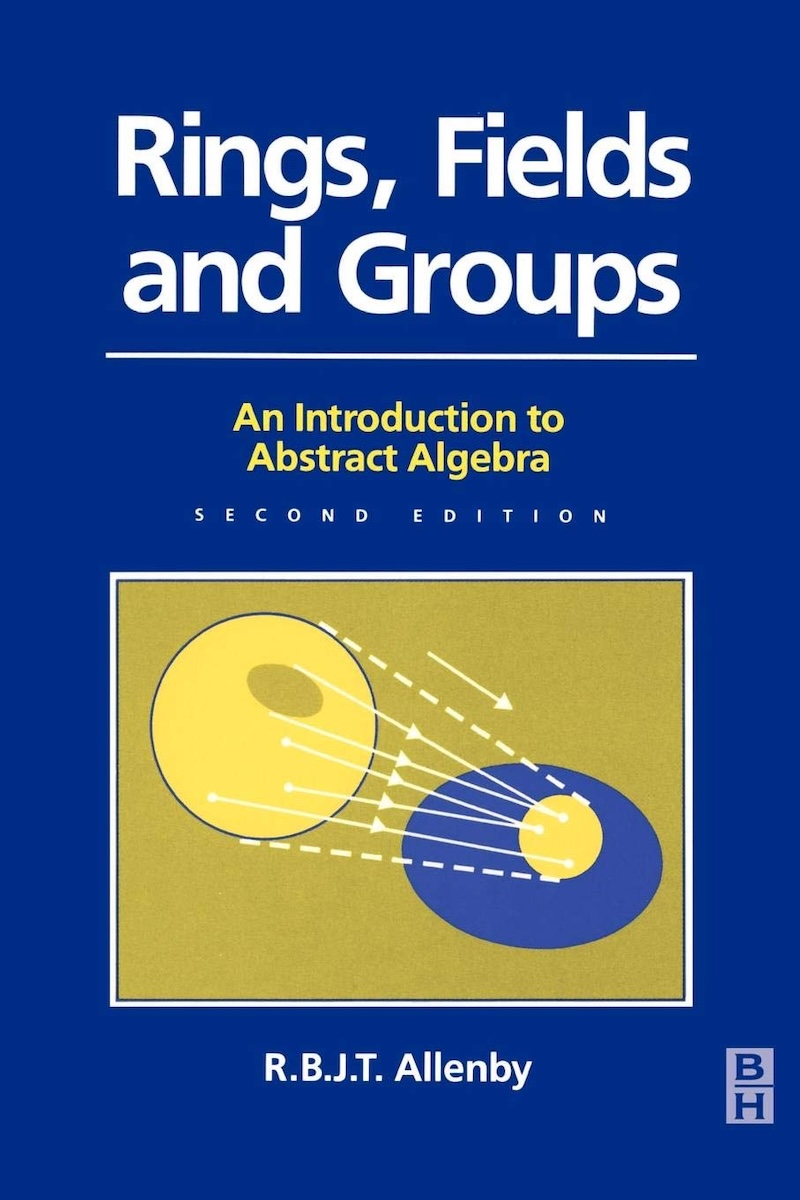
Allenby, R. B. J. T. (1991). Rings, Fields and Groups, An Introduction to Abstract Algebra. Edward Arnold & Butterworth-Heinemann.
Chapter Summary:
Chapter 1: Numbers and Polynomials
Explores basic properties of integers and polynomials, including divisibility, primes, and the fundamental theorem of arithmetic. Discusses polynomial rings, divisibility in these rings, and their algebraic properties.
Chapter 2: Binary Relations and Binary Operations
Introduces concepts of binary relations and operations, focusing on congruences mod n, equivalence relations, partitions, and their significance in algebra.
Chapter 3: Introduction to Rings
Covers the abstract definition of rings, ring properties deduced from axioms, subrings, subfields, ideals, and important number-theoretic applications.
Chapter 4: Factor Rings and Fields
Discusses the construction of factor rings, ring homomorphisms, and fields derived from rings. It also explores isomorphism theorems and constructions linking different fields.
Chapter 5: Basic Group Theory
Introduces group theory, covering axioms, examples, subgroups, homomorphisms, normal subgroups, factor groups, and the symmetric and alternating groups.
Chapter 6: Structure Theorems of Group Theory
Detailed discussion on further aspects of group theory, including Sylow's theorems, direct products, finite abelian groups, soluble groups, and composition series.
Chapter 7: A Brief Excursion into Galois Theory
Provides an introduction to Galois Theory, exploring concepts such as radical towers, splitting fields, and the correspondence between subfields and subgroups.
Key Concepts:
Chapter 1: Numbers and Polynomials
Divisibility and Primes: Fundamental concepts in number theory, including the Euclidean algorithm and the unique prime factorization of integers.
Polynomial Rings: Discusses the structure and properties of polynomial rings, emphasizing concepts such as divisibility, irreducibility, and the Euclidean algorithm for polynomials.
Chapter 2: Binary Relations and Binary Operations
Equivalence Relations: Introduces equivalence relations and their properties, demonstrating how these relations partition sets into equivalence classes.
Modular Arithmetic: Explores arithmetic operations under modulus, which is fundamental in constructing other algebraic systems and has applications in cryptography.
Chapter 3: Introduction to Rings
Ring Properties: Explains the axioms that define rings, including commutative rings, rings with identity, and zero divisors.
Ideals and Quotient Rings: Discusses the role of ideals in constructing new rings from existing ones and the concept of quotient rings, which are essential in understanding ring homomorphisms and isomorphisms.
Chapter 4: Factor Rings and Fields
Homomorphisms and Isomorphisms: Examines the structure-preserving maps between rings that lead to deeper insights into their structure and classification.
Field Constructions: Provides insight into how fields can be constructed from rings through the process of quotienting by maximal ideals.
Chapter 5: Basic Group Theory
Fundamentals of Groups: Covers the definitions, examples, and basic properties of groups, including the order of a group and cyclic groups.
Subgroups and Cosets: Discusses the concepts of subgroups, cosets, and Lagrange’s theorem, which states that the order of a subgroup divides the order of the group.
Chapter 6: Structure Theorems of Group Theory
Sylow Theorems: Examines theorems that provide conditions under which groups have subgroups of a particular order, crucial for understanding the structure of finite groups.
Direct Products and Classification of Finite Groups: Discusses how groups can be constructed by direct products and explores the classification of particularly simple forms of groups, such as abelian groups.
Chapter 7: A Brief Excursion into Galois Theory
Fundamentals of Galois Theory: Introduces the relationship between field extensions and groups, particularly focusing on the solvability of polynomial equations by radicals.
Applications of Galois Theory: Highlights the practical implications of Galois theory in solving classical problems in algebra, including the insolvability of the general quintic by radicals.
Critical Analysis:
Strengths:
Comprehensive and Structured Presentation: Allenby's text is well-structured, progressively building from basic concepts to more complex theories in abstract algebra. This gradual approach is beneficial for students as it provides a solid foundation before introducing advanced topics.
Clarity and Depth: Each topic is presented with clarity and sufficient depth, offering detailed explanations, proofs, and examples that enhance understanding. The text strikes a balance between theoretical rigor and accessibility.
Practical Examples and Exercises: The inclusion of numerous exercises and examples throughout the chapters helps reinforce the material and demonstrates the practical applications of abstract algebra in solving real-world problems.
Limitations:
Visual and Graphical Content: While the text is rich in content, it could benefit from more diagrams, charts, and visual aids to help illustrate complex structures and proofs, which would be particularly helpful in explaining group actions, fields, and Galois theory.
Modern Computational Approaches: The book could be updated to include more on the use of computational tools in abstract algebra. Modern software tools like SageMath, MATLAB, or Mathematica are increasingly important for exploring algebraic structures and could enhance the learning experience.
Connection to Contemporary Research: The book primarily focuses on classical aspects of algebra without extensive discussion of its applications in modern mathematics and other sciences like physics, computer science, and cryptography. Expanding on these applications could highlight the relevance of abstract algebra in contemporary research and industry.
Real-World Applications and Examples:
Cryptography:
Public Key Cryptography: Groups, rings, and fields play crucial roles in the development of cryptographic algorithms, which secure digital communications and data. Understanding these structures helps in designing more secure cryptographic systems.
Coding Theory:
Error-Correcting Codes: Algebraic structures are fundamental in designing codes that automatically detect and correct errors in data transmission, crucial for reliable communication systems and data storage technologies.
Computer Graphics:
Geometric Transformations: Groups and matrices are used to perform geometric transformations in computer graphics, aiding in object modeling and animation.
Quantum Computing:
Quantum Algorithms: Group theory, particularly representations of groups, is essential in developing algorithms for quantum computers, which could potentially revolutionize computing by performing certain calculations much faster than classical computers.