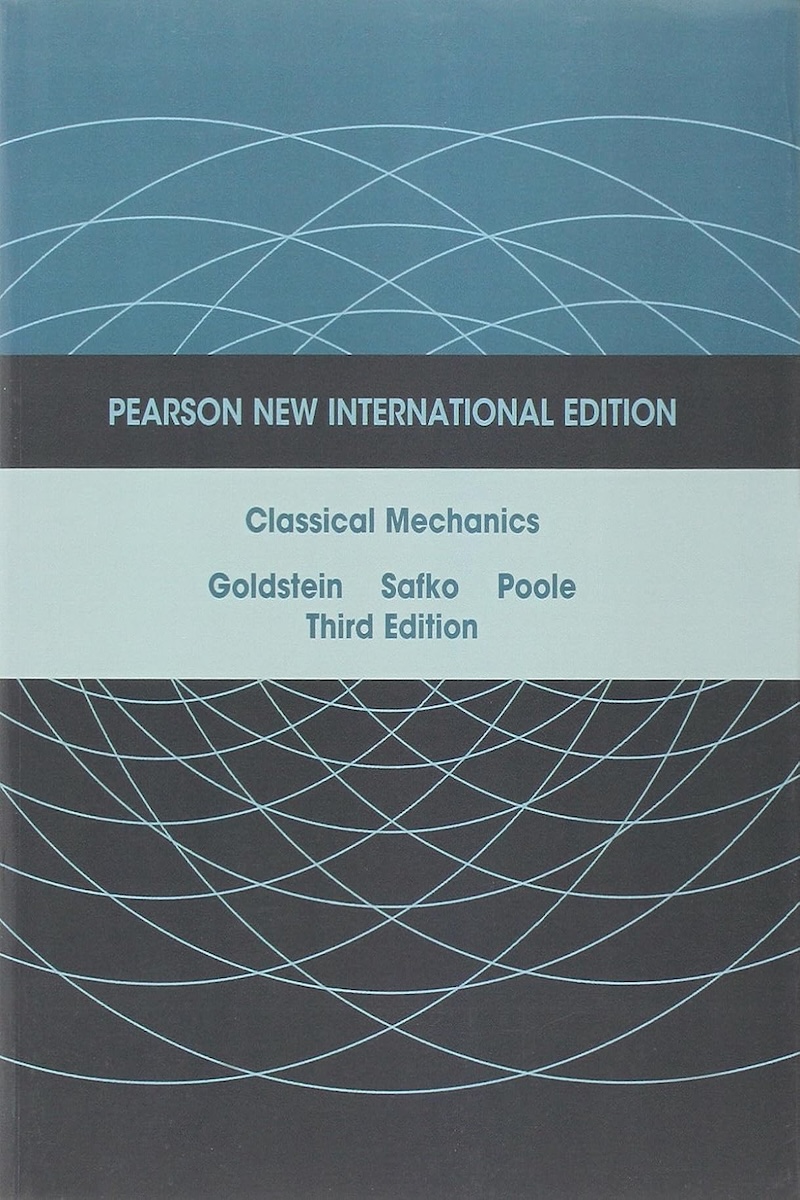
01 / Classic Textbook Recommendation
Classic Textbook Recommendation
Citation
Goldstein, H., Poole, C. P., & Safko, J. L. (2002). Classical Mechanics (3rd ed.). Addison-Wesley. ISBN 978-81-317-5891-5
Chapter Summary
Chapter 1 – Survey of the Elementary Principles
Reviews Newtonian mechanics for single particles and systems of particles. Introduces constraints, D’Alembert’s principle, generalized coordinates, and the Lagrangian formulation. Establishes conservation theorems for momentum, angular momentum, and energy.
Chapter 2 – Variational Principles and Lagrange’s Equations
Develops Hamilton’s principle and techniques of the calculus of variations. Derives Lagrange’s equations for constrained systems. Explores the advantages of variational methods, conservation laws, and the role of symmetries.
Chapter 3 – The Central Force Problem
Analyzes central force motion, including reduction to the equivalent one-body problem, orbit classification, the virial theorem, the Kepler problem, scattering, and the three-body problem.
Chapter 4 – The Kinematics of Rigid Body Motion
Covers rigid body degrees of freedom, orthogonal transformations, Euler angles, infinitesimal rotations, and the Coriolis effect. Establishes the geometric framework for rotational motion.
Chapter 5 – The Rigid Body Equations of Motion
Introduces the inertia tensor, principal axes, and Euler’s equations of motion. Studies torque-free motion, the heavy symmetrical top, and physical applications such as satellite precession.
Chapter 6 – Oscillations
Explores small oscillations, eigenvalue problems, normal modes, and coupled oscillators. Extends to forced and damped oscillations, with applications such as the Josephson junction.
Chapter 7 – Classical Mechanics of Special Relativity
Presents the postulates of special relativity, Lorentz transformations, relativistic kinematics, four-vectors, and tensor methods. Extends Lagrangian and Hamiltonian mechanics to relativistic systems and briefly introduces general relativity.
Chapter 8 – The Hamilton Equations of Motion
Introduces Legendre transformations and Hamilton’s equations. Discusses cyclic coordinates, Routh’s procedure, and the Hamiltonian formulation for relativistic mechanics.
Chapter 9 – Canonical Transformations
Explains canonical transformations, generating functions, the symplectic formalism, and Poisson brackets. Connects symmetry groups and conservation laws through canonical invariants.
Chapter 10 – Hamilton–Jacobi Theory and Action-Angle Variables
Formulates the Hamilton–Jacobi equation and applies it to problems such as the harmonic oscillator and the Kepler problem. Develops action–angle variables for integrable systems.
Chapter 11 – Classical Chaos
Introduces nonlinear dynamics, periodic motion, perturbations, attractors, Lyapunov exponents, Poincaré maps, bifurcations, fractals, and chaos in Hamiltonian systems.
Chapter 12 – Canonical Perturbation Theory
Presents time-dependent and time-independent perturbation theory for Hamiltonian systems. Discusses adiabatic invariants and applications to nearly integrable systems.
Chapter 13 – Continuous Systems and Fields
Extends mechanics to continuous systems and fields. Covers Lagrangian and Hamiltonian field theory, the stress–energy tensor, relativistic field theory, and Noether’s theorem.
Appendices
Provide supplemental material on Euler angle conventions, group theory, Lie algebras, and selected exercise solutions.
Key Concepts
Lagrangian Mechanics
- Reformulation of Newtonian mechanics using generalized coordinates and the principle of least action.
- D’Alembert’s principle and constraints naturally incorporated into the Lagrangian framework.
- Emphasis on variational methods and Hamilton’s principle as the foundation of dynamics.
Hamiltonian Mechanics
- Transition from Lagrangian to Hamiltonian formalism via Legendre transformations.
- Hamilton’s equations of motion as first-order differential equations.
- Canonical transformations, generating functions, and the symplectic structure of phase space.
- Hamilton–Jacobi theory as a bridge to action–angle variables and semiclassical mechanics.
Symmetry and Conservation
- Noether’s theorem linking symmetries of the action to conservation laws.
- Cyclic coordinates and conserved quantities such as linear momentum, angular momentum, and energy.
- Role of symmetry groups (e.g., SO(3), SU(2)) in mechanics.
Relativistic Mechanics
- Extension of classical mechanics to special relativity using four-vectors and tensor notation.
- Relativistic dynamics of particles, collisions, and electromagnetic interactions.
- Covariant Lagrangian and Hamiltonian formulations.
- Introduction to general relativity concepts within a classical framework.
Oscillations and Stability
- Normal modes and eigenfrequencies in small oscillations.
- Coupled oscillators, damping, and resonance phenomena.
- Applications to molecular vibrations and nonlinear systems such as the driven pendulum.
Chaos and Nonlinear Dynamics
- Sensitivity to initial conditions, Lyapunov exponents, and strange attractors.
- Poincaré maps, bifurcation theory, and fractal structures in classical systems.
- The KAM theorem and transition from integrable to chaotic motion.
Continuous Systems and Fields
- Passage from discrete particles to continuous media and fields.
- Lagrangian and Hamiltonian formulations for fields, including relativistic field theory.
- The stress–energy tensor and conservation theorems in field dynamics.
Critical Analysis
Strengths of the Text
- Comprehensive Scope: Covers both foundational mechanics (Newtonian, Lagrangian, Hamiltonian) and advanced topics (chaos, perturbation theory, field theory).
- Balance of Rigor and Application: Provides mathematical precision while also demonstrating physical relevance through worked examples and derivations.
- Integration of Modern Developments: Incorporates nonlinear dynamics, relativistic mechanics, and symmetry principles, aligning the subject with contemporary physics.
- Pedagogical Clarity: Exercises divided into “Derivations” and “Problems” help reinforce theoretical understanding and practical skill.
Limitations and Challenges
- Mathematical Demands: Requires strong background in calculus, linear algebra, and differential equations; challenging for students with weaker math preparation.
- Density of Presentation: The text can feel terse, with some derivations skipped or only outlined, expecting readers to fill in steps.
- Classical Bias: While serving as a bridge to quantum mechanics and field theory, the book’s focus remains classical, which may limit direct applicability in modern research contexts.
Position in the Curriculum
- Graduate Standard: Historically the canonical graduate-level mechanics text in the U.S. and abroad.
- Bridge to Quantum and Field Theory: Provides the formal tools (e.g., Hamilton–Jacobi, canonical transformations, Noether’s theorem) that are essential in advanced theoretical physics.
- Comparative Role: Complements other mechanics texts (e.g., Landau & Lifshitz for more concise theory, Arnold for mathematical rigor) but remains more accessible to physicists than mathematicians.
Overall Evaluation
Goldstein’s Classical Mechanics remains a cornerstone of advanced physics education. Its endurance stems from combining traditional mechanics with 20th-century developments, preparing students both for research and for teaching. Despite its mathematical intensity, the book succeeds in framing classical mechanics as a living subject, not merely a historical discipline.
Real-World Applications and Examples
Celestial Mechanics and Astrophysics
- Keplerian orbits and perturbation theory are directly applied to planetary motion, satellite trajectories, and spacecraft navigation.
- The three-body problem and chaos theory inform our understanding of asteroid dynamics and orbital resonances in planetary systems.
Engineering and Applied Mechanics
- Rigid body dynamics and oscillation theory underpin robotics, structural engineering, and aerospace design.
- Gyroscopic motion and precession principles are crucial in navigation systems, from mechanical gyroscopes to modern inertial guidance.
Modern Physics Foundations
- Variational principles and Hamiltonian mechanics provide the mathematical toolkit for quantum mechanics and quantum field theory.
- Action–angle variables and canonical transformations form the conceptual bridge between classical integrable systems and quantum spectra.
- Noether’s theorem links symmetry to conservation laws, central to both particle physics and general relativity.
Relativity and High-Energy Applications
- Relativistic Lagrangian and Hamiltonian mechanics are applied to high-energy particle collisions in accelerators.
- Concepts of four-vectors and stress–energy tensors extend to astrophysical contexts such as black hole dynamics and gravitational waves.
Nonlinear Dynamics and Chaos in Technology
- Chaos theory informs the design of secure communication systems, nonlinear circuits, and control theory.
- Models of driven damped oscillators explain phenomena ranging from electrical circuits to climate oscillations.
Interdisciplinary Applications
- Vibrational analysis in chemistry (normal modes of molecules).
- Biomechanics and motion analysis using rigid-body dynamics.
- Computational physics methods for simulating chaotic trajectories and complex dynamical systems.