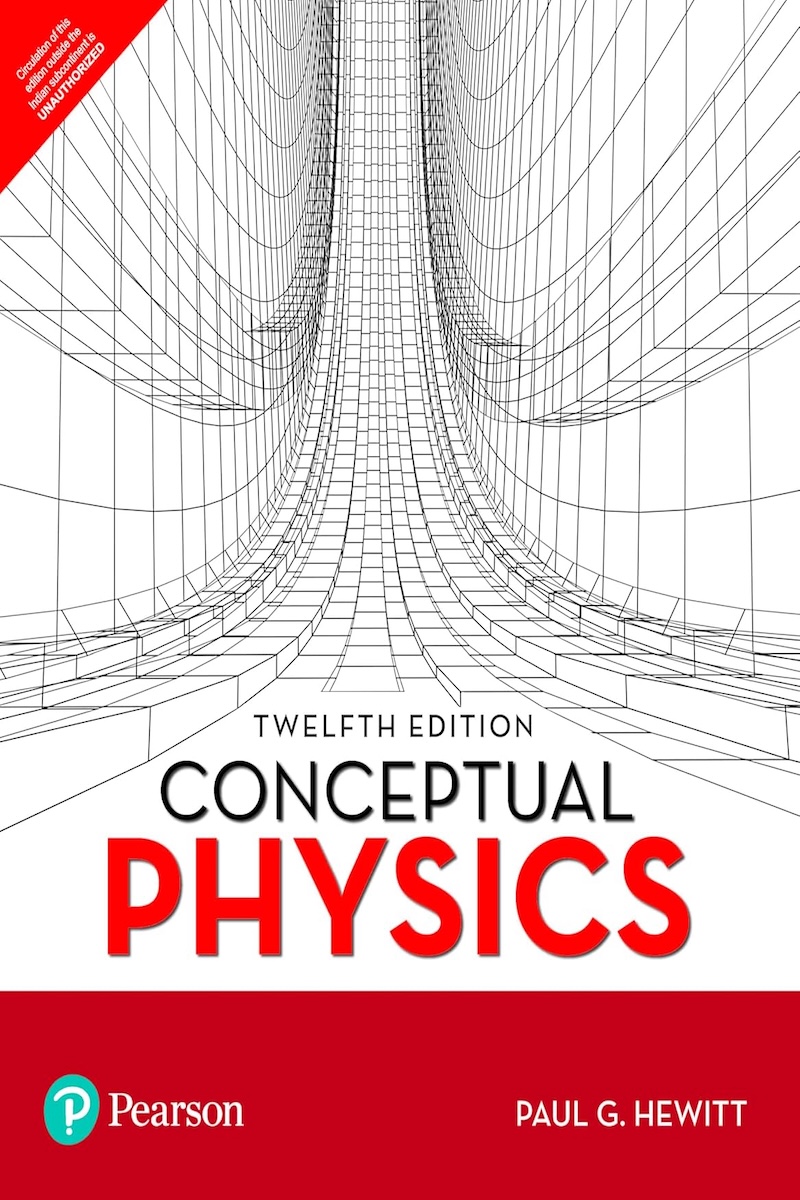
01 / Classic Textbook Recommendation
Classic Textbook Recommendation
Citation
Hewitt, P. G. (2017). Conceptual Physics (12th ed.). Pearson India Education Services. ISBN 978-9352861774
Chapter Summary
Chapter 1 – About Science
Introduces the nature of science, measurement, and the scientific method; explores connections between science, art, and religion, and establishes physics as the foundation of all sciences.
Part One: Mechanics (Chapters 2–10)
- Newton’s Laws of Motion: Inertia, linear motion, force and acceleration, action and reaction.
- Momentum and Energy: Impulse, conservation of momentum, work–energy theorem, efficiency.
- Rotational Motion & Gravity: Torque, angular momentum, universal gravitation, tides, and black holes.
- Projectile & Satellite Motion: Parabolic trajectories, orbits, Kepler’s laws, and escape velocity.
Part Two: Properties of Matter (Chapters 11–14)
- Atomic Nature of Matter: Atoms, isotopes, antimatter, dark matter.
- Solids, Liquids, and Gases: Density, elasticity, pressure, buoyancy, surface tension, and plasma.
Part Three: Heat (Chapters 15–18)
- Temperature & Heat: Specific heat, thermal expansion, and water’s anomalies.
- Heat Transfer: Conduction, convection, radiation, greenhouse effect, climate change.
- Phase Changes & Thermodynamics: Evaporation, boiling, melting, first and second laws, entropy.
Part Four: Sound (Chapters 19–21)
- Vibrations & Waves: Pendulums, wave speed, interference, Doppler effect.
- Sound: Properties of sound waves, resonance, beats, loudness.
- Musical Sounds: Pitch, tone quality, instruments, Fourier analysis.
Part Five: Electricity and Magnetism (Chapters 22–25)
- Electrostatics: Charges, Coulomb’s law, electric fields, shielding, potential.
- Electric Current: Resistance, Ohm’s law, circuits, power.
- Magnetism: Fields, domains, electromagnets, Earth’s field.
- Electromagnetic Induction: Faraday’s law, generators, transformers, power transmission.
Part Six: Light (Chapters 26–31)
- Properties of Light: Electromagnetic waves, transparency, reflection, refraction.
- Color: Additive and subtractive mixing, scattering, rainbows.
- Wave Nature: Diffraction, interference, polarization, holography.
- Emission & Quanta: Spectra, incandescence, fluorescence, lasers.
- Quantum Aspects: Photoelectric effect, wave–particle duality, uncertainty principle.
Part Seven: Atomic and Nuclear Physics (Chapters 32–34)
- Atomic Structure: Bohr model, quantum mechanics, Higgs boson.
- Nuclear Physics: Radioactivity, half-life, detectors, transmutation, dating methods.
- Fission & Fusion: Reactors, mass–energy equivalence, controlled fusion.
Part Eight: Relativity (Chapters 35–36)
- Special Relativity: Michelson–Morley experiment, postulates, time dilation, length contraction, relativistic momentum, E = mc².
- General Relativity: Equivalence principle, bending of light, gravitational redshift, spacetime curvature, gravitational waves.
Appendices
Provide review material on measurement, unit conversions, motion, graphing, vectors, and exponential growth, plus answers to odd-numbered problems, glossary, and index.
Key Concepts
Nature of Science
- Science as a method of inquiry based on observation, experimentation, and logical reasoning.
- Distinction between facts, hypotheses, laws, and theories.
- Interconnections of science with art, philosophy, and everyday life.
Mechanics
- Newton’s three laws of motion as the foundation of dynamics.
- Conservation principles for momentum, energy, and angular momentum.
- Projectile motion, circular motion, and universal gravitation.
- Role of forces, torques, and equilibrium in everyday contexts.
Properties of Matter
- Atomic structure of matter and its implications for physical properties.
- Density, elasticity, pressure, and buoyancy as macroscopic effects of microscopic interactions.
- States of matter, including plasma and exotic forms.
Heat and Thermodynamics
- Temperature as a measure of molecular motion.
- Methods of heat transfer: conduction, convection, and radiation.
- Laws of thermodynamics, entropy, and their consequences for natural processes.
- Climate and environmental physics applications (greenhouse effect, global warming).
Waves and Sound
- Vibrations as the source of wave phenomena.
- Wave properties: frequency, wavelength, amplitude, speed.
- Superposition, interference, resonance, and Doppler effect.
- Characteristics of sound and musical tones.
Electricity and Magnetism
- Electric charge, fields, and potential.
- Current, resistance, circuits, and energy transfer.
- Magnetic fields, forces, and induction.
- Unification of electricity and magnetism into electromagnetism.
Light and Optics
- Dual nature of light as wave and particle.
- Reflection, refraction, diffraction, and polarization.
- Color perception and spectrum analysis.
- Quantum properties of light, including the photoelectric effect and uncertainty principle.
Atomic and Nuclear Physics
- Quantum models of the atom and subatomic particles.
- Radioactivity, half-life, and nuclear reactions.
- Mass–energy equivalence and applications in fission and fusion.
Relativity
- Special relativity: invariance of light speed, time dilation, length contraction, E = mc².
- General relativity: spacetime curvature, equivalence principle, and gravitational waves.
Critical Analysis
Strengths of the Text
- Accessibility: Uses plain language, analogies, and real-world examples to make physics approachable for non-majors.
- Conceptual Emphasis: Prioritizes understanding over mathematics, ensuring that students grasp the underlying ideas before equations.
- Visual Pedagogy: Rich illustrations, cartoons, and diagrams support intuitive learning.
- Breadth of Topics: Covers mechanics through relativity, offering a broad survey of physics in a single volume.
Limitations and Challenges
- Limited Mathematical Depth: Minimal algebra and almost no calculus; not sufficient preparation for advanced or engineering physics.
- Surface-Level Treatment: Complex topics like quantum mechanics and relativity are simplified, which may omit critical nuances.
- U.S.-Centric Examples: Some analogies and contexts may feel less relevant to international audiences.
Position in the Curriculum
- Introductory Level: Best suited for high school or college students in non-science majors, or as a preparatory text before calculus-based physics.
- General Education: Commonly used in “Physics for Poets” or liberal arts curricula to foster scientific literacy.
- Bridge Role: Provides a conceptual foundation that can support later transition to algebra-based or calculus-based physics courses.
Overall Evaluation
Hewitt’s Conceptual Physics is a pioneering text in physics education, shaping how the subject is taught to non-specialists. Its focus on ideas rather than equations democratizes access to physics, cultivating intuition and appreciation for the subject. While unsuitable as the sole textbook for students pursuing advanced study, it excels as an entry point and as a means to build scientific literacy.
Real-World Applications and Examples
Everyday Mechanics
- Explains why seatbelts and airbags save lives using Newton’s laws and momentum conservation.
- Illustrates projectile motion through sports (basketball arcs, soccer kicks) and space launches.
- Applies rotational dynamics to bicycles, playground equipment, and amusement park rides.
Properties of Matter
- Density and buoyancy principles applied to ship design, submarines, and hot air balloons.
- Elasticity and material strength concepts linked to construction and earthquake engineering.
- Plasma physics connected to neon lights and fusion research.
Heat and Energy
- Household phenomena such as insulation, cooking, and refrigeration explained with thermodynamics.
- Climate science framed through heat transfer, greenhouse effect, and entropy considerations.
- Efficiency and energy conservation connected to engines, appliances, and sustainable technologies.
Waves, Sound, and Music
- Explains acoustics in concert halls, noise cancellation in headphones, and tuning of musical instruments.
- Demonstrates Doppler effect in radar, medical imaging, and astronomy.
Electricity and Magnetism
- Power generation and transmission explained via electromagnetic induction.
- Everyday technologies such as smartphones, credit cards, and MRI machines rooted in electromagnetism.
- Household safety with circuits, fuses, and grounding.
Light and Modern Physics
- Optics applied to glasses, cameras, fiber optics, and telescopes.
- Color perception in art, displays, and atmospheric optics (rainbows, sunsets).
- Quantum phenomena linked to solar cells, LEDs, and lasers.
Atomic, Nuclear, and Relativity
- Nuclear physics behind medical imaging, radiation therapy, and nuclear energy.
- Fission and fusion in power plants and research facilities like ITER.
- Relativity applied to GPS satellites, cosmology, and gravitational wave detection.