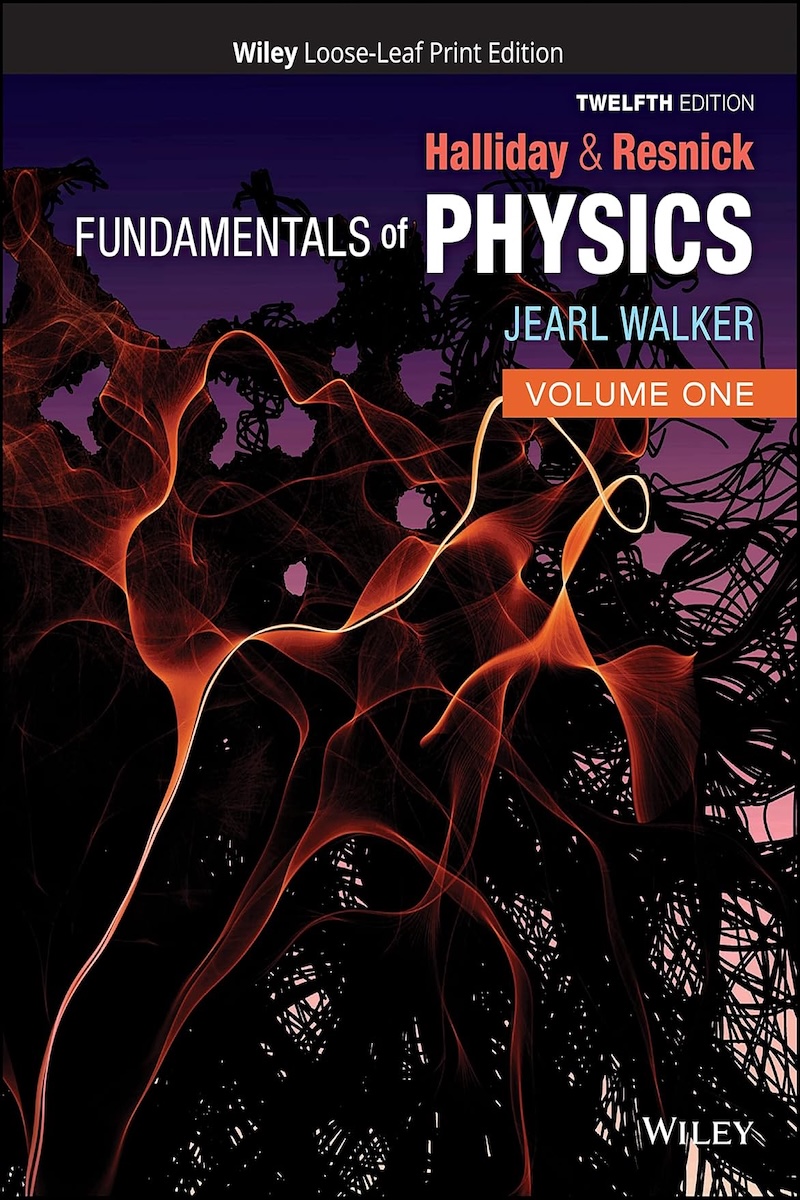
01 / Classic Textbook Recommendation
Classic Textbook Recommendation
Citation
Halliday, D., Resnick, R., & Walker, J. (2021). Fundamentals of Physics (11th ed.). John Wiley & Sons. ISBN 978-1-118-98483-3
Chapter Summary
Chapter 1 – Measurement
Introduces the role of measurement in physics, SI units, dimensional analysis, unit conversions, and significant figures.
Chapter 2 – Motion Along a Straight Line
Covers displacement, velocity, acceleration, constant acceleration, and free-fall motion.
Chapter 3 – Vectors
Explains vector addition, components, unit vectors, and multiplication of vectors.
Chapter 4 – Motion in Two and Three Dimensions
Studies projectile motion, uniform circular motion, and relative motion.
Chapter 5 – Force and Motion I
Introduces Newton’s laws of motion, force, and mass; explores applications of Newton’s second law.
Chapter 6 – Force and Motion II
Examines friction, drag forces, uniform circular motion, and terminal velocity.
Chapter 7 – Kinetic Energy and Work
Develops the work–energy theorem, power, and work by variable forces.
Chapter 8 – Potential Energy and Conservation of Energy
Introduces conservative forces, potential energy, mechanical energy conservation, and energy diagrams.
Chapter 9 – Center of Mass and Linear Momentum
Explores the center of mass, momentum, impulse, collisions, and rockets.
Chapter 10 – Rotation
Covers rotational kinematics, angular acceleration, rotational energy, torque, and moment of inertia.
Chapter 11 – Rolling, Torque, and Angular Momentum
Introduces rolling motion, angular momentum conservation, gyroscopic precession, and rotational dynamics.
Chapter 12 – Equilibrium and Elasticity
Analyzes conditions for static equilibrium and the concepts of stress, strain, and elasticity.
Chapter 13 – Gravitation
Presents Newton’s law of gravitation, planetary motion, satellites, and Einstein’s corrections to Newtonian gravity.
Chapter 14 – Fluids
Covers density, pressure, Pascal’s principle, Archimedes’ principle, and Bernoulli’s equation.
Chapter 15 – Oscillations
Explores simple harmonic motion, energy in oscillations, pendulums, damping, and resonance.
Chapter 16 – Waves I
Introduces wave properties, traveling waves, interference, and standing waves.
Chapter 17 – Waves II (Sound)
Examines sound waves, intensity, beats, Doppler effect, and shock waves.
Chapter 18 – Temperature, Heat, and the First Law of Thermodynamics
Defines temperature, thermal expansion, heat transfer, and the first law of thermodynamics.
Chapter 19 – The Kinetic Theory of Gases
Relates temperature to molecular motion, distribution of speeds, and specific heats.
Chapter 20 – Entropy and the Second Law of Thermodynamics
Explores entropy, heat engines, refrigerators, and statistical views of thermodynamics.
Chapter 21 – Coulomb’s Law
Introduces electric charge, quantization, conservation of charge, and Coulomb’s law.
Chapter 22 – Electric Fields
Discusses field lines, electric fields of charges and dipoles, and forces on charges in fields.
Chapter 23 – Gauss’s Law
Applies Gauss’s law to symmetric charge distributions and electric flux.
Chapter 24 – Electric Potential
Introduces potential energy, potential difference, equipotential surfaces, and calculating potential.
Chapter 25 – Capacitance
Covers capacitors, capacitance in series and parallel, dielectrics, and energy storage.
Chapter 26 – Current and Resistance
Explains current, resistance, Ohm’s law, resistivity, and superconductivity.
Chapter 27 – Circuits
Analyzes single-loop and multi-loop circuits, Kirchhoff’s rules, RC circuits, and instrumentation.
Chapter 28 – Magnetic Fields
Introduces magnetic fields, Lorentz force, cyclotrons, and torque on current loops.
Chapter 29 – Magnetic Fields Due to Currents
Covers Biot–Savart law, Ampère’s law, and magnetic fields of solenoids and current loops.
Chapter 30 – Induction and Inductance
Discusses Faraday’s law, Lenz’s law, inductors, mutual induction, and energy in magnetic fields.
Chapter 31 – Electromagnetic Oscillations and AC Circuits
Covers LC oscillations, AC circuits, resonance, transformers, and power in AC.
Chapter 32 – Maxwell’s Equations and Magnetism of Matter
Unifies electromagnetism with Maxwell’s equations and introduces diamagnetism, paramagnetism, and ferromagnetism.
Chapter 33 – Electromagnetic Waves
Derives properties of EM waves, polarization, reflection, refraction, and radiation pressure.
Chapter 34 – Images
Explains mirrors, lenses, optical instruments, and image formation.
Chapter 35 – Interference
Studies double-slit interference, thin-film interference, and Michelson’s interferometer.
Chapter 36 – Diffraction
Covers single-slit diffraction, diffraction gratings, resolving power, and X-ray diffraction.
Chapter 37 – Relativity
Presents Einstein’s special relativity: simultaneity, time dilation, length contraction, and Lorentz transformations.
Chapter 38 – Photons and Matter Waves
Introduces the photon, photoelectric effect, Compton scattering, wave-particle duality, and quantum beginnings.
Chapter 39 – More About Matter Waves
Explores Schrödinger’s equation, tunneling, hydrogen atom, and electron confinement.
Chapter 40 – All About Atoms
Covers atomic properties, Stern–Gerlach experiment, exclusion principle, and lasers.
Chapter 41 – Conduction of Electricity in Solids
Explains electrical properties of metals, semiconductors, p-n junctions, and transistors.
Chapter 42 – Nuclear Physics
Discusses nuclear structure, radioactive decay, nuclear models, and radiation dosage.
Chapter 43 – Energy from the Nucleus
Explores nuclear fission, reactors, nuclear fusion in stars, and controlled fusion.
Chapter 44 – Quarks, Leptons, and the Big Bang
Introduces particle physics, conservation laws, quark model, fundamental interactions, and cosmology.
Appendices
Provide constants, unit systems, conversion factors, mathematical formulas, and reference data.
Key Concepts
Measurement and Mathematical Tools
- Precision, accuracy, and uncertainty in physical measurement.
- SI units, dimensional analysis, and unit conversions.
- Vectors, vector addition, and coordinate systems as essential tools.
Mechanics
- Kinematics in one, two, and three dimensions; motion under constant acceleration.
- Newton’s three laws of motion and their applications.
- Work, energy, and the conservation of energy.
- Linear momentum, impulse, collisions, and conservation principles.
- Rotation, torque, angular momentum, and equilibrium.
- Gravitation and planetary motion, including Newton’s law and relativistic corrections.
Oscillations and Waves
- Simple harmonic motion, pendulums, damping, and resonance.
- Wave properties: speed, frequency, wavelength, superposition, and standing waves.
- Sound waves, intensity, beats, Doppler effect, and shock waves.
Thermodynamics
- Temperature and heat as manifestations of molecular motion.
- Heat transfer mechanisms: conduction, convection, and radiation.
- Kinetic theory of gases, distribution of speeds, and specific heats.
- Laws of thermodynamics, entropy, and efficiency of engines and refrigerators.
Electricity and Magnetism
- Electric charge, Coulomb’s law, electric fields, and Gauss’s law.
- Electric potential, capacitors, and dielectric effects.
- Electric current, resistance, circuits, and Kirchhoff’s rules.
- Magnetic fields, forces on charges and currents, Biot–Savart law, and Ampère’s law.
- Electromagnetic induction, Faraday’s law, inductors, and AC circuits.
- Maxwell’s equations unifying electricity and magnetism.
Optics
- Electromagnetic wave nature of light.
- Reflection, refraction, lenses, and optical instruments.
- Interference and diffraction phenomena, including double-slit experiments and diffraction gratings.
- Polarization and applications in optical technologies.
Relativity
- Einstein’s special relativity: postulates, Lorentz transformations, time dilation, and length contraction.
- Relativistic momentum, energy, and mass–energy equivalence (E = mc²).
Quantum and Atomic Physics
- Photon theory of light, photoelectric effect, and Compton scattering.
- Matter waves, Schrödinger’s equation, tunneling, and hydrogen atom structure.
- Atomic models, quantum numbers, and exclusion principle.
- Properties of solids: conduction, semiconductors, and transistor physics.
Nuclear and Particle Physics
- Nuclear structure, decay processes, and radiation.
- Nuclear fission, fusion, and energy production.
- Elementary particles: quarks, leptons, conservation laws, and interactions.
- Big Bang cosmology and the evolution of the universe.
Critical Analysis
Strengths of the Text
- Comprehensive Coverage: Spans the entire undergraduate physics curriculum, from mechanics to modern physics.
- Pedagogical Approach: Clear explanations, worked examples, and problem sets graded by difficulty levels.
- Problem-Solving Focus: Extensive emphasis on quantitative practice, preparing students for exams and applications.
- Integration of Modern Topics: Includes relativity, quantum physics, particle physics, and cosmology alongside classical material.
- Longevity and Authority: Established reputation as a standard reference for physics education worldwide.
Limitations and Challenges
- Mathematical Rigor: Demands strong algebra and calculus skills; may be intimidating for students without solid math preparation.
- Volume and Density: Large size and detailed treatment can overwhelm beginners.
- Conceptual Gaps: Prioritizes problem-solving over conceptual discussions; less emphasis on intuition compared to texts like Hewitt’s Conceptual Physics.
- Cultural Accessibility: Examples and contexts are sometimes U.S.-centric.
Position in the Curriculum
- Primary Undergraduate Text: Widely used for calculus-based introductory physics in science and engineering programs.
- Preparation for Advanced Courses: Provides the mathematical and physical foundation necessary for upper-level mechanics, electromagnetism, and quantum mechanics.
- Reference Role: Serves as a long-term resource for problem sets, worked examples, and physics review even after coursework.
Overall Evaluation
Fundamentals of Physics remains one of the most influential and widely adopted physics textbooks. Its strength lies in its thoroughness, logical structure, and emphasis on practice. While it can be daunting for some students, it is unmatched in scope and reliability as a teaching and reference text for introductory university physics.
Real-World Applications and Examples
Mechanics
- Newton’s laws applied to vehicle safety (seatbelts, airbags) and structural engineering.
- Projectile motion used in sports, ballistics, and satellite launches.
- Rotational dynamics central to turbines, flywheels, and gyroscopic navigation.
- Gravitation applied to orbital mechanics, space exploration, and GPS technology.
Oscillations and Waves
- Resonance in bridges, buildings, and musical instruments.
- Wave principles in seismology for studying earthquakes.
- Doppler effect applied in radar, astronomy, and medical imaging.
Thermodynamics
- Heat engines and refrigerators as models for power plants and household appliances.
- Entropy concepts applied to efficiency limits in renewable energy systems.
- Climate modeling using thermodynamics of the atmosphere and oceans.
Electricity and Magnetism
- Circuits as the foundation of electronics and electrical engineering.
- Electromagnetic induction in power generation and transformers.
- Magnetic resonance imaging (MRI) in medicine.
- Maxwell’s equations applied to wireless communication technologies.
Optics
- Lens systems in cameras, telescopes, microscopes, and corrective eyewear.
- Interference and diffraction in spectroscopy and optical instruments.
- Polarization in sunglasses, photography, and liquid crystal displays.
Relativity
- Special relativity corrections essential for GPS satellite synchronization.
- High-energy particle accelerators designed using relativistic dynamics.
- General relativity applied in astrophysics, black hole research, and gravitational wave detection.
Quantum and Atomic Physics
- Photoelectric effect forming the basis for solar cells.
- Quantum tunneling in semiconductor devices and nuclear fusion.
- Laser technology for communication, medicine, and industry.
Nuclear and Particle Physics
- Nuclear power plants and medical isotopes based on fission and radioactive decay.
- Fusion research (e.g., ITER) aiming at sustainable energy solutions.
- Particle physics experiments (CERN, Fermilab) advancing fundamental science and technology.
- Big Bang cosmology shaping our understanding of the universe’s origin and evolution.