01 / Classic Textbook Recommendation
Classic Textbook Recommendation
Citation
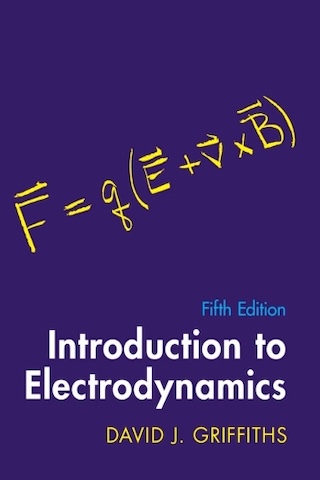
Griffiths, D. J. (2024). Introduction to Electrodynamics (5th ed.). Cambridge University Press. ISBN 9781009397759
Chapter Summary
Chapter 1 – Vector Analysis
Reviews vector algebra, calculus, and integral theorems. Introduces curvilinear coordinates, the Dirac delta function, and the theory of vector fields. Establishes mathematical tools for electrodynamics.
Chapter 2 – Electrostatics
Covers Coulomb’s law, the electric field, Gauss’s law, and electric potential. Discusses energy in electrostatics, conductors, and capacitors.
Chapter 3 – Potentials
Focuses on Laplace’s equation, uniqueness theorems, and boundary conditions. Explores the method of images, separation of variables, and multipole expansion.
Chapter 4 – Electric Fields in Matter
Introduces polarization, bound charges, electric displacement, and linear dielectrics. Examines boundary conditions and energy considerations in dielectric systems.
Chapter 5 – Magnetostatics
Presents the Lorentz force law, Biot–Savart law, Ampère’s law, and magnetic vector potential. Compares magnetostatics with electrostatics.
Chapter 6 – Magnetic Fields in Matter
Examines magnetization, diamagnetism, paramagnetism, and ferromagnetism. Defines bound currents, auxiliary field H, and nonlinear magnetic media.
Chapter 7 – Electrodynamics
Develops Faraday’s law of induction, electromotive force, inductance, and energy in magnetic fields. Introduces Maxwell’s equations and their implications.
Chapter 8 – Conservation Laws
Derives charge, energy, and momentum conservation in electrodynamics. Discusses Poynting’s theorem, Maxwell’s stress tensor, and angular momentum.
Chapter 9 – Electromagnetic Waves
Analyzes wave equations in vacuum and matter, reflection, transmission, polarization, and guided waves. Introduces absorption, dispersion, and waveguides.
Chapter 10 – Potentials and Fields
Covers scalar and vector potentials, gauge transformations, and retarded potentials. Introduces Jefimenko’s equations and Liénard–Wiechert potentials for moving charges.
Chapter 11 – Radiation
Studies dipole radiation, power radiated by point charges, and radiation reaction forces. Discusses the Abraham–Lorentz and self-force problems.
Chapter 12 – Electrodynamics and Relativity
Integrates electrodynamics with special relativity. Covers Lorentz transformations, relativistic mechanics, the field tensor, and covariant formulations.
Appendices
Provide advanced treatments of vector calculus in curvilinear coordinates, the Helmholtz theorem, and unit systems.
Key Concepts
Mathematical Foundations
- Vector calculus: gradient, divergence, curl, and Laplacian as applied to fields.
- Integral theorems: Gauss’s, Stokes’s, and divergence theorems as tools for electromagnetism.
- Dirac delta function and curvilinear coordinates for advanced problem-solving.
Electrostatics
- Coulomb’s law and the principle of superposition.
- Electric field and potential, with Gauss’s law as a unifying principle.
- Energy storage in fields, conductors, and capacitors.
Potentials and Boundary Value Problems
- Laplace’s and Poisson’s equations governing electrostatics.
- Boundary conditions and uniqueness theorems.
- Problem-solving techniques: method of images, separation of variables, multipole expansion.
Matter and Polarization
- Polarization and bound charges as microscopic origins of dielectric phenomena.
- Electric displacement field D and its role in Maxwell’s equations.
- Linear, nonlinear, and anisotropic dielectrics.
Magnetostatics
- Magnetic fields generated by steady currents.
- Biot–Savart law, Ampère’s law, and vector potential formulation.
- Analogy and contrast between electrostatics and magnetostatics.
Magnetized Materials
- Magnetization and bound currents as microscopic sources of magnetic effects.
- Auxiliary field H, susceptibility, and permeability.
- Diamagnetism, paramagnetism, and ferromagnetism.
Electrodynamics and Maxwell’s Equations
- Faraday’s law of induction and electromotive force.
- Inductance, energy in magnetic fields, and displacement current.
- Full form of Maxwell’s equations unifying electricity and magnetism.
Conservation Principles
- Charge conservation expressed via the continuity equation.
- Energy flow through the Poynting vector and energy density.
- Momentum transfer via Maxwell’s stress tensor; angular momentum conservation.
Electromagnetic Waves
- Wave equations in vacuum and media; speed of light as fundamental constant.
- Reflection, refraction, polarization, and dispersion.
- Guided waves, absorption, and transmission lines.
Radiation
- Dipole approximation and multipole radiation.
- Power radiated by accelerating charges.
- Radiation reaction and self-force issues in classical electrodynamics.
Relativity and Electrodynamics
- Lorentz transformations and four-vector formalism.
- Electromagnetic field tensor and covariant Maxwell equations.
- Unity of electricity and magnetism within the relativistic framework.
Critical Analysis
Strengths of the Text
- Pedagogical Clarity: Griffiths is widely praised for clear explanations, conversational tone, and step-by-step derivations.
- Balanced Rigor and Accessibility: Provides mathematical rigor while remaining more approachable than mathematically heavy texts (e.g., Jackson’s Classical Electrodynamics).
- Problem-Solving Orientation: End-of-chapter problems range from straightforward practice to challenging conceptual puzzles.
- Coverage of Relativity: Inclusion of covariant electrodynamics links classical EM to modern physics contexts.
- Updated Content: The 5th edition incorporates improved explanations and problem sets reflecting student feedback.
Limitations and Challenges
- Prerequisite Demands: Assumes solid grounding in vector calculus and differential equations, which can be a barrier for underprepared students.
- Intermediate Scope: Excellent for advanced undergraduates, but not sufficient for graduate-level research preparation without supplementation.
- Less Emphasis on Applications: While strong in theory, real-world engineering and technological contexts are less developed compared to applied EM texts.
- Radiation and Self-Force: Treatment of advanced topics such as radiation reaction is brief, leaving deeper exploration to specialized literature.
Position in the Curriculum
- Core Undergraduate Electrodynamics: Standard text for junior or senior undergraduate courses in physics.
- Bridge to Graduate Studies: Prepares students for more advanced electrodynamics (e.g., Jackson), quantum mechanics, and field theory.
- Reference Text: Serves as a reliable resource for problem-solving and conceptual understanding even beyond coursework.
Overall Evaluation
Griffiths’ Introduction to Electrodynamics remains the gold standard for teaching classical electromagnetism at the undergraduate level. Its clarity, logical progression, and accessible style make it beloved by students and instructors alike. While it may not delve into the full mathematical depth or applications needed for specialists, it succeeds brilliantly in its intended role: building a strong, intuitive, and rigorous foundation in electrodynamics.
Real-World Applications and Examples
Electrostatics
- Capacitors in electronic circuits, energy storage, and signal processing.
- Electrostatic shielding used in Faraday cages and sensitive electronics protection.
- Medical imaging and diagnostics employing electrostatic principles in devices like electrocardiograms (ECGs).
Potentials and Boundary Value Problems
- Method of images applied to grounded conductors in accelerator and detector design.
- Multipole expansion techniques used in molecular physics and astrophysics.
- Separation of variables crucial in solving waveguides and cavity resonators.
Dielectrics and Polarization
- Dielectric materials in capacitors, insulators, and high-voltage engineering.
- Polarization concepts in liquid crystal displays (LCDs) and optical devices.
- Understanding dielectric breakdown in power transmission systems.
Magnetostatics
- Design of electromagnets and MRI technology based on Biot–Savart and Ampère’s laws.
- Magnetic vector potential applied in quantum mechanics (Aharonov–Bohm effect).
- Applications in particle accelerators and beam steering.
Magnetic Materials
- Ferromagnetism at the core of data storage, transformers, and electric motors.
- Diamagnetism and paramagnetism relevant in material characterization and magnetic levitation.
- Magnetic susceptibility measurements used in geology and material science.
Electrodynamics and Maxwell’s Equations
- Induction principles powering generators, transformers, and wireless charging.
- Maxwell’s equations as the theoretical foundation of all electrical engineering and telecommunications.
- Displacement current concept enabling the prediction of electromagnetic waves.
Conservation Laws
- Poynting vector analysis in energy transfer for antennas and waveguides.
- Maxwell stress tensor applied in optical tweezers and radiation pressure studies.
- Momentum and angular momentum conservation in laser cooling and particle trapping.
Electromagnetic Waves
- Reflection and transmission applied to fiber optics, radar, and Wi-Fi.
- Polarization control in sunglasses, antenna design, and quantum optics.
- Dispersion relations applied in telecommunications and material science.
Radiation
- Dipole radiation theory applied to antenna design.
- Synchrotron radiation in particle accelerators for imaging and material research.
- Bremsstrahlung radiation in X-ray production and astrophysics.
Relativity and Electrodynamics
- Relativistic electrodynamics applied in GPS satellite synchronization.
- Field tensor formalism used in quantum electrodynamics (QED).
- High-energy astrophysics phenomena (jets, pulsars) explained via covariant electrodynamics.