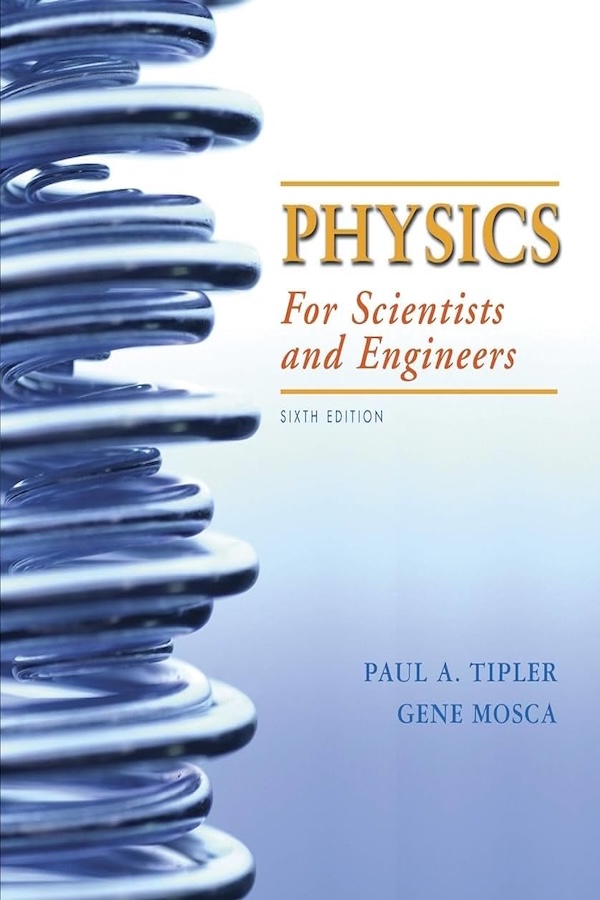
01 / Classic Textbook Recommendation
Classic Textbook Recommendation
Citation
Tipler, P. A., & Mosca, G. (2007). Physics for Scientists and Engineers, Extended Version (6th ed.). W. H. Freeman and Company. ISBN 978-0-7167-8964-2
Chapter Summary
Chapter 1 – Measurement and Vectors
Introduces the nature of physics, units, dimensional analysis, significant figures, and vectors. Provides the mathematical foundations for describing physical quantities.
Chapter 2 – Motion in One Dimension
Covers displacement, velocity, acceleration, and motion under constant acceleration. Introduces problem-solving strategies and linear accelerators as applications.
Chapter 3 – Motion in Two and Three Dimensions
Discusses projectile motion, circular motion, and vector methods for displacement, velocity, and acceleration. Applies motion analysis to navigation and GPS.
Chapter 4 – Newton’s Laws
Presents Newton’s three laws of motion, free-body diagrams, and applications involving forces such as gravity, contact forces, and tension.
Chapter 5 – Additional Applications of Newton’s Laws
Explores friction, drag forces, motion along curved paths, center of mass, and numerical integration methods.
Chapter 6 – Work and Kinetic Energy
Introduces work, kinetic energy, the work–energy theorem, and applications to curvilinear motion and center of mass systems.
Chapter 7 – Conservation of Energy
Discusses potential energy, conservation of mechanical energy, and quantization of energy. Introduces mass–energy equivalence.
Chapter 8 – Conservation of Linear Momentum
Covers momentum conservation, collisions, rocket propulsion, and applications such as pulse detonation engines.
Chapter 9 – Rotation
Explains angular velocity, angular acceleration, rotational kinetic energy, and the moment of inertia. Applies Newton’s second law to rotational systems.
Chapter 10 – Angular Momentum
Analyzes torque, conservation of angular momentum, and quantization in rotational systems.
Chapter R – Special Relativity
Introduces Einstein’s postulates, time dilation, length contraction, simultaneity, relativistic momentum, and energy.
Chapter 11 – Gravity
Covers Kepler’s laws, Newton’s law of gravitation, gravitational potential energy, and fields. Discusses gravitational lenses as applications.
Chapter 12 – Static Equilibrium and Elasticity
Explores conditions for equilibrium, center of gravity, stability, stress, and strain.
Chapter 13 – Fluids
Introduces density, pressure, buoyancy, fluid dynamics, and applications in aerodynamics.
Chapter 14 – Oscillations
Covers simple harmonic motion, energy in oscillations, damping, resonance, and real-world oscillatory systems.
Chapter 15 – Traveling Waves
Explains wave motion, periodic waves, three-dimensional waves, barriers, and the Doppler effect.
Chapter 16 – Superposition and Standing Waves
Analyzes wave superposition, standing waves, resonance, and acoustical applications.
Chapter 17 – Temperature and Kinetic Theory of Gases
Introduces temperature scales, ideal gas law, and kinetic theory. Connects microscopic and macroscopic descriptions.
Chapter 18 – Heat and the First Law of Thermodynamics
Discusses heat capacity, phase changes, Joule’s experiment, internal energy, and PV diagrams.
Chapter 19 – The Second Law of Thermodynamics
Presents heat engines, refrigerators, Carnot cycles, entropy, and the statistical interpretation of thermodynamics.
Chapter 20 – Thermal Properties and Processes
Explores thermal expansion, van der Waals gases, phase diagrams, and heat transfer mechanisms.
Chapter 21 – The Electric Field I: Discrete Charge Distributions
Covers Coulomb’s law, electric fields from point charges, and electric field lines.
Chapter 22 – The Electric Field II: Continuous Charge Distributions
Explains Gauss’s law, field calculations using symmetry, and conductor properties.
Chapter 23 – Electric Potential
Discusses electric potential energy, equipotential surfaces, and calculations of potential.
Chapter 24 – Capacitance
Explains capacitors, energy storage, and dielectrics.
Chapter 25 – Electric Current and Direct-Current Circuits
Covers current, resistance, Ohm’s law, circuit analysis, and RC circuits.
Chapter 26 – The Magnetic Field
Explores magnetic forces on charges and currents, torques, and the Hall effect.
Chapter 27 – Sources of the Magnetic Field
Introduces the Biot–Savart law, Ampère’s law, and magnetism in matter.
Chapter 28 – Magnetic Induction
Covers Faraday’s law, Lenz’s law, motional EMF, inductance, and superconductors.
Chapter 29 – Alternating-Current Circuits
Discusses AC circuits, phasors, RLC circuits, transformers, and power grids.
Chapter 30 – Maxwell’s Equations and Electromagnetic Waves
Unifies electricity and magnetism via Maxwell’s equations and derives the electromagnetic wave equation.
Chapter 31 – Properties of Light
Analyzes light as a wave and a particle, reflection, refraction, polarization, and spectra.
Chapter 32 – Optical Images
Covers mirrors, lenses, optical instruments, and aberrations.
Chapter 33 – Interference and Diffraction
Discusses coherence, thin-film interference, diffraction, and holography.
Chapter 34 – Wave–Particle Duality and Quantum Physics
Introduces photons, matter waves, quantization, and the particle-in-a-box model.
Chapter 35 – Applications of the Schrödinger Equation
Covers potential wells, harmonic oscillator, tunneling, and hydrogen-like atoms.
Chapter 36 – Atoms
Explores Bohr’s model, quantum theory of atoms, spin–orbit coupling, and atomic spectra.
Chapter 37 – Molecules
Introduces molecular bonding, diatomic molecules, and molecular spectra.
Chapter 38 – Solids
Covers crystal structure, conduction, band theory, semiconductors, and superconductivity.
Chapter 39 – Relativity
Revisits Einstein’s theory with Lorentz transformations, velocity addition, relativistic energy, and general relativity.
Chapter 40 – Nuclear Physics
Explains nuclear properties, radioactivity, reactions, fission, and fusion.
Chapter 41 – Elementary Particles and the Universe
Covers quarks, leptons, conservation laws, the Standard Model, and cosmology.
Appendices
Provide SI units, conversion factors, numerical data, periodic table, math tutorials, and selected solutions.
Key Concepts
Foundations of Physics
- Physics as the quantitative study of nature based on measurement, models, and experimentation.
- Role of units, dimensional analysis, and vectors in describing physical systems.
Mechanics
- Kinematics: motion in one, two, and three dimensions.
- Dynamics: Newton’s laws of motion, forces, and free-body diagrams.
- Work, energy, and conservation of mechanical energy.
- Momentum, impulse, collisions, and rocket propulsion.
- Rotational motion: torque, angular momentum, and rotational dynamics.
- Gravitation: Newton’s law, Kepler’s laws, and relativistic corrections.
Relativity
- Special relativity: postulates, time dilation, length contraction, simultaneity, relativistic energy and momentum.
- General relativity (introductory concepts): gravitational time dilation, curvature of spacetime.
Equilibrium, Fluids, and Elasticity
- Static equilibrium conditions and stability of structures.
- Stress, strain, and elasticity in materials.
- Fluid statics: buoyancy, Pascal’s principle, and Archimedes’ law.
- Fluid dynamics: Bernoulli’s equation, viscosity, and turbulence.
Oscillations and Waves
- Simple harmonic motion, damping, and resonance.
- Traveling and standing waves, interference, and beats.
- Sound waves, intensity, Doppler effect, and acoustics.
Thermodynamics
- Kinetic theory of gases and molecular interpretation of temperature.
- Heat transfer: conduction, convection, and radiation.
- First law of thermodynamics: energy conservation in thermal processes.
- Second law of thermodynamics: entropy, Carnot cycles, and irreversibility.
Electricity and Magnetism
- Electrostatics: Coulomb’s law, electric fields, Gauss’s law, and potential.
- Capacitance, dielectrics, and stored energy.
- Current, resistance, Ohm’s law, circuits, and RC transients.
- Magnetism: magnetic fields, forces, Biot–Savart law, Ampère’s law.
- Electromagnetic induction: Faraday’s and Lenz’s laws, inductance, AC circuits.
- Maxwell’s equations and the electromagnetic wave equation.
Optics
- Wave optics: interference, diffraction, and polarization.
- Geometrical optics: reflection, refraction, lenses, and optical instruments.
- Dual nature of light: photons and wave–particle duality.
Quantum Physics
- Early quantum theory: blackbody radiation, photoelectric effect, Compton scattering.
- Schrödinger equation and quantum states.
- Quantum models: wells, oscillators, tunneling, hydrogen atom.
- Atomic structure: spectra, spin, and fine structure.
Molecular and Solid-State Physics
- Molecular bonding and vibrational/rotational spectra.
- Crystal structure, band theory, conductors, semiconductors, and superconductivity.
Nuclear and Particle Physics
- Nuclear structure, radioactivity, fission, and fusion.
- Elementary particles, quarks, leptons, and the Standard Model.
- Cosmology: early universe, conservation laws, and fundamental interactions.
Critical Analysis
Strengths of the Text
- Comprehensive Coverage: Spans classical mechanics, electromagnetism, thermodynamics, optics, quantum physics, relativity, and modern topics in one volume.
- Problem-Solving Orientation: Provides a wide variety of problems with different levels of difficulty, emphasizing quantitative skills.
- Pedagogical Features: Worked examples, conceptual checkpoints, and real-world applications aid student engagement.
- Integration of Modern Physics: Includes quantum mechanics, relativity, nuclear physics, and cosmology, making the text suitable for extended undergraduate curricula.
- Flexibility: The extended version allows instructors to tailor the content for different course sequences.
Limitations and Challenges
- Mathematical Intensity: Requires strong calculus skills; can be challenging for students less confident in math.
- Density of Presentation: Explanations are sometimes concise, requiring supplementary instruction or references for deeper understanding.
- Conceptual Balance: Focuses more on calculations than conceptual development compared to texts like Hewitt’s Conceptual Physics.
- Volume Size: The extended edition is large and heavy, which may limit its appeal as a single-course text.
Position in the Curriculum
- Primary Textbook: Widely adopted for calculus-based introductory physics courses for science and engineering majors.
- Preparation for Advanced Study: Builds the foundation for specialized courses in mechanics, electromagnetism, quantum physics, and thermodynamics.
- Reference Role: Serves as a long-term reference for problem-solving techniques and physical constants.
Overall Evaluation
Tipler & Mosca’s Physics for Scientists and Engineers remains one of the most respected calculus-based physics textbooks. Its broad scope, rigorous problem sets, and integration of modern physics make it highly valuable for undergraduate education. While demanding in mathematical prerequisites and sometimes dense in presentation, it succeeds in equipping students with the tools and knowledge needed for advanced scientific and engineering studies.
Real-World Applications and Examples
Mechanics
- Vehicle safety systems (seatbelts, airbags) explained by Newton’s laws and momentum conservation.
- Orbital mechanics applied to satellites, GPS, and space exploration.
- Structural engineering informed by static equilibrium and torque analysis.
Relativity
- Time dilation and length contraction tested with high-speed particle experiments.
- GPS satellites require relativistic corrections for accurate navigation.
- Gravitational lensing and black hole physics as astrophysical applications.
Fluids and Oscillations
- Aerodynamics of airplanes and automobiles based on Bernoulli’s principle.
- Hydraulic systems (brakes, lifts) using Pascal’s principle.
- Resonance phenomena applied in musical instruments and earthquake engineering.
Thermodynamics
- Heat engines and refrigerators modeled with Carnot cycles.
- Thermodynamic principles applied in power plants and renewable energy systems.
- Entropy concepts applied to climate science and information theory.
Electricity and Magnetism
- Circuit theory used in electronics, communications, and power distribution.
- Electromagnetic induction powering electric generators, transformers, and wireless charging.
- MRI technology based on magnetic fields and nuclear spin.
Optics
- Lenses in cameras, microscopes, and telescopes.
- Optical interference used in thin-film coatings and holography.
- Diffraction principles applied in X-ray crystallography and spectroscopy.
Quantum Physics
- Photoelectric effect forming the basis for solar cells.
- Quantum tunneling in semiconductor devices and nuclear fusion.
- Laser technology applied in medicine, communications, and manufacturing.
Solid-State Physics
- Band theory explaining semiconductors, transistors, and integrated circuits.
- Superconductivity applied in maglev trains, MRI machines, and particle accelerators.
Nuclear and Particle Physics
- Nuclear fission powering reactors and nuclear fusion research for sustainable energy.
- Radiation therapy in medicine using nuclear decay.
- Particle accelerators (CERN, Fermilab) probing fundamental physics and enabling technological advances.
Cosmology
- Big Bang theory and cosmic microwave background radiation shaping our understanding of the universe.
- Conservation laws applied to astrophysical processes and dark matter/energy research.