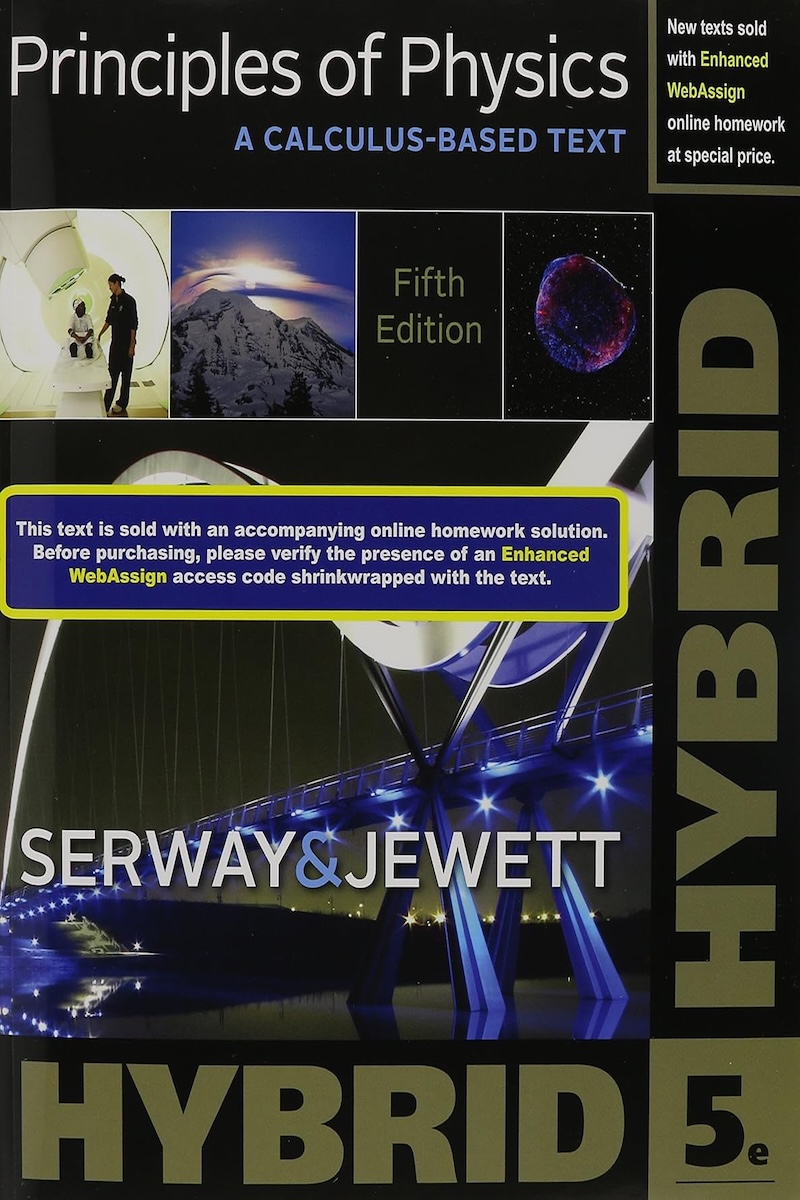
01 / Classic Textbook Recommendation
Classic Textbook Recommendation
Citation
Serway, R. A., & Jewett, J. W., Jr. (2013). Principles of Physics: A Calculus-Based Text (5th ed.). Brooks/Cole. ISBN 9781133104261
Chapter Summary
Chapter 1 – Introduction and Vectors
Introduces units, dimensional analysis, significant figures, coordinate systems, and vectors. Emphasizes modeling and problem-solving strategies.
Chapter 2 – Motion in One Dimension
Covers displacement, velocity, and acceleration. Discusses uniformly accelerated motion and free-fall examples.
Chapter 3 – Motion in Two Dimensions
Analyzes projectile motion, relative velocity, and uniform circular motion. Introduces tangential and radial acceleration.
Chapter 4 – The Laws of Motion
Explores Newton’s three laws, the concept of force, and weight. Uses free-body diagrams and models for problem solving.
Chapter 5 – More Applications of Newton’s Laws
Examines friction, circular motion, drag forces, and the fundamental interactions in nature.
Chapter 6 – Energy of a System
Introduces work, kinetic energy, and potential energy. Discusses conservative vs. nonconservative forces and energy diagrams.
Chapter 7 – Conservation of Energy
Formulates the principle of energy conservation. Explains power, frictional energy loss, and steady-state systems.
Chapter 8 – Momentum and Collisions
Covers linear momentum, impulse, collisions, and center-of-mass motion. Applications include rocket propulsion.
Chapter 9 – Relativity
Introduces Einstein’s postulates, Lorentz transformations, time dilation, length contraction, relativistic momentum and energy, and general relativity.
Chapter 10 – Rotational Motion
Covers rotational kinematics, torque, and angular momentum. Introduces rolling motion and rigid-body dynamics.
Chapter 11 – Angular Momentum and Equilibrium
Explains angular momentum conservation, gyroscopes, and static equilibrium of structures.
Chapter 12 – Oscillatory Motion
Analyzes simple harmonic oscillators, pendulums, damped and driven oscillations, and resonance.
Chapter 13 – Mechanical Waves
Covers wave propagation, energy transfer, reflection, transmission, and sound waves including the Doppler effect.
Chapter 14 – Superposition and Standing Waves
Introduces interference, standing waves, beats, and applications to musical acoustics.
Chapter 15 – Fluid Mechanics
Discusses pressure, buoyancy, Bernoulli’s principle, viscosity, turbulence, and applications in biology.
Chapter 16 – Temperature and Kinetic Theory
Explores thermometry, thermal expansion, the ideal gas law, and kinetic theory of gases.
Chapter 17 – Energy in Thermal Processes
Covers heat, specific heat, latent heat, and the first law of thermodynamics.
Chapter 18 – Heat Engines and Entropy
Explains the second law of thermodynamics, Carnot cycles, entropy, and energy efficiency.
Chapter 19 – Electric Fields
Introduces Coulomb’s law, the electric field concept, dipoles, and Gauss’s law.
Chapter 20 – Electric Potential
Discusses potential energy, electric potential, equipotential surfaces, and capacitors.
Chapter 21 – Electric Circuits
Covers current, resistance, Ohm’s law, DC circuits, Kirchhoff’s rules, and RC transients.
Chapter 22 – Magnetic Forces and Fields
Introduces magnetic fields, forces on charges and currents, the Biot–Savart law, and Ampère’s law.
Chapter 23 – Electromagnetic Induction
Explains Faraday’s law, motional emf, inductance, RL circuits, and magnetic energy storage.
Chapter 24 – Electromagnetic Waves
Presents Maxwell’s equations, properties of EM waves, polarization, and the electromagnetic spectrum.
Chapter 25 – Reflection and Refraction of Light
Explains geometrical optics, reflection, refraction, dispersion, and total internal reflection.
Chapter 26 – Image Formation
Covers mirrors, lenses, the eye, and optical instruments.
Chapter 27 – Wave Optics
Explores interference, diffraction, polarization, and holography.
Chapter 28 – Quantum Physics
Discusses blackbody radiation, photoelectric and Compton effects, wave–particle duality, uncertainty, and Schrödinger’s equation.
Chapter 29 – Atomic Physics
Analyzes hydrogen atom, quantum numbers, Pauli exclusion principle, atomic spectra, and X-rays.
Chapter 30 – Nuclear Physics
Explores nuclear properties, binding energy, radioactivity, decay processes, and nuclear reactions.
Chapter 31 – Particle Physics
Introduces fundamental forces, conservation laws, mesons, quarks, and the Standard Model.
Appendices
Include mathematical tools, SI units, periodic table, and selected problem solutions.
Key Concepts
Foundations of Physics
- Measurement, units, and dimensional analysis as the groundwork for physical modeling.
- Vectors and calculus-based tools as essential language for describing physical systems.
Mechanics
- Kinematics: motion in one, two, and three dimensions.
- Newton’s laws of motion and applications in linear and circular motion.
- Work, energy, and conservation of energy in mechanical systems.
- Linear momentum, impulse, and collisions.
- Rotational dynamics, torque, and conservation of angular momentum.
- Equilibrium of rigid bodies and stability of structures.
Relativity
- Einstein’s postulates of special relativity.
- Lorentz transformations, time dilation, and length contraction.
- Relativistic momentum and energy, including mass–energy equivalence.
- Introductory ideas from general relativity.
Oscillations and Waves
- Simple harmonic motion, damping, and resonance.
- Traveling and standing waves, superposition, and beats.
- Properties of sound waves and the Doppler effect.
Fluid Mechanics
- Pressure, buoyancy, and Pascal’s principle.
- Bernoulli’s equation and applications in biological and engineering systems.
- Viscosity and turbulence in real fluids.
Thermodynamics
- Kinetic theory of gases and the microscopic interpretation of temperature.
- Heat transfer methods: conduction, convection, radiation.
- First law of thermodynamics: conservation of energy in thermal processes.
- Second law of thermodynamics: entropy, Carnot cycles, and efficiency.
Electricity and Magnetism
- Electric fields, Coulomb’s law, Gauss’s law, and electric potential.
- Capacitance, energy storage, and dielectrics.
- Current, resistance, circuits, and Kirchhoff’s rules.
- Magnetic fields, forces on moving charges and currents.
- Electromagnetic induction, Faraday’s and Lenz’s laws, and inductance.
- Maxwell’s equations and electromagnetic wave propagation.
Optics
- Geometrical optics: reflection, refraction, lenses, and image formation.
- Wave optics: interference, diffraction, polarization, and coherence.
- Optical instruments and applications in imaging technologies.
Quantum Physics
- Origins of quantum mechanics: blackbody radiation, photoelectric effect, Compton scattering.
- Schrödinger equation, probability interpretation, and uncertainty principle.
- Quantum models: potential wells, hydrogen atom, atomic orbitals.
Atomic and Nuclear Physics
- Atomic structure, spectra, Pauli exclusion principle, and spin.
- Nuclear properties, radioactivity, decay modes, and nuclear energy.
- Applications of fission, fusion, and radiation in technology and medicine.
Particle Physics
- Fundamental particles: quarks, leptons, mesons, baryons.
- Conservation laws and interactions (strong, weak, electromagnetic, gravitational).
- Standard Model framework and cosmological connections.
Critical Analysis
Strengths of the Text
- Comprehensive Curriculum Coverage: Spans mechanics, thermodynamics, electromagnetism, optics, quantum, nuclear, and particle physics in one volume.
- Calculus-Based Approach: Emphasizes rigorous problem-solving with calculus, preparing students for advanced science and engineering coursework.
- Pedagogical Features: Clear structure with worked examples, problem-solving strategies, and a wide variety of end-of-chapter problems.
- Balanced Modern Content: Includes relativity, quantum theory, and particle physics alongside classical foundations.
- Real-World Applications: Frequent links to biology, medicine, engineering, and technology to contextualize theory.
Limitations and Challenges
- Mathematical Demands: Requires strong prior knowledge of calculus; may challenge students with weaker math backgrounds.
- Density of Exposition: Concise explanations sometimes assume a higher level of intuition than students possess.
- Problem-Heavy Orientation: Strong emphasis on calculations can overshadow deeper conceptual discussions compared to more narrative texts.
- Weight and Scope: Large volume may be overwhelming when used for a single course sequence.
Position in the Curriculum
- Primary Textbook: Widely used for calculus-based introductory physics courses for science and engineering majors.
- Preparation for Upper-Level Physics: Provides the foundation for advanced mechanics, electromagnetism, thermodynamics, and modern physics.
- Comparison to Other Texts: Less concise than Halliday & Resnick but more focused on problem-solving; more rigorous than Hewitt’s conceptual approach.
Overall Evaluation
Serway & Jewett’s Principles of Physics is a standard, well-respected text in undergraduate physics education. Its strength lies in its rigorous, problem-solving orientation and integration of classical and modern topics. While it may feel dense or mathematically demanding, it equips students with the analytical skills and foundational knowledge essential for further study in physics and engineering.
Real-World Applications and Examples
Mechanics
- Vehicle safety devices (seatbelts, airbags, crumple zones) explained through Newton’s laws and conservation of momentum.
- Satellite orbits, space travel, and GPS navigation based on gravitation and relativity.
- Engineering applications of torque and equilibrium in bridges, cranes, and buildings.
Relativity
- GPS satellite corrections using time dilation and relativistic momentum.
- High-energy particle physics experiments validating relativistic predictions.
- Astrophysical phenomena such as black holes and gravitational lensing.
Oscillations and Waves
- Resonance in musical instruments, buildings, and bridges.
- Acoustic design of concert halls using standing wave principles.
- Seismology applying wave interference and Doppler shifts to study earthquakes.
Fluid Mechanics
- Hydraulic systems (brakes, lifts, medical devices) utilizing Pascal’s principle.
- Aerodynamics in airplane wing design using Bernoulli’s equation.
- Biological applications such as blood flow and respiratory mechanics.
Thermodynamics
- Heat engines in cars, power plants, and renewable energy systems.
- Refrigeration and air conditioning cycles explained by the first and second laws.
- Entropy considerations applied in climate modeling and information theory.
Electricity and Magnetism
- Electric circuits powering electronics, communications, and household devices.
- Electromagnetic induction applied in power generation, transformers, and wireless charging.
- MRI and other medical imaging technologies relying on magnetic fields.
Optics
- Eyeglasses, microscopes, telescopes, and cameras based on lens and mirror optics.
- Thin-film interference applied in anti-reflective coatings and holography.
- Fiber optics and laser communication systems exploiting reflection and diffraction.
Quantum Physics
- Photoelectric effect forming the basis of solar cells and light sensors.
- Quantum tunneling applied in scanning tunneling microscopes and semiconductor devices.
- Lasers applied in surgery, data storage, and industrial cutting.
Atomic and Nuclear Physics
- Radioactive isotopes used in medical diagnostics and cancer treatment.
- Nuclear fission powering reactors; fusion research as a sustainable energy source.
- Dating techniques (carbon-14, uranium-lead) in archaeology and geology.
Particle Physics and Cosmology
- Standard Model predictions tested at CERN and other accelerators.
- Quarks and leptons as building blocks of matter.
- Big Bang cosmology and dark matter research shaping our understanding of the universe.