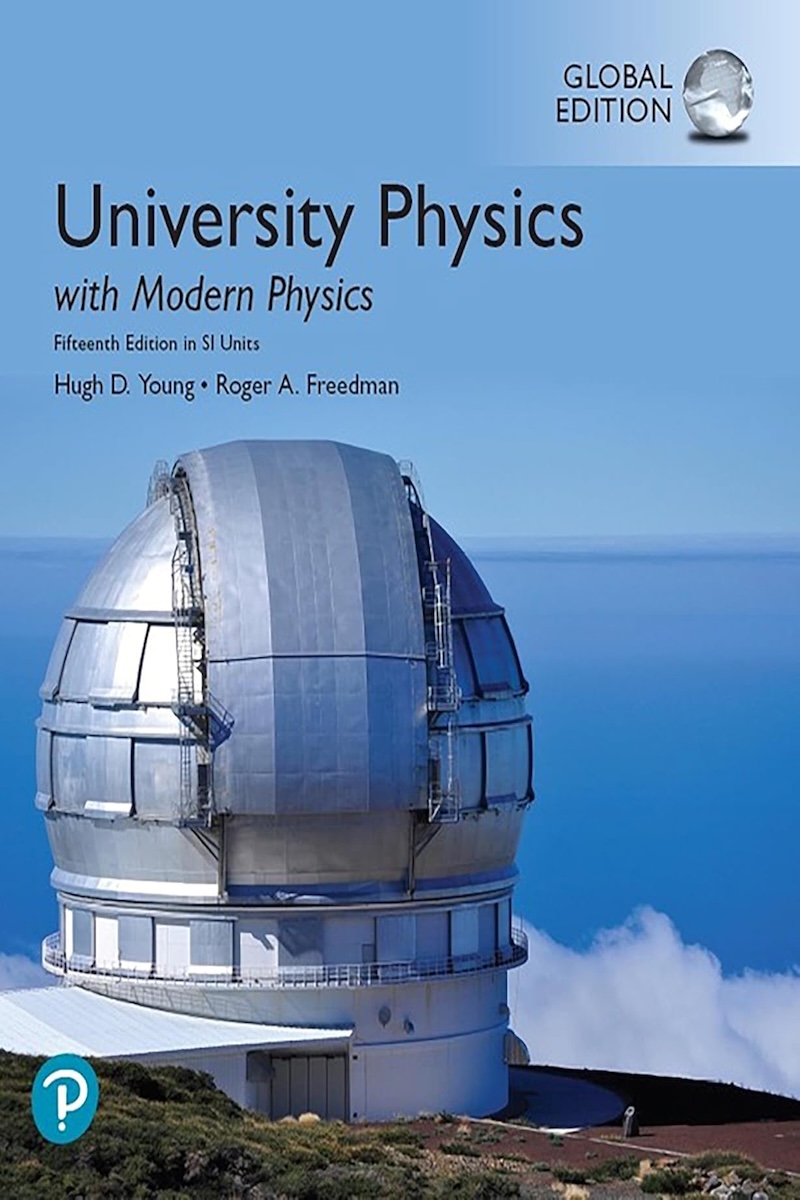
01 / Classic Textbook Recommendation
Classic Textbook Recommendation
Citation
Young, H. D., Freedman, R. A., & Ford, A. L. (2019). University Physics with Modern Physics (15th ed., SI Units). Pearson Education. ISBN 9781292317335
Chapter Summary
Chapter 1 – Units, Physical Quantities, and Vectors
Covers SI units, dimensional analysis, significant figures, and vector algebra.
Chapter 2 – Motion Along a Straight Line
Describes kinematic quantities—displacement, velocity, and acceleration—in one dimension.
Chapter 3 – Motion in Two or Three Dimensions
Analyzes projectile and circular motion; introduces relative velocity and acceleration components.
Chapter 4 – Newton’s Laws of Motion
Explains Newton’s laws, inertial frames, and applications of forces.
Chapter 5 – Applying Newton’s Laws
Covers friction, drag forces, uniform circular motion, and tension problems.
Chapter 6 – Work and Kinetic Energy
Defines work, power, and kinetic energy. Introduces the work–energy theorem.
Chapter 7 – Potential Energy and Energy Conservation
Introduces conservative forces, potential energy, and mechanical energy conservation.
Chapter 8 – Momentum, Impulse, and Collisions
Explores momentum, impulse, and conservation in collisions and systems.
Chapter 9 – Rotation of Rigid Bodies
Introduces angular velocity, angular acceleration, and rotational kinematics.
Chapter 10 – Dynamics of Rotational Motion
Explains torque, rotational inertia, rolling motion, and angular momentum.
Chapter 11 – Equilibrium and Elasticity
Covers static equilibrium, torque balance, and stress–strain in solids.
Chapter 12 – Fluid Mechanics
Discusses pressure, buoyancy, Bernoulli’s principle, and viscosity.
Chapter 13 – Gravitation
Covers Newton’s law of gravitation, satellite motion, and Kepler’s laws.
Chapter 14 – Periodic Motion
Analyzes harmonic oscillators, pendulums, damping, and resonance.
Chapter 15 – Mechanical Waves
Introduces wave properties, energy transport, and wave speed.
Chapter 16 – Sound and Hearing
Explains sound waves, Doppler effect, intensity, and resonance.
Chapter 17 – Temperature and Heat
Defines temperature scales, heat, and thermal expansion.
Chapter 18 – Thermal Properties of Matter
Covers specific heat, phase changes, and molecular motion.
Chapter 19 – The First Law of Thermodynamics
Applies energy conservation to thermodynamic systems and processes.
Chapter 20 – The Second Law of Thermodynamics
Introduces entropy, heat engines, Carnot cycles, and irreversibility.
Chapter 21 – Electric Charge and Electric Field
Covers Coulomb’s law, electric fields, and dipoles.
Chapter 22 – Gauss’s Law
Applies Gauss’s law to symmetric charge distributions.
Chapter 23 – Electric Potential
Defines electric potential, potential energy, and equipotential surfaces.
Chapter 24 – Capacitance and Dielectrics
Explores capacitors, dielectrics, and stored energy.
Chapter 25 – Current, Resistance, and Electromotive Force
Introduces current, resistance, Ohm’s law, and EMF.
Chapter 26 – Direct-Current Circuits
Covers Kirchhoff’s rules, RC circuits, and energy considerations.
Chapter 27 – Magnetic Field and Magnetic Forces
Explains magnetic forces on charges and currents.
Chapter 28 – Sources of Magnetic Field
Covers Biot–Savart law, Ampère’s law, and solenoids.
Chapter 29 – Electromagnetic Induction
Explains Faraday’s law, Lenz’s law, and motional emf.
Chapter 30 – Inductance
Covers self-inductance, mutual inductance, and RL circuits.
Chapter 31 – Alternating Current
Analyzes AC circuits, reactance, resonance, and power.
Chapter 32 – Electromagnetic Waves
Introduces Maxwell’s equations, wave properties, and spectrum.
Chapter 33 – The Nature and Propagation of Light
Describes light as an EM wave, polarization, and speed.
Chapter 34 – Geometric Optics
Explores reflection, refraction, lenses, mirrors, and optical instruments.
Chapter 35 – Interference
Covers double-slit interference, thin films, and coherence.
Chapter 36 – Diffraction
Explains diffraction patterns, gratings, and resolution limits.
Chapter 37 – Relativity
Introduces Einstein’s postulates, Lorentz transformations, and relativistic mechanics.
Key Concepts
Foundations of Physics
- Units, dimensions, and significant figures as the language of measurement.
- Vectors and calculus as the mathematical tools of physics.
Mechanics
- Kinematics: motion in 1D, 2D, and 3D; velocity and acceleration.
- Dynamics: Newton’s laws of motion and free-body diagrams.
- Work, kinetic energy, potential energy, and conservation of energy.
- Linear momentum, impulse, and collisions.
- Rotation: angular velocity, torque, rotational inertia, angular momentum.
- Equilibrium and elasticity in solids and structures.
- Gravitation: Newton’s law, Kepler’s laws, orbits, and satellites.
Oscillations and Waves
- Simple harmonic motion, damping, resonance, and energy in oscillators.
- Traveling and standing waves, superposition, and interference.
- Sound: Doppler effect, intensity, resonance, and hearing.
Fluid Mechanics
- Pressure, buoyancy, and Archimedes’ principle.
- Bernoulli’s principle and fluid dynamics.
- Viscosity, turbulence, and real-fluid effects.
Thermodynamics
- Temperature, thermal expansion, and molecular interpretation.
- Heat transfer: conduction, convection, radiation.
- First law of thermodynamics: conservation of energy in heat processes.
- Second law: entropy, irreversibility, heat engines, Carnot cycles.
Electricity and Magnetism
- Electrostatics: Coulomb’s law, electric fields, Gauss’s law, electric potential.
- Capacitance, dielectrics, and stored electric energy.
- Current, resistance, electromotive force, and circuit analysis.
- Magnetism: magnetic fields, forces, Biot–Savart law, Ampère’s law.
- Electromagnetic induction: Faraday’s law, Lenz’s law, motional emf.
- Inductance, AC circuits, resonance, and power.
- Maxwell’s equations and electromagnetic wave propagation.
Optics
- Light as an electromagnetic wave.
- Geometrical optics: reflection, refraction, lenses, mirrors, optical instruments.
- Wave optics: interference, diffraction, coherence, and polarization.
- Resolution limits and holography.
Relativity
- Einstein’s postulates of special relativity.
- Lorentz transformations, time dilation, length contraction, simultaneity.
- Relativistic momentum and energy.
Modern Physics
- Quantum foundations: blackbody radiation, photoelectric effect, Compton scattering.
- Schrödinger equation, uncertainty principle, and wave–particle duality.
- Atomic structure: hydrogen atom, quantum numbers, spin.
- Nuclear physics: radioactivity, fission, fusion, and binding energy.
- Particle physics: quarks, leptons, conservation laws, Standard Model.
- Cosmology: Big Bang, expansion of the universe, and fundamental interactions.
Critical Analysis
Strengths of the Text
- Comprehensive Scope: Covers mechanics, thermodynamics, electromagnetism, optics, relativity, and modern physics in a unified sequence.
- Pedagogical Structure: Clear explanations, worked examples, and problem-solving strategies guide students from fundamentals to advanced applications.
- Problem Sets: Large variety of end-of-chapter problems, ranging from conceptual checks to challenging quantitative exercises.
- Integration of Modern Physics: Relativity, quantum mechanics, nuclear and particle physics are incorporated alongside classical foundations.
- Consistency Across Volumes: Uniform style and progression across mechanics, E&M, and modern physics, making it adaptable for multi-semester courses.
Limitations and Challenges
- Mathematical Demands: Assumes strong calculus background; students without sufficient math preparation may struggle.
- Density of Content: Comprehensive coverage can overwhelm beginners; explanations sometimes prioritize conciseness over depth.
- Conceptual Emphasis: Less emphasis on intuitive, conceptual approaches compared to texts like Hewitt’s Conceptual Physics.
- Sheer Volume: Two large volumes can feel unwieldy, especially for shorter course sequences.
Position in the Curriculum
- Primary Undergraduate Text: Standard text for calculus-based physics courses in science and engineering programs.
- Preparation for Advanced Study: Builds foundations for specialized courses in mechanics, electromagnetism, quantum physics, and thermodynamics.
- Comparative Role: Sits between Halliday & Resnick (more concise) and Tipler & Mosca (more problem-heavy), striking a balance between rigor and accessibility.
Overall Evaluation
Young & Freedman’s University Physics remains a benchmark calculus-based physics textbook, widely adopted in universities worldwide. Its strength lies in blending clarity, breadth, and rigor, making it highly effective for preparing students in both science and engineering. While it can be mathematically demanding and dense, its pedagogical clarity and comprehensive problem sets make it one of the most enduring and versatile physics textbooks in higher education.
Real-World Applications and Examples
Mechanics
- Vehicle safety systems (airbags, crumple zones) explained using momentum conservation and impulse.
- Satellite orbits, GPS navigation, and space exploration based on Newtonian gravitation and relativity.
- Structural stability in bridges, skyscrapers, and cranes analyzed with torque and equilibrium principles.
Oscillations and Waves
- Resonance in buildings, bridges, and musical instruments.
- Seismology using wave interference and Doppler shifts to study earthquakes.
- Acoustic engineering in concert halls and noise reduction technologies.
Fluid Mechanics
- Hydraulic systems (brakes, lifts, syringes) based on Pascal’s principle.
- Aerodynamics in aircraft wing design and automotive engineering using Bernoulli’s principle.
- Biological fluid dynamics: blood circulation, air flow in lungs.
Thermodynamics
- Power plants, refrigerators, and heat pumps modeled with thermodynamic cycles.
- Efficiency limits of engines explained by the second law.
- Entropy concepts applied in climate science, information theory, and statistical mechanics.
Electricity and Magnetism
- Circuit theory underlying all electronics, computing, and power distribution.
- Electromagnetic induction in generators, transformers, and wireless charging.
- MRI and NMR in medicine using magnetic fields and nuclear spin.
Optics
- Eyeglasses, cameras, microscopes, and telescopes designed with lens and mirror equations.
- Interference in thin-film coatings for anti-reflective glasses and holography.
- Fiber optics for internet and telecommunications relying on total internal reflection.
Relativity
- GPS satellites requiring relativistic time corrections for navigation accuracy.
- High-energy particle accelerators designed with relativistic momentum and energy.
- Astrophysical phenomena such as black holes and gravitational lensing.
Modern Physics
- Quantum tunneling in semiconductor devices, nuclear fusion, and scanning tunneling microscopes.
- Lasers used in communication, medicine, and manufacturing.
- Nuclear fission powering reactors; nuclear fusion under research for sustainable energy.
- Particle accelerators (CERN, Fermilab) probing quarks and leptons.
- Cosmology: Big Bang theory, cosmic microwave background, and dark matter/energy research.