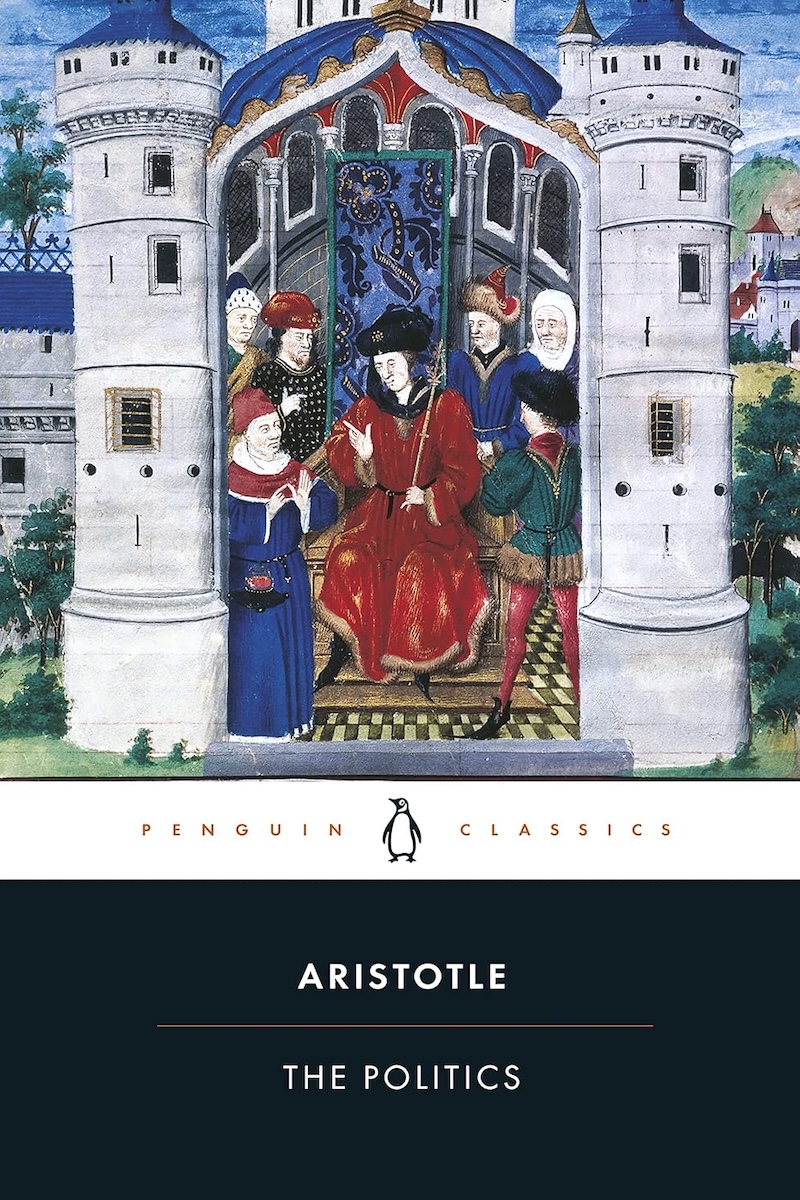
01 / Classic Textbook Recommendation
Classic Textbook Recommendation
Citation
Aristotle. (2013). Politics (C. Lord, Trans.). University of Chicago Press. (Original work published 4th century BCE).
Intellectual & Historical Context
Aristotle's Politics was written in the 4th century BCE during a period of political upheaval in the Greek world. Following his teacher Plato's death and his own departure from the Academy, Aristotle had the opportunity to observe various political systems firsthand, including his time as tutor to Alexander the Great and his residence in different Greek city-states.
The work emerges from Aristotle's broader philosophical project of systematic investigation into all areas of human knowledge. Unlike Plato's more idealistic approach in the Republic, Aristotle's method is empirical and practical, examining existing constitutions and political arrangements to understand what makes governments work effectively.
Writing during the decline of the classical polis system, Aristotle sought to preserve the wisdom of Greek political experience while addressing the challenges facing city-states in an increasingly complex world. His analysis draws on the study of 158 constitutions, making it one of the first works of comparative politics.
Thesis Statement
Aristotle argues that humans are naturally political animals who can achieve their highest potential only within properly organized political communities. He contends that the purpose of the state is to enable citizens to live well and virtuously, not merely to survive, and that the best constitution combines elements of democracy and oligarchy while being adapted to local circumstances.
Key Concepts
Polis (City-State)
The highest form of human community, existing for the sake of the good life rather than mere survival, where citizens can develop their full human potential.
Political Animal (Zoon Politikon)
Aristotle's famous declaration that humans are by nature political beings who require community life to achieve their essential nature and purposes.
Constitution (Politeia)
The arrangement of offices in a state and the fundamental structure that determines how power is distributed and exercised within the political community.
Citizenship
Active participation in the deliberative and judicial functions of the polis, distinguished from mere residence or economic activity within the community.
Rule of Law
The principle that law, rather than the arbitrary will of rulers, should govern political communities, providing stability and justice.
Mixed Constitution
Aristotle's preferred system that combines elements of democracy (rule by the many) and oligarchy (rule by the wealthy few) to create a stable middle way.
Practical Wisdom (Phronesis)
The intellectual virtue necessary for good political judgment and the ability to deliberate well about human affairs.
Common Good
The shared interests and welfare of the political community that should guide governance rather than the private interests of rulers.
Structure and Book Analysis
Book I: The Nature of the State
Chapters 1-2: The Polis as Natural Community
Aristotle establishes that the state is a natural entity that exists for the sake of the good life, arguing against the view that political association is merely conventional.
Chapters 3-8: Household Management and Economics
Analysis of the household as the basic unit of the polis, including discussions of slavery, property, and the relationship between economics and politics.
Chapters 9-13: Natural Slavery and Property
Controversial examination of slavery as a "natural" institution, property acquisition, and the relationship between household and state management.
Book II: Critique of Ideal States
Chapters 1-5: Plato's Republic
Systematic critique of Plato's proposals for community of property and family, arguing that such arrangements would destroy the bonds that hold society together.
Chapters 6-8: Plato's Laws and Other Utopias
Examination of other ideal state proposals, including those by Phaleas and Hippodamus, showing the practical difficulties of utopian schemes.
Chapters 9-12: Actual Constitutions
Analysis of existing constitutions like those of Sparta, Crete, and Carthage, extracting lessons about what works in practice.
Book III: Theory of the State and Citizenship
Chapters 1-5: The Nature of Citizenship
Definition of citizenship as participation in deliberative and judicial functions, distinguishing true citizenship from mere residence.
Chapters 6-8: Classification of Constitutions
The famous sixfold classification of constitutions: three correct forms (kingship, aristocracy, polity) and three deviant forms (tyranny, oligarchy, democracy).
Chapters 9-18: Justice and Political Legitimacy
Discussion of different conceptions of justice and their relationship to various forms of government, examining claims to political power.
Book IV: Varieties of Constitution
Chapters 1-10: Types of Democracy and Oligarchy
Detailed analysis of different species of democratic and oligarchic constitutions, showing the variety within each basic type.
Chapters 11-16: The Best Practicable Constitution
Introduction of the "polity" (politeia) as the best constitution for most states, combining democratic and oligarchic elements.
Book V: Constitutional Change and Revolution
Chapters 1-4: Causes of Constitutional Change
Systematic analysis of why constitutions fail and revolutions occur, examining both general causes and specific triggers.
Chapters 5-7: Revolution in Different Constitution Types
Specific analysis of how and why particular types of constitutions (democracy, oligarchy, aristocracy) experience revolutionary change.
Chapters 8-12: Methods of Constitutional Preservation
Practical advice for maintaining constitutional stability, including the importance of education, moderation, and addressing grievances.
Book VI: Democratic Constitutions
Chapters 1-8: Varieties of Democracy
Detailed examination of different types of democratic constitutions and the institutions appropriate to each type.
Book VII: The Ideal State
Chapters 1-3: The Best Life and Best Constitution
Discussion of what constitutes the best life for individuals and communities, linking personal and political virtue.
Chapters 4-12: Territory, Population, and Social Structure
Analysis of the practical requirements for an ideal state, including size, location, and the composition of the citizen body.
Chapters 13-17: Political Institutions of the Ideal State
Description of the governmental structure, military organization, and religious institutions of the best possible state.
Book VIII: Education in the Ideal State
Chapters 1-7: The Purpose and Content of Education
Examination of education as the key to creating and maintaining good constitutions, discussing what should be taught and how.
Key Arguments
The Natural Basis of Politics
Aristotle argues against the sophist view that political association is merely conventional, contending instead that humans are naturally political and that the state exists by nature.
The Purpose of the State
The state exists not merely for security or economic cooperation but to enable citizens to live well and develop their full human potential through virtuous activity.
Constitutional Relativism
No single constitution is best for all circumstances; the best constitution for any particular state depends on the character, resources, and circumstances of its people.
The Rule of Law vs. Rule of Men
Law should be supreme rather than any individual, as law embodies reason without passion, but law must be supplemented by prudent judgment in particular cases.
The Middle Way
The best practical constitution combines elements of democracy and oligarchy, avoiding the extremes of both while incorporating their respective strengths.
Education and Politics
Constitutional stability and good government depend fundamentally on the education of citizens in civic virtue and the requirements of their particular constitution.
Critical Analysis
Strengths
Aristotle provides the first systematic and empirical approach to political science, examining actual constitutions rather than relying solely on theoretical speculation. His classification of constitutions remains influential, and his attention to practical politics offers insights for real-world governance. The work's integration of ethics and politics provides a framework for thinking about the purposes of government.
Criticisms
Defense of Slavery: Aristotle's argument that slavery is "natural" is morally indefensible and reflects the prejudices of his time and social position.
Exclusion of Women: Women are largely excluded from political participation in Aristotle's scheme, limiting the universality of his political theory.
Limited Social Mobility: The static view of social classes and occupations doesn't account for the dynamic nature of modern societies.
Scale Limitations: The focus on small city-states may not apply to large, complex modern nation-states.
Cultural Specificity: Many arguments may reflect specifically Greek cultural assumptions rather than universal political truths.
Influence and Legacy
Medieval Political Thought
Aristotle's Politics was rediscovered in medieval Europe through Arabic translations, profoundly influencing thinkers like Thomas Aquinas and becoming central to scholastic political theory.
Constitutional Theory
The classification of government types and analysis of mixed constitutions influenced constitutional design from the Roman Republic through modern democratic systems.
Modern Political Science
Aristotle's empirical method and systematic approach to political analysis established the foundation for political science as an academic discipline.
American Founding
The framers of the American Constitution drew on Aristotelian insights about mixed government, separation of powers, and the dangers of both democracy and oligarchy.
Contemporary Relevance
Comparative Government
Aristotle's method of studying multiple constitutions remains central to comparative political analysis and constitutional design.
Democratic Theory
Contemporary debates about participatory democracy, civic education, and the relationship between economic and political power continue to engage with Aristotelian themes.
Political Development
Analysis of why governments succeed or fail, and how to maintain constitutional stability, remains relevant for understanding political development worldwide.
Civic Education
Aristotle's emphasis on education for citizenship continues to influence discussions about civic education and democratic participation.
Modern Applications
Constitutional Design
Constitutional framers continue to grapple with Aristotelian questions about how to balance different social groups and prevent the dominance of any single faction.
Political Stability
Aristotle's analysis of the causes of revolution and constitutional breakdown provides insights for understanding contemporary political crises.
Governance Theory
The relationship between law and prudential judgment in governance remains relevant for administrative law and public policy.
Citizenship Studies
Contemporary discussions of citizenship, civic virtue, and political participation draw heavily on Aristotelian foundations.
Criticisms and Debates
The Natural Slavery Problem
Modern scholars extensively debate how to interpret Aristotle's defense of slavery and whether it undermines his broader political theory.
Gender and Politics
Feminist scholars examine how Aristotle's exclusion of women affects his political theory and whether his framework can be extended to include gender equality.
Economic and Political Power
Contemporary debates about the relationship between economic inequality and democratic governance often reference Aristotelian insights about the dangers of extreme wealth concentration.
Scale and Complexity
Questions remain about how Aristotelian principles apply to modern mass democracies that far exceed the scale of ancient city-states.
Methodological Contributions
Empirical Political Science
Aristotle's systematic study of existing constitutions established the empirical method in political science, emphasizing observation and comparison.
Typological Analysis
The classification of constitutions and systematic comparison of government types became a standard method in political science.
Institutional Analysis
Focus on how political institutions actually function, rather than just how they should function in theory, influenced subsequent political analysis.
Relationship to Ethics
Political and Personal Virtue
Aristotle sees politics as the completion of ethics, with the state existing to enable individuals to develop and exercise moral virtue.
The Good Life
Political association is necessary for human flourishing, as individuals can achieve their full potential only within properly ordered communities.
Practical Wisdom in Governance
Good governance requires the same intellectual virtue (phronesis) that characterizes excellent individual moral decision-making.
Conclusion
Aristotle's Politics remains one of the most influential works in the history of political thought, establishing the foundation for systematic political analysis and constitutional theory. While some of its specific arguments reflect the limitations of ancient Greek society, its core insights about the nature of political community, the purposes of government, and the requirements for stable constitutions continue to inform contemporary political theory and practice.
The work's greatest contribution may be its recognition that politics is both a practical art requiring prudential judgment and a moral enterprise aimed at human flourishing. Aristotle's integration of empirical observation with normative reflection provides a model for political science that remains relevant for understanding contemporary challenges in governance, citizenship, and constitutional design.
In an era of democratic crisis and constitutional stress, Aristotle's emphasis on civic education, mixed government, and the rule of law offers enduring insights. His recognition that different constitutions suit different circumstances, combined with his analysis of what makes governments stable or unstable, provides valuable guidance for anyone seeking to understand or improve political institutions.