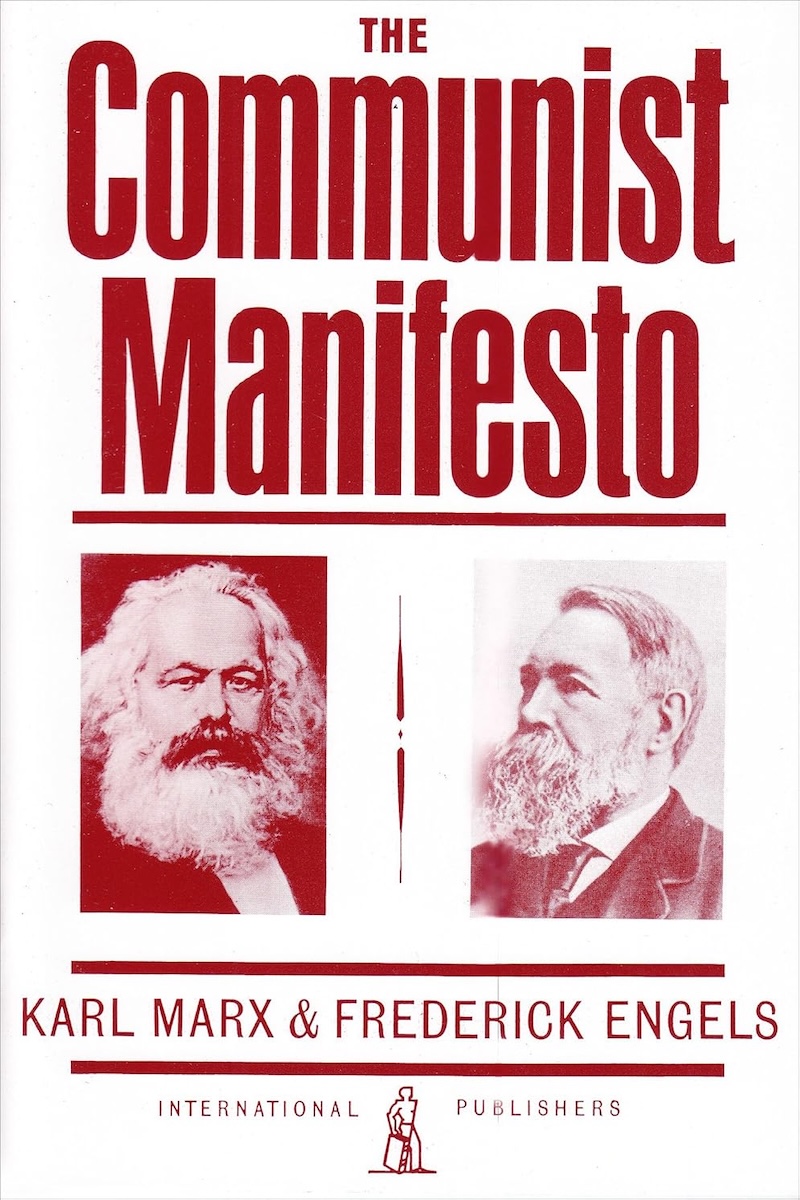
01 / Classic Textbook Recommendation
Classic Textbook Recommendation
Citation
Marx, K., & Engels, F. (2002). The Communist Manifesto (G. Stedman Jones, Ed.). Penguin Classics. (Original work published 1848).
Intellectual & Historical Context
The Communist Manifesto was written in 1847-1848 by Karl Marx and Friedrich Engels, commissioned by the Communist League, a secret international association of workers. Published in London in February 1848, it appeared just as revolutionary movements were erupting across Europe in what became known as the "Spring of Nations."
The manifesto emerged from the intellectual ferment of 19th-century Europe, where rapid industrialization was creating new social classes and unprecedented urban poverty. Marx and Engels drew on German philosophy (particularly Hegel's dialectical method), French socialism (especially the works of Saint-Simon and Fourier), and English political economy (notably Adam Smith and David Ricardo) to develop their revolutionary theory.
The work represents the culmination of Marx's early philosophical development, moving from his critique of religion and the state to a materialist analysis of economic relations. It was written for a popular audience, intended as a clear and accessible statement of communist principles rather than a detailed theoretical treatise.
Thesis Statement
Marx and Engels argue that all of human history is fundamentally the history of class struggle between oppressor and oppressed classes. Under capitalism, this struggle has reached its final stage between the bourgeoisie (owners of capital) and the proletariat (wage workers). The inherent contradictions of capitalism will inevitably lead to its overthrow by the working class, establishing a classless, communist society where the means of production are collectively owned.
Key Concepts
Class Struggle
The central driving force of historical change, where economically defined classes with opposing interests engage in conflict. Marx and Engels argue this struggle is the "motor of history."
Historical Materialism
The theory that economic relations and the mode of production form the base of society, determining political, legal, and cultural institutions (the "superstructure").
Bourgeoisie
The capitalist class who own the means of production (factories, land, capital) and purchase labor power from workers to generate profit.
Proletariat
The working class who own only their labor power and must sell it to the bourgeoisie to survive. They are the revolutionary class destined to overthrow capitalism.
Alienation
The process by which workers become estranged from their labor, products, fellow workers, and human essence under capitalist production.
Surplus Value
The value created by workers beyond what they are paid in wages, which is appropriated by capitalists as profit.
Revolution
The violent overthrow of the capitalist system by the organized proletariat, necessary because the ruling class will not voluntarily surrender power.
Communism
The final stage of historical development characterized by collective ownership of the means of production, abolition of class distinctions, and the withering away of the state.
Structure and Chapter Summaries
I. Bourgeois and Proletarians
This opening section presents Marx and Engels' materialist conception of history, arguing that "the history of all hitherto existing society is the history of class struggles."
Historical Development of Class Relations
The authors trace the evolution of class systems from ancient slavery through feudalism to modern capitalism, showing how each epoch contains the seeds of its own destruction.
The Rise of the Bourgeoisie
Marx and Engels describe how the bourgeoisie emerged from the medieval bourgeois class, breaking feudal chains through commercial expansion, technological innovation, and political revolution.
Creation of the Proletariat
Capitalism's development concentrates workers in factories, creating a class-conscious proletariat that will eventually unite across national boundaries.
Contradictions of Capitalism
The system's need for constant expansion and competition leads to periodic crises of overproduction, increasing immiseration of workers, and growing class polarization.
II. Proletarians and Communists
This section clarifies the relationship between the communist movement and the broader working-class struggle.
The Role of Communists
Communists are not a separate party but the most advanced section of the working class, providing theoretical clarity and international perspective to the movement.
Immediate Aims
The immediate goal is the overthrow of bourgeois supremacy and the conquest of political power by the proletariat.
Property Relations
Marx and Engels address bourgeois criticisms of communist property proposals, arguing that private property already exists only for the ruling class while workers own nothing.
Response to Objections
The authors systematically refute common objections to communism, including claims about the abolition of family, nationality, and culture.
III. Socialist and Communist Literature
This section provides a critical analysis of various socialist and communist theories competing with Marx and Engels' approach.
Reactionary Socialism
Feudal Socialism: Aristocratic attempts to use socialist rhetoric against the bourgeoisie while defending feudal privilege.
Petty-Bourgeois Socialism: Small-scale producers' critique of capitalism that seeks to return to pre-industrial conditions.
German or "True" Socialism: Abstract philosophical socialism divorced from material conditions and political struggle.
Conservative or Bourgeois Socialism
Middle-class attempts to reform capitalism while preserving its essential features and their own privileged position.
Critical-Utopian Socialism and Communism
Respect for early socialists like Saint-Simon and Fourier while criticizing their utopian approach and rejection of class struggle.
IV. Position of the Communists in Relation to the Various Existing Opposition Parties
The final section outlines communist strategy and tactics for different national contexts.
International Strategy
Communists support democratic and revolutionary movements while maintaining their ultimate goal of proletarian revolution.
National Contexts
Specific analysis of conditions in Germany, France, and other European countries, advocating tactical alliances with progressive bourgeois forces where necessary.
Revolutionary Unity
Call for international working-class solidarity and coordination across national boundaries.
Key Quotes
The history of all hitherto existing society is the history of class struggles.
This opening statement encapsulates the materialist conception of history that underlies Marxist theory.
The bourgeoisie, during its rule of scarce one hundred years, has created more massive and more colossal productive forces than have all preceding generations together.
Acknowledgment of capitalism's revolutionary productive potential while critiquing its social relations.
What the bourgeoisie therefore produces, above all, are its own grave-diggers. Its fall and the victory of the proletariat are equally inevitable.
The prediction that capitalism creates the conditions for its own overthrow through the development of the working class.
Workers of the world, unite! You have nothing to lose but your chains.
The famous rallying cry concluding the manifesto, emphasizing international solidarity and revolutionary potential.
Significance & Impact
The Communist Manifesto became one of the most influential political documents in history:
Revolutionary Movements: Inspired socialist and communist parties worldwide, from the Paris Commune to the Russian Revolution.
Labor Organization: Provided theoretical foundation for trade unions and working-class political movements.
Anti-Colonial Struggles: Influenced liberation movements in Asia, Africa, and Latin America during decolonization.
Social Theory: Established class analysis as a central tool in sociology, history, and political science.
Economic Critique: Pioneered systematic critique of capitalism that continues to influence economic theory.
Critical Analysis
Strengths
Marx and Engels provide a powerful analytical framework for understanding social change and economic development. Their emphasis on material conditions and class relations offers insights into power structures and inequality. The work's clear, accessible style made complex ideas available to working-class audiences.
Criticisms
Economic Determinism: Critics argue Marx and Engels overemphasize economic factors while underestimating the autonomy of politics, culture, and ideas.
Class Reductionism: The focus on class struggle may obscure other important social divisions based on race, gender, nationality, or religion.
Revolutionary Predictions: The predicted inevitable collapse of capitalism and worldwide proletarian revolution have not materialized as expected.
Democratic Deficits: The text provides little discussion of democratic institutions or protection of individual rights in post-revolutionary society.
Historical Validation and Refutation
Validated Predictions: Many observations about capitalism's tendencies toward concentration, crisis, and globalization proved accurate.
Failed Predictions: The immiseration thesis, inevitable revolution in advanced capitalist countries, and the withering away of the state under socialism did not occur as predicted.
Influence on Later Thinkers
Vladimir Lenin developed Marx's ideas into a theory of imperialism and revolutionary party organization.
Antonio Gramsci expanded Marxist analysis to include cultural hegemony and the role of ideas in maintaining power.
Georg Lukács explored the relationship between class consciousness and revolutionary potential.
Louis Althusser attempted to develop a more scientific Marxism emphasizing structural analysis over humanism.
Frankfurt School thinkers like Herbert Marcuse critiqued both capitalism and existing socialism while maintaining Marxist insights.
Contemporary Relevance
Economic Inequality
Marx and Engels' analysis of capitalism's tendency to concentrate wealth remains relevant to contemporary discussions of inequality and economic crisis.
Labor Relations
Their insights into the relationship between capital and labor continue to inform debates about workers' rights, automation, and the gig economy.
Globalization
The manifesto's discussion of capitalism's international expansion anticipates many features of contemporary globalization.
Environmental Crisis
Some scholars apply Marxist analysis to environmental problems, arguing that capitalism's growth imperative conflicts with ecological sustainability.
Social Movements
Contemporary movements often draw on Marxist concepts of class struggle while expanding analysis to include other forms of oppression.
Real-World Applications
Socialist Experiments
The manifesto influenced various attempts to build socialist societies, from the Soviet Union to Cuba, China, and Yugoslavia, with varying degrees of success and failure.
Social Democratic Parties
European social democratic parties adopted many Marxist insights while pursuing parliamentary rather than revolutionary change.
Development Theory
Post-colonial theorists used Marxist analysis to understand relationships between developed and developing countries.
Labor Movements
Trade unions worldwide have drawn on Marxist ideas about collective action and class solidarity.
Modern Interpretations
Post-Marxism
Thinkers like Ernesto Laclau and Chantal Mouffe maintain Marxist insights about power and struggle while rejecting economic determinism and class essentialism.
Analytical Marxism
Scholars like Jon Elster and John Roemer use modern social science methods to test and refine Marxist propositions.
Cultural Marxism
Focus on ideology, culture, and consciousness as sites of struggle, influenced by Gramsci and the Frankfurt School.
Feminist Marxism
Integration of gender analysis with class analysis, examining the intersection of patriarchal and capitalist oppression.
Ecological Marxism
Application of Marxist methods to environmental issues, examining capitalism's relationship to ecological crisis.
Criticisms and Debates
Liberal Critiques
Individual Rights: Liberals argue that Marxism insufficiently protects individual liberty and democratic institutions.
Market Efficiency: Defenders of capitalism contend that markets allocate resources more efficiently than planned economies.
Empirical Failures: Critics point to the collapse of communist regimes and persistent inequality in socialist countries.
Socialist Critiques
Democratic Socialism: Some socialists argue for gradual, democratic transition rather than revolutionary overthrow.
Market Socialism: Others propose combining socialist ownership with market mechanisms.
Post-Colonial Critiques
Eurocentrism: Critics argue that Marxism reflects European historical experience and may not apply universally.
Cultural Imperialism: Some view Marxist internationalism as potentially suppressing local cultures and traditions.
Conclusion
The Communist Manifesto remains a foundational text in political theory and social analysis. While many of its specific predictions proved incorrect, its core insights about capitalism, class relations, and social change continue to influence contemporary thought and political practice.
The manifesto's greatest contribution may be its analytical method rather than its specific conclusions. Marx and Engels' emphasis on material conditions, class struggle, and historical change provides tools for understanding power relations and social transformation that remain relevant regardless of one's position on communist revolution.
In our current era of growing inequality, economic crisis, and social unrest, the manifesto's analysis of capitalism's contradictions and its call for international working-class solidarity resonates with new urgency. Whether one agrees with its revolutionary conclusions or not, engagement with its arguments remains essential for understanding both the development of modern political thought and the challenges facing contemporary societies.
The text's influence extends far beyond those who explicitly embrace Marxism, shaping how we think about economics, politics, history, and social change. Its combination of rigorous analysis with passionate commitment to social justice continues to inspire movements for equality and human liberation around the world.