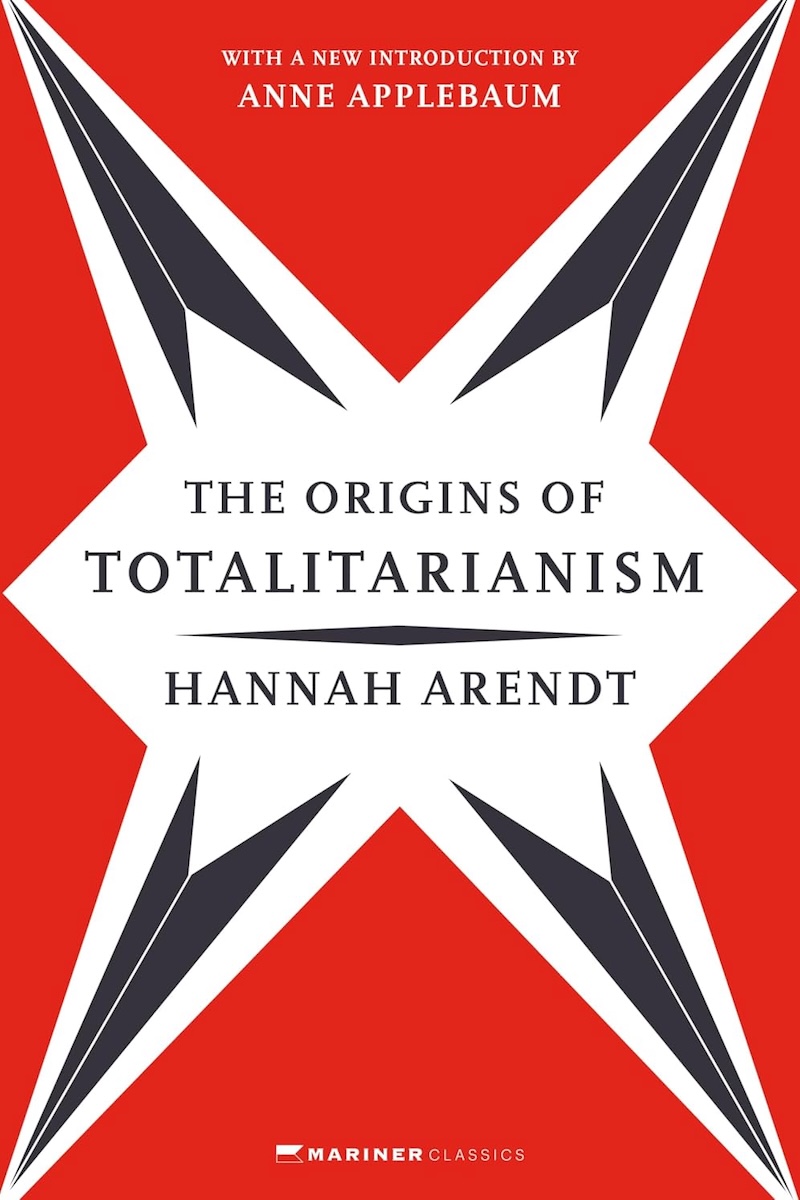
01 / Classic Textbook Recommendation
Classic Textbook Recommendation
Citation
Arendt, H. (1973). The Origins of Totalitarianism. Harcourt Brace Jovanovich. (Original work published 1951).
Intellectual & Historical Context
The Origins of Totalitarianism was written in the immediate aftermath of World War II and published in 1951, as the world was coming to terms with the unprecedented horrors of Nazi Germany and the emerging threat of Stalinist Russia. Arendt, a German-Jewish political theorist who fled Nazi Germany in 1933, brought both personal experience and scholarly rigor to understanding the phenomenon of totalitarianism.
Writing during the early Cold War period, Arendt challenged conventional political categories by arguing that Nazi Germany and Soviet Russia represented not opposing ideologies but rather two manifestations of the same novel form of government. Her work emerged from her conviction that traditional political theory was inadequate to explain these unprecedented regimes.
Arendt's analysis was influenced by her studies of anti-Semitism, her observations of statelessness and rightlessness during the interwar period, and her understanding of how European imperialism had created new forms of domination. The work represents an attempt to understand how civilized European societies could produce such radical evil.
Thesis Statement
Arendt argues that totalitarianism represents a completely novel form of government that destroys the political sphere and reduces human beings to their biological existence through terror and ideology. She contends that totalitarianism emerged from three interconnected historical phenomena: the political mobilization of anti-Semitism, European imperialism's creation of new forms of domination, and the breakdown of traditional class structures into atomized masses vulnerable to totalitarian movements.
Key Concepts
Totalitarianism
A novel form of government that differs fundamentally from traditional tyranny or despotism by seeking to eliminate politics entirely and reduce humans to predictable biological functions.
Radical Evil
Arendt's adaptation of Kant's concept to describe the unprecedented nature of totalitarian crimes that cannot be understood through traditional categories of wickedness or sin.
Superfluous People
Individuals made "superfluous" by totalitarian regimes, stripped of their humanity and political existence, often leading to their systematic elimination.
The Mob
The declassed masses created by the breakdown of traditional social structures, distinguished from "the people" by their lack of political organization and susceptibility to totalitarian appeals.
Ideology
Totalitarian movements' use of pseudo-scientific explanations of reality that claim to reveal the hidden logic of history and justify any action in service of historical necessity.
Terror
The systematic use of violence not merely to eliminate enemies but to create a state of constant fear that makes independent thought and action impossible.
Rightlessness
The condition of people without citizenship or legal protection, making them vulnerable to arbitrary power and persecution.
Loneliness
The fundamental experience of isolation that makes individuals susceptible to totalitarian movements by destroying their capacity for political action and independent judgment.
Structure and Part Analysis
Part I: Antisemitism
Chapter 1: A Reply to Critics
Arendt's response to early criticisms and clarification of her analytical approach, emphasizing that she seeks to understand, not explain away, totalitarianism.
Chapter 2: The Jews and Society
Analysis of how Jewish emancipation in the 19th century led to new forms of anti-Semitism as Jews became both more visible and more vulnerable in European society.
Chapter 3: The Jews and the State
Examination of the relationship between Jewish communities and European nation-states, showing how the decline of the nation-state system exposed Jews to new dangers.
Chapter 4: The Dreyfus Affair
Detailed analysis of the Dreyfus Affair as a harbinger of modern anti-Semitism and a preview of totalitarian methods of destroying political institutions.
Part II: Imperialism
Chapter 5: The Political Emancipation of the Bourgeoisie
Analysis of how the expansion of capitalism beyond national boundaries undermined traditional political structures and created new forms of domination.
Chapter 6: Race-Thinking Before Racism
Examination of how 18th and 19th-century race theories developed into the ideological foundations for later totalitarian movements.
Chapter 7: Race and Bureaucracy
Analysis of colonial administration and the development of bureaucratic rule that would later characterize totalitarian governments.
Chapter 8: Continental Imperialism
Study of pan-movements (Pan-Germanism and Pan-Slavism) as precursors to totalitarian movements, showing how they transcended national boundaries and traditional political categories.
Part III: Totalitarianism
Chapter 9: A Classless Society
Analysis of how the breakdown of traditional class structures created atomized masses susceptible to totalitarian appeals.
Chapter 10: The Temporary Alliance Between the Mob and the Elite
Examination of how totalitarian movements initially gained support by appealing to both declassed masses and disaffected intellectuals.
Chapter 11: The Totalitarian Movement
Analysis of the structure and methods of totalitarian movements before they achieve power, including their use of propaganda and organization.
Chapter 12: Totalitarianism in Power
Detailed examination of how totalitarian governments function, including their use of terror, ideology, and bureaucratic organization.
Chapter 13: Ideology and Terror as Instruments of Total Domination
Analysis of how totalitarian regimes use ideology and terror to destroy human spontaneity and reduce people to predictable biological functions.
Key Arguments
Novelty of Totalitarianism
Arendt argues that totalitarianism represents something fundamentally new in human history, not merely an extreme form of traditional tyranny or despotism.
The Destruction of Politics
Totalitarian regimes seek to eliminate the public sphere and reduce all human activity to private, biological existence, destroying the possibility of political action.
The Role of Ideology
Totalitarian movements use ideological thinking to replace common sense and experience, creating closed systems of thought that justify any action.
Terror as Governance
Unlike traditional tyrannies that use terror to eliminate enemies, totalitarian regimes use terror as a permanent feature of governance to prevent any independent action.
The Importance of Plurality
Arendt emphasizes that human plurality and the capacity for new beginnings are what totalitarian regimes seek to destroy through their reduction of humans to biological functions.
Modern Conditions for Totalitarianism
The breakdown of traditional social structures, the creation of stateless populations, and the development of modern bureaucratic and technological capabilities created unprecedented conditions for totalitarian domination.
Critical Analysis
Strengths
Arendt provides a penetrating analysis of totalitarianism that recognizes its unprecedented nature and refuses to normalize it through conventional political categories. Her insights into the relationship between loneliness, ideology, and political destruction remain influential. The work's interdisciplinary approach illuminates connections between seemingly disparate historical phenomena.
Criticisms
Historical Accuracy: Some historians question Arendt's historical claims, particularly her analysis of imperialism and anti-Semitism, arguing that she sometimes subordinates historical accuracy to theoretical consistency.
Conceptual Problems: Critics argue that Arendt's definition of totalitarianism is too restrictive and that her distinction between totalitarian and authoritarian regimes is problematic.
Limited Scope: The focus on Nazi Germany and Stalinist Russia may not capture the full range of authoritarian and totalitarian experiences worldwide.
Theoretical Coherence: Some scholars argue that the three parts of the book are not well integrated and that the connections between anti-Semitism, imperialism, and totalitarianism are not convincingly established.
Influence and Legacy
Political Science
Arendt's work fundamentally shaped the field of comparative authoritarianism and continues to influence studies of democratic breakdown and authoritarian consolidation.
Holocaust Studies
The concept of "radical evil" and "superfluous people" became central to understanding the Holocaust and other genocides.
Human Rights Theory
Arendt's analysis of rightlessness and statelessness influenced the development of human rights law and refugee protection.
Democratic Theory
Her insights into the fragility of democratic institutions and the conditions that make totalitarianism possible remain relevant for contemporary democratic theory.
Contemporary Relevance
Authoritarianism Studies
Contemporary scholars of authoritarianism draw on Arendt's insights to understand modern authoritarian movements and their appeal to mass populations.
Digital Age Concerns
Arendt's analysis of propaganda and ideology resonates with contemporary concerns about misinformation, social media manipulation, and the breakdown of shared reality.
Refugee Crises
Her analysis of statelessness and rightlessness remains relevant for understanding contemporary refugee crises and immigration debates.
Democratic Backsliding
Arendt's warnings about the fragility of democratic institutions speak to contemporary concerns about democratic erosion and the rise of populist movements.
Modern Applications
Comparative Authoritarianism
Scholars use Arendt's framework to analyze contemporary authoritarian regimes and movements, examining how they differ from traditional forms of authoritarianism.
Genocide Studies
The concepts of "radical evil" and systematic dehumanization inform contemporary understanding of genocide and crimes against humanity.
Political Psychology
Arendt's insights into loneliness, ideology, and mass behavior influence research on political psychology and the appeal of extremist movements.
International Relations
Her analysis of imperialism and the breakdown of the nation-state system informs contemporary debates about globalization and international governance.
Criticisms and Debates
Historical Methodology
Historians debate whether Arendt's approach is sufficiently empirical or whether she imposes theoretical frameworks on historical evidence.
Conceptual Clarity
Political scientists question whether Arendt's concepts are precise enough for systematic analysis and whether they can be operationalized for comparative research.
Geographical Scope
Critics argue that Arendt's focus on European experiences limits the global applicability of her insights about totalitarianism.
Gender and Race
Feminist and postcolonial scholars examine how Arendt's analysis may reflect particular perspectives that overlook other forms of domination and resistance.
The Banality of Evil
While not extensively developed in The Origins of Totalitarianism, Arendt's later concept of the "banality of evil" (developed during the Eichmann trial) complements her analysis by showing how ordinary people can become complicit in radical evil through thoughtlessness and bureaucratic routine.
Philosophical Implications
Human Condition
Arendt's analysis of totalitarianism is connected to her broader understanding of the human condition and the importance of political action for human dignity.
Political vs. Social
Her distinction between the political and social spheres influenced subsequent political theory by highlighting the unique character of political action.
Natality
Arendt's concept of natality - the human capacity for new beginnings - stands in opposition to totalitarian attempts to make human behavior predictable.
Contemporary Warnings
Technology and Control
Arendt's insights about bureaucratic administration and control mechanisms resonate with contemporary concerns about surveillance technology and digital authoritarianism.
Mass Society
Her analysis of the breakdown of traditional communities and the creation of atomized masses speaks to contemporary concerns about social fragmentation and political polarization.
Ideological Thinking
Arendt's warnings about the dangers of ideological thinking remain relevant in an era of political polarization and conspiracy theories.
Conclusion
The Origins of Totalitarianism remains one of the most important works of 20th-century political thought, providing essential insights into the nature of unprecedented forms of political domination. While some of Arendt's historical claims have been disputed, her theoretical framework for understanding totalitarianism continues to influence political science, philosophy, and human rights discourse.
The work's enduring significance lies in its recognition that totalitarianism represents something fundamentally new in human experience that cannot be understood through traditional political categories. Arendt's emphasis on the importance of political action, human plurality, and the dangers of ideological thinking provides crucial guidance for understanding contemporary threats to democratic institutions.
In an era of rising authoritarianism, democratic backsliding, and technological surveillance, Arendt's warnings about the conditions that make totalitarianism possible remain disturbingly relevant. Her work serves as both a historical analysis of past horrors and a continuing warning about the fragility of human dignity and political freedom.