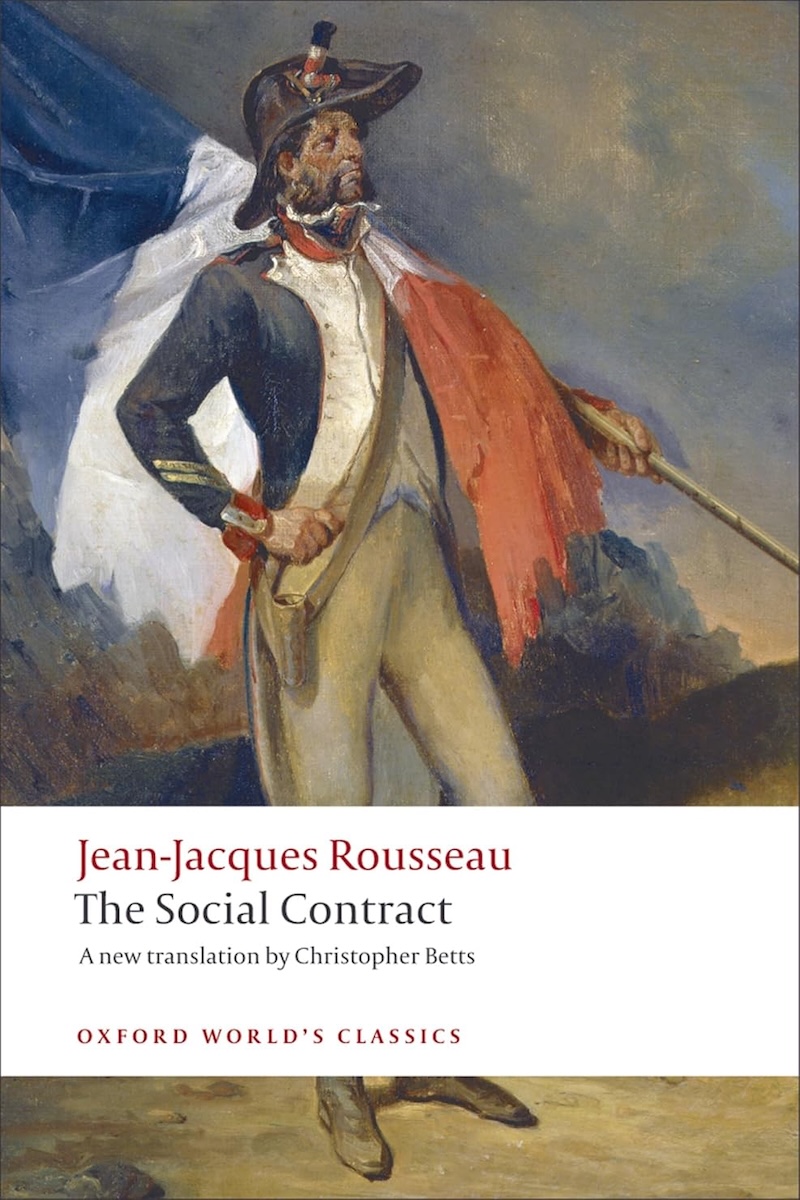
01 / Classic Textbook Recommendation
Classic Textbook Recommendation
Citation
Rousseau, J.-J. (1997). The Social Contract and Other Later Political Writings (V. Gourevitch, Ed. & Trans.). Cambridge University Press. (Original work published 1762).
Intellectual & Historical Context
The Social Contract was published in 1762, during the height of the Enlightenment, when traditional forms of political authority were being questioned across Europe. Written just before the outbreak of the American Revolution and a generation before the French Revolution, Rousseau's work provided theoretical foundations for democratic movements that would reshape the political landscape.
Rousseau wrote as both a critic of existing political arrangements and a theorist of legitimate government. Unlike Hobbes, who argued for absolute sovereignty to escape the state of nature, and Locke, who emphasized individual rights and limited government, Rousseau sought to reconcile individual freedom with collective authority through the concept of the general will.
The work emerged from Rousseau's broader philosophical project examining the origins of inequality and corruption in human society. Having argued in his Discourse on Inequality that private property and social competition had corrupted natural human goodness, Rousseau now sought to design political institutions that could restore moral community while preserving the benefits of civilization.
Thesis Statement
Rousseau argues that legitimate political authority can only arise from a social contract in which individuals unite to form a collective body governed by the "general will." This general will represents the common good and provides the only legitimate basis for political obligation. Through this arrangement, individuals can remain free while submitting to political authority, because they obey only laws they have given themselves as members of the sovereign people.
Key Concepts
The General Will (Volonté Générale)
The collective will of the people when they act as citizens concerned with the common good rather than their private interests. Unlike the "will of all" (which is merely the sum of individual wills), the general will aims at what is best for the community as a whole.
Popular Sovereignty
The principle that ultimate political authority resides in the people as a whole. The sovereign people cannot transfer or alienate this authority to representatives or monarchs.
The Social Contract
The agreement by which individuals surrender their natural freedom and join together to form a political community. Unlike other contract theorists, Rousseau argues this creates a moral transformation in participants.
Civil Liberty vs. Natural Liberty
Natural liberty is the unlimited freedom to pursue one's desires, limited only by physical power. Civil liberty is freedom within the constraints of law, but it is accompanied by moral liberty—the capacity to act according to reason and duty rather than mere impulse.
The Legislator
A quasi-mythical figure who provides the fundamental laws and institutions for a new political community. The legislator must possess extraordinary wisdom and moral authority but cannot hold political power.
Government vs. Sovereignty
Rousseau distinguishes sharply between the sovereign (the people) and the government (the administrative body that executes the general will). Government is merely the agent of the sovereign and can be changed at will.
Chapter Summaries
Book I: The Foundation of Political Society
Chapter 1: Subject of This Work
Rousseau poses the fundamental question: "Man is born free, and everywhere he is in chains. How did this happen and what makes it legitimate?"
Chapter 2-5: Early Forms of Society
Critique of theories that derive political authority from natural hierarchy, paternal authority, or force. True political authority must be based on convention.
Chapter 6: The Social Pact
The famous chapter outlining the terms of the social contract: "Each of us puts his person and all his power in common under the supreme direction of the general will."
Chapter 7-9: The Sovereign and Civil State
Description of how the social contract creates both the sovereign people and transforms individuals from natural beings into citizens and moral agents.
Book II: Sovereignty and the General Will
Chapter 1-2: Sovereignty and Its Limits
Sovereignty is inalienable, indivisible, and always right when it expresses the true general will. However, it can only legislate on matters of general concern.
Chapter 3-4: Whether the General Will Can Err
The general will is always right, but the people may be deceived about what the general will requires. Distinction between the general will and the will of all.
Chapter 5-6: The Right of Life and Death
The sovereign has the right to demand citizens' lives for the defense of the state, but this right has strict limits.
Chapter 7-12: Law and the Legislator
Laws must be general in form and content. The role of the extraordinary legislator in providing fundamental institutions.
Book III: Forms of Government
Chapter 1-9: Government Structure
Analysis of different forms of government (democracy, aristocracy, monarchy) as administrative bodies serving the sovereign people.
Chapter 10-18: Degeneration and Dissolution
How governments tend to usurp sovereignty and the conditions under which political bodies dissolve.
Book IV: Political Institutions
Chapter 1-2: The General Will and Voting
How the general will is expressed through voting and the conditions for its proper functioning.
Chapter 3-4: Elections and Popular Assemblies
The importance of regular assemblies for maintaining popular sovereignty.
Chapter 5-8: Historical Examples
Discussion of Roman institutions, particularly the tribunate and dictatorship, as models of popular government.
Chapter 9: Civil Religion
Rousseau's controversial proposal for a civil religion to promote civic virtue and social unity.
Key Quotes
Man is born free, and everywhere he is in chains. One who believes himself the master of others is nonetheless a greater slave than they.
The famous opening line that encapsulates Rousseau's central concern with legitimate political authority.
Each of us puts his person and all his power in common under the supreme direction of the general will, and in a body we receive each member as an indivisible part of the whole.
The fundamental terms of the social contract that creates both individual citizenship and collective sovereignty.
Whoever refuses to obey the general will shall be constrained to do so by the entire body: which means nothing other than that he shall be forced to be free.
The paradoxical but important claim that true freedom consists in obedience to laws one has given oneself as a citizen.
The general will is always right and always tends toward the public utility.
Rousseau's controversial claim about the infallibility of the properly constituted general will.
Significance & Impact
The Social Contract profoundly influenced democratic theory and practice:
Democratic Revolutions: The work provided theoretical foundations for the American and French Revolutions, particularly concepts of popular sovereignty and legitimate resistance to tyranny.
Constitutional Theory: Rousseau's ideas about the constituent power of the people influenced modern constitutional thinking about how political communities can legitimately create fundamental law.
Democratic Theory: The concept of the general will became central to subsequent democratic theory, influencing thinkers from Kant to Marx to contemporary deliberative democrats.
Nationalism: Rousseau's emphasis on shared citizenship and common identity contributed to the development of modern nationalism.
Totalitarian Critique: Critics have argued that Rousseau's general will concept provides justification for totalitarian democracy and the suppression of individual rights.
Critical Analysis
Strengths
Rousseau addresses the fundamental problem of political philosophy: how to reconcile individual freedom with collective authority. His concept of the general will provides a sophisticated framework for understanding democratic legitimacy that goes beyond mere majority rule. The work successfully challenges both traditional authority and pure individualism.
Criticisms
The General Will Problem: Critics argue that the concept of the general will is either meaningless (how do we know what it is?) or dangerous (it can justify suppressing dissent in the name of the "true" popular will).
Scale and Complexity: Rousseau's model seems to require small, homogeneous communities with direct democratic participation, making it unsuitable for modern large-scale societies.
Individual Rights: The work provides insufficient protection for individual rights against democratic majorities, potentially justifying what Tocqueville would later call "tyranny of the majority."
Representation: Rousseau's rejection of political representation creates practical difficulties for implementing popular sovereignty in complex modern societies.
Liberal vs. Republican Interpretations
Liberal Reading: Emphasizes Rousseau's concern with individual freedom and sees the general will as a constraint on government power.
Republican Reading: Emphasizes civic participation and the transformation of individuals into virtuous citizens through political engagement.
Totalitarian Reading: Critics like J.L. Talmon argue that Rousseau's concepts justify "totalitarian democracy" where the state claims to embody the people's true will.
Influence on Later Thinkers
Immanuel Kant drew on Rousseau's insights about moral autonomy and the categorical imperative as self-legislation.
G.W.F. Hegel developed Rousseau's ideas about the relationship between individual and community in his concept of Sittlichkeit (ethical life).
Karl Marx praised Rousseau's critique of private property and inequality while criticizing his idealistic approach to political reform.
John Stuart Mill engaged critically with Rousseau's democratic theory while developing his own thoughts on representative government and individual liberty.
Contemporary Deliberative Democrats like Jürgen Habermas and Joshua Cohen draw on Rousseauian themes about democratic discourse and the common good.
Contemporary Relevance
Democratic Participation
Rousseau's emphasis on active citizenship resonates with contemporary concerns about political apathy and the need for meaningful democratic participation.
Populism and the General Will
Modern populist movements often invoke concepts similar to Rousseau's general will, claiming to represent the "true" will of the people against corrupt elites.
Deliberative Democracy
Contemporary democratic theorists draw on Rousseau's ideas about how democratic discourse can transform preferences and create genuine public interest.
Global Governance
Rousseau's insights about the conditions for legitimate political authority remain relevant for thinking about international institutions and global democracy.
Real-World Applications
Constitutional Conventions
The idea that the people have constituent power to create fundamental law has influenced constitutional conventions from the American founding to contemporary constitutional reforms.
Referendum and Initiative
Direct democratic mechanisms reflect Rousseauian concerns about maintaining popular sovereignty and preventing the alienation of political authority.
Civic Education
Rousseau's emphasis on forming virtuous citizens influences approaches to civic education and public engagement.
Community Organizing
Grassroots democratic movements often draw inspiration from Rousseauian ideals of participatory self-government.
Modern Interpretations
Isaiah Berlin criticized Rousseau as a founder of "positive liberty" that can justify coercion in the name of freedom.
Robert Dahl argued that Rousseau's direct democracy model is impractical for modern societies, necessitating "polyarchy" instead.
Jürgen Habermas draws on Rousseauian themes while developing a more procedural approach to democratic legitimacy through communicative action.
Philip Pettit and other neo-republicans find in Rousseau resources for thinking about freedom as non-domination rather than non-interference.
Feminist theorists like Carole Pateman have both criticized Rousseau's exclusion of women and drawn on his insights about democratic participation.
Conclusion
The Social Contract remains one of the most influential and controversial works in political philosophy. Rousseau's central insight—that legitimate political authority must be based on the consent of the governed—became foundational to democratic theory. However, his specific solutions, particularly the concept of the general will, continue to generate debate about their meaning and implications.
The work's enduring significance lies not in providing definitive answers but in framing essential questions about democratic governance: How can we reconcile individual freedom with collective decision-making? What makes political authority legitimate? How can citizens maintain control over their representatives? What kind of civic education and institutions are necessary for democracy to flourish?
In our contemporary context of democratic crisis, populist challenges, and questions about representation, Rousseau's Social Contract continues to provide both inspiration and warning about the possibilities and dangers of popular government. Whether one views Rousseau as a founder of democratic freedom or a precursor to totalitarian democracy, engagement with his ideas remains essential for anyone seeking to understand the foundations and dilemmas of modern democratic politics.