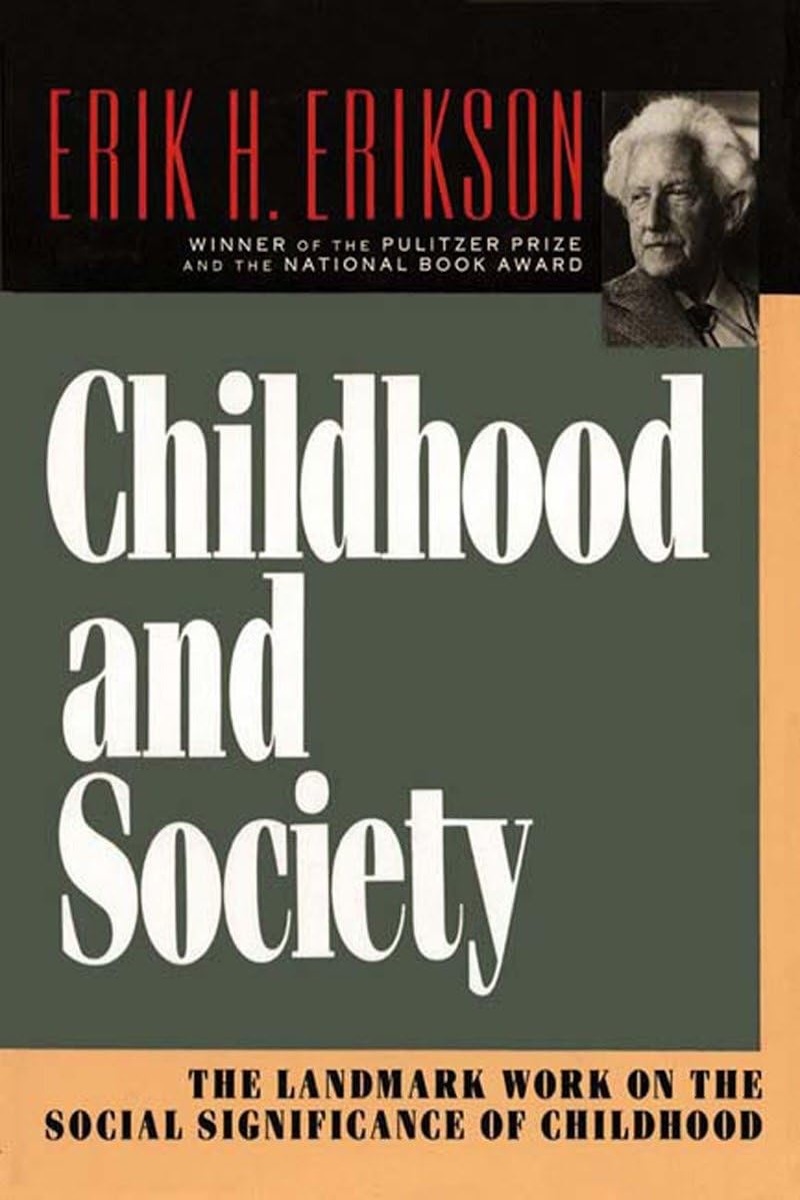
01 / Classic Textbook Recommendation
Classic Textbook Recommendation
Part 1. Citation, Context, Thesis & Key Concepts
Citation
Erikson, E. H. (1985). Childhood and society (35th anniversary ed.). W. W. Norton & Company. (Original work published 1950)
Author & Publication Information
- Author: Erik Homburger Erikson (1902–1994), German-born psychoanalyst and developmental psychologist.
- Publication: First edition published in 1950; the 35th Anniversary Edition includes Erikson’s 1985 “Afterthoughts.”
- Publisher: W. W. Norton & Company.
Intellectual & Historical Context
- Written during the post-WWII period when psychology, psychoanalysis, and anthropology were converging in the United States.
- Erikson, trained under Anna Freud, integrated psychoanalysis with anthropological field studies (notably among Sioux and Yurok tribes) and clinical work with children and veterans.
- Situated at a historical moment when psychoanalysis was transitioning from an exclusive focus on neurosis to a broader ego psychology that engaged with culture and society.
- Context of Cold War anxieties, fascism’s legacy, and democratic identity-building in the U.S. shaped Erikson’s concern with how childhood socialization patterns influence cultural and political life.
- The book anticipated and profoundly influenced developmental psychology, education, and the emerging field of identity studies.
Thesis Statement
Erikson argues that childhood development is not merely a biological or individual process but a psychosocial one, embedded in cultural patterns and historical contexts. The ego develops through stages of psychosocial crises, each requiring resolution, and these stages are both universal and culturally inflected. Thus, the growth of identity is at once personal and societal.
Key Concepts
- Psychosocial Development: Expansion of Freudian psychosexual theory into eight stages across the life cycle, each defined by a core crisis (e.g., trust vs. mistrust, identity vs. role confusion).
- Ego Psychology: The ego as an adaptive, integrative function balancing inner drives with social demands.
- Epigenetic Principle: Human development unfolds in a predetermined sequence of stages, each building on the previous, but shaped by cultural context.
- Identity: Central construct; the integration of personal and social experiences into a coherent sense of self, with adolescence as a critical stage.
- Cultural Variation: Studies of Sioux and Yurok child-rearing practices illustrate how different societies resolve developmental challenges.
- Play & Symbolization: Play as a medium for working through psychosocial conflicts and identity formation.
- Pseudo-speciation: The tendency of groups to treat cultural differences as if they were biological species boundaries, a source of conflict and violence.
- Youth & Politics: Analysis of historical figures (e.g., Hitler, Maxim Gorky) to show how unresolved developmental crises manifest in destructive or creative leadership.
Part 2. Chapter Summaries
Prefaces and Afterthoughts
- Afterthoughts 1985: Erikson reflects on the book’s legacy, his intellectual “itinerary,” and introduces the concept of “pseudo-species” in the nuclear age. He emphasizes the interplay of maternal and paternal roles in shaping both personality and global politics.
- Foreword to the Second Edition (1963): Positions the book as a record of his early psychoanalytic and anthropological itinerary; explains limited revisions.
- Foreword to the First Edition (1950): Declares the work as a psychoanalytic study of the ego’s relation to society, rooted in clinical practice and anthropology.
Part One: Childhood and the Modalities of Social Life
Chapter 1. Relevance and Relativity in the Case History
- Presents two clinical cases (a child with epileptic fits; a veteran Marine with psychosomatic illness).
- Emphasizes the interrelation of somatic, ego, and social processes in crises.
- Introduces Erikson’s methodological stance: psychoanalysis as a historical, participatory method.
Chapter 2. The Theory of Infantile Sexuality
- Revisits Freud’s psychosexual stages but reframes them as psychosocial modalities.
- Clinical vignettes illustrate libido, aggression, and developmental zones (oral, anal, phallic, genital).
- Links bodily functions to emerging social relationships and modes of adaptation.
Part Two: Childhood in Two American Indian Tribes
Chapter 3. Hunters Across the Prairie (Sioux)
- Ethnographic study of Sioux child-rearing.
- Key stages: birth rituals, practices of getting/taking, holding/letting go, making/creating.
- Highlights the Sun Dance and Vision Quest as symbolic of identity formation.
- Illustrates how Sioux cultural values structure ego development.
Chapter 4. Fishermen Along a Salmon River (Yurok)
- Study of Yurok child-rearing practices.
- Emphasis on cleanliness, order, and self-restraint.
- Child psychiatry shows link between cultural practices and psychological orientation.
- Comparative analysis: contrasts Sioux emphasis on mobility and daring with Yurok emphasis on control and order.
Part Three: The Growth of the Ego
Chapter 5. Early Ego Failure: Jean
- Case study of a young girl with psychosomatic and developmental difficulties.
- Explores how early ego breakdowns can manifest in pathology.
Chapter 6. Toys and Reasons
- Analysis of play as central to ego growth.
- Subsections:
- Play, work, and growth.
- Play as therapeutic and curative.
- The beginnings of identity through play in different milieus (e.g., war children, Black children).
- Argues that play mediates between imagination and social reality.
Chapter 7. Eight Ages of Man
- Landmark chapter presenting eight stages of psychosocial development:
- Basic Trust vs. Mistrust
- Autonomy vs. Shame & Doubt
- Initiative vs. Guilt
- Industry vs. Inferiority
- Identity vs. Role Confusion
- Intimacy vs. Isolation
- Generativity vs. Stagnation
- Ego Integrity vs. Despair
- Introduces the epigenetic chart mapping life-cycle crises.
Part Four: Youth and the Evolution of Identity
Chapter 8. Reflections on the American Identity
- Uses cultural symbols (e.g., “Mom,” John Henry, machines) to analyze U.S. identity.
- Explores how American youth negotiate autonomy, technology, and authority.
Chapter 9. The Legend of Hitler’s Childhood
- Psychohistorical study of Hitler.
- Childhood dynamics (strict father, doting mother) linked to authoritarian pathology.
- Introduces the concept of pseudo-speciation: seeing groups as separate “species,” leading to dehumanization.
Chapter 10. The Legend of Maxim Gorky’s Youth
- Contrasts Hitler’s destructiveness with Gorky’s creative transformation of adversity.
- Russian socialization, suffering, and resilience as sources of revolutionary identity.
Chapter 11. Conclusion: Beyond Anxiety
- Argues that human development is a struggle between anxiety and growth.
- Childhood and cultural practices are central to producing resilient or destructive identities.
- Ends with a call for integrating psychological, cultural, and political perspectives in understanding humanity.
Appendices
- Published Writings of Erik H. Erikson up to 1985.
- Index of key terms and names.
Part 3. Key Quotes & Significance
Key Quotes
“The strength of the ego is never final; it grows by the successive solutions of crises, which arise out of the demands of life.”
- Summarizes Erikson’s view of ego as a dynamic, developmental process.
“In the social jungle of human existence there is no feeling of being alive without a sense of identity.”
- Establishes identity as the central construct of human development.
“Man lives by ideals as much as by bread.”
- Emphasizes the symbolic, cultural, and moral dimensions of psychosocial development.
“Play is the royal road to the understanding of the young child’s personality.”
- Stresses the diagnostic and therapeutic value of play.
“Pseudo-speciation—the human tendency to see other groups as if they were a different species—remains the greatest danger in the nuclear age.”
- Links developmental psychology to global politics and survival.
Significance & Impact
- Developmental Psychology:
- Introduced the eight stages of psychosocial development, still foundational in psychology, education, and counseling.
- Shifted emphasis from Freud’s psychosexual theory to a broader psychosocial model.
- Ego Psychology:
- Advanced the role of the ego as adaptive and socially embedded, moving psychoanalysis beyond drives.
- Identity Theory:
- Pioneered the concept of identity crisis, crucial for adolescent psychology and later identity studies.
- Cross-Cultural Psychology:
- Early integration of anthropology and psychoanalysis; Sioux and Yurok studies illustrate cultural variation in development.
- Psychohistory:
- Applied developmental concepts to historical figures (Hitler, Gorky), opening new methods for understanding leadership and political movements.
- Clinical & Educational Practice:
- Play therapy and psychosocial assessment transformed child psychiatry and pedagogy.
- Political & Ethical Relevance:
- Concepts like pseudo-speciation highlighted the dangers of nationalism, racism, and nuclear war.
Broader Implications
- Interdisciplinary Influence: Influenced fields from education and sociology to political science and history.
- Identity Politics: Provided conceptual grounding for the study of ethnic, national, and gender identities in the late 20th century.
- Public Discourse: Popularized the idea of the “identity crisis,” entering everyday vocabulary.
- Critiques and Developments:
- Later feminist and postcolonial scholars critiqued Erikson for universalizing Western norms.
- Nonetheless, his psychosocial framework remains widely applied and adapted.