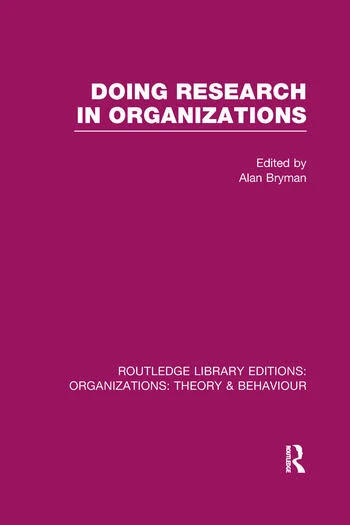
01 / Classic Textbook Recommendation
Classic Textbook Recommendation
Part 1. Citation, Context, Thesis & Key Concepts
Citation
Bryman, A. (Ed.). (2013). Doing research in organisations (RLE: Organizations). Routledge.
Editor & Publication Information
- Editor: Alan Bryman, Professor of Organizational and Social Research at the University of Leicester, renowned for his expertise in social research methodology and mixed methods research.
- Publication: Part of the Routledge Library Editions: Organizations series, this 2013 edition reprints important scholarly work on organizational research methods.
Intellectual & Historical Context
- Emerges from the growing recognition in the 1980s-1990s that conducting research in organizational settings requires specialized knowledge and skills.
- Addresses the practical challenges researchers face when studying organizations from within, building on ethnographic and field research traditions.
- Represents a shift toward acknowledging the political, ethical, and practical dimensions of organizational research beyond purely methodological considerations.
- Written during a period when access to organizations was becoming increasingly difficult and researchers needed practical guidance.
Thesis Statement
Bryman argues that conducting research in organizational settings involves unique challenges and opportunities that require specialized approaches, from gaining access and navigating organizational politics to selecting appropriate methods and managing the researcher-subject relationship in complex organizational environments.
Key Concepts
- Organizational Access: Strategies for gaining entry into organizations and maintaining research relationships.
- Insider vs. Outsider Research: The advantages and challenges of conducting research as an organizational member versus external researcher.
- Political Dimensions: How organizational politics affect research design, data collection, and findings.
- Methodological Pluralism: The value of combining quantitative and qualitative approaches in organizational settings.
- Ethical Considerations: Special ethical challenges in organizational research, including confidentiality and power dynamics.
- Cross-Cultural Research: Conducting organizational research across different cultural contexts.
Part 2. Chapter Summaries
Part I: Access and Entry
- Chs. 1-3: Addresses the fundamental challenge of gaining access to organizations, including formal and informal gatekeepers, the role of sponsorship, and strategies for building trust with organizational members.
Part II: Methodological Approaches
- Chs. 4-6: Explores different research approaches in organizational settings:
- Quantitative Methods: Survey research, statistical analysis, and large-scale organizational studies
- Qualitative Methods: Ethnography, interviews, and participant observation in organizational contexts
- Mixed Methods: Combining approaches for comprehensive organizational understanding
Part III: Navigating Organizational Dynamics
- Chs. 7-9: Examines the social and political dimensions of organizational research:
- Power Relations: How organizational hierarchies affect research relationships
- Confidentiality: Managing sensitive information and protecting participants
- Researcher Roles: Balancing objectivity with necessary organizational engagement
Part IV: Specialized Contexts
- Chs. 10-12: Addresses specific organizational research contexts:
- Historical Research: Using organizational archives and documents
- Cross-Cultural Studies: Methodological considerations for international organizational research
- Grounded Theory: Developing theory from organizational data
Part V: Practical Considerations
- Chs. 13-15: Covers practical aspects of organizational research:
- Resource Management: Time, funding, and personnel considerations
- Data Analysis: Approaches to analyzing organizational data
- Reporting Findings: Presenting research results to academic and practitioner audiences
Part 3. Key Quotes & Significance
Key Quotes
- "Organizations are not neutral sites for research; they are political arenas where knowledge has power implications."
- "The challenge of organizational research lies not just in choosing the right method, but in navigating the complex social realities of organizational life."
- "Access is not a one-time achievement but an ongoing negotiation throughout the research process."
- "The most significant insights often emerge from the unexpected aspects of organizational life that formal methods cannot capture."
- "Successful organizational research requires understanding both the manifest and latent functions of organizational behavior."
Significance & Impact
- Methodological Advancement: Established practical frameworks for conducting high-quality research in organizational settings.
- Academic Training: Became essential reading for graduate students and researchers in organizational studies, management, and applied social science.
- Practitioner Relevance: Bridged the gap between academic research and organizational practice by addressing real-world constraints.
- Ethical Standards: Contributed to the development of ethical guidelines for organizational research.
- Interdisciplinary Influence: Influenced research approaches across sociology, psychology, management studies, and anthropology.
Broader Implications
- Demonstrates the complexity of conducting research in "real-world" organizational settings versus controlled laboratory conditions.
- Highlights the importance of reflexivity and researcher positionality in organizational studies.
- Shows how methodological choices have political and ethical implications in organizational contexts.
- Emphasizes the value of methodological flexibility and adaptation to organizational realities.
- Contributes to ongoing debates about the relationship between research rigor and practical relevance in organizational studies.