01 / Classic Textbook Recommendation
Classic Textbook Recommendation
Part 1. Citation, Context, Thesis & Key Concepts
Citation
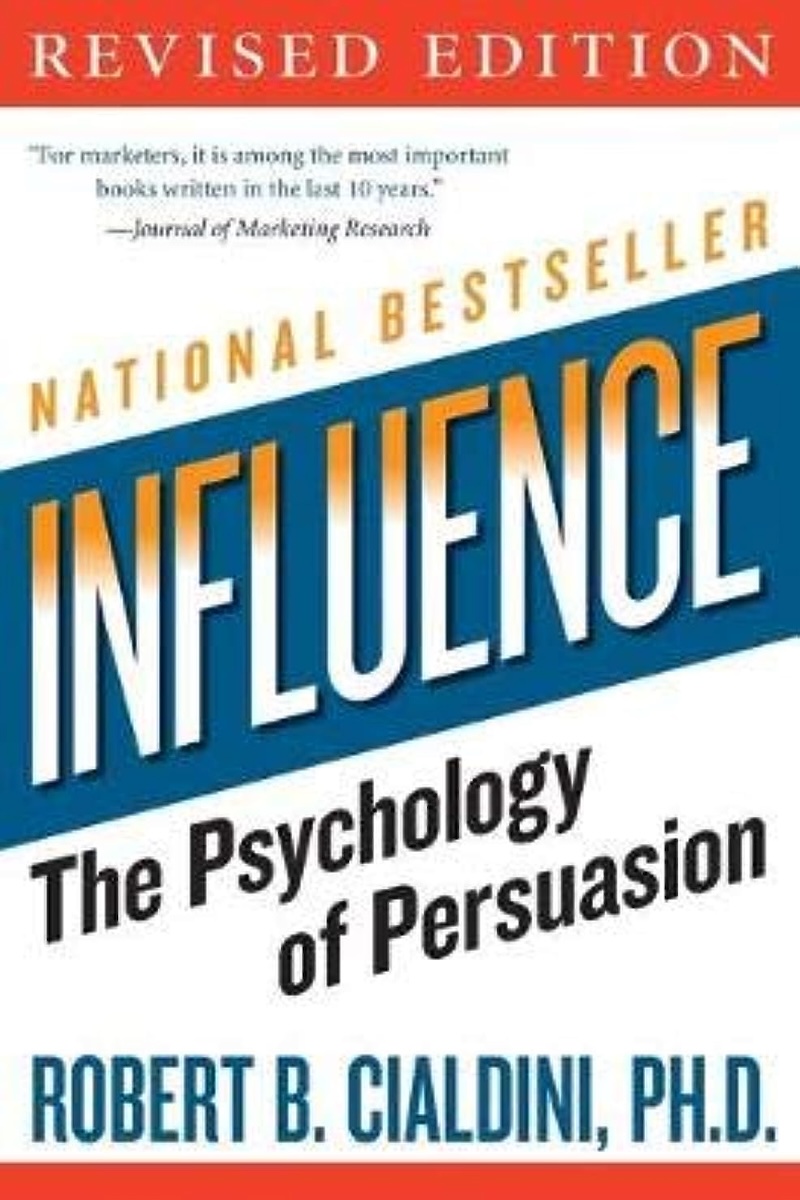
Cialdini, R. B. (2021). Influence: The psychology of persuasion (New and expanded ed.). Harper Business. (Original work published 1984)
Author & Publication Information
- Author: Robert B. Cialdini, Ph.D. (b. 1945), American social psychologist and Regents’ Professor Emeritus at Arizona State University.
- Publication: Originally published in 1984; the New and Expanded Edition (2021) adds new research, digital-age applications, and a seventh principle (unity).
- Publisher: Harper Business (an imprint of HarperCollins).
Intellectual & Historical Context
- Emerging from 1970s–1980s social psychology, Cialdini’s work bridged experimental lab studies and participant observation within sales, marketing, and fundraising industries.
- At a time of growing consumer capitalism and the rise of behavioral economics, Influence popularized empirically grounded persuasion principles for a broad readership.
- The book belongs to the tradition of applied social psychology, akin to heuristics-and-biases research (Kahneman, Tversky), but with a stronger orientation toward compliance professionals and real-world influence tactics.
- The 2021 edition integrates insights on online commerce, social media manipulation, and digital persuasion, reflecting new technological landscapes.
Thesis Statement
Cialdini contends that human compliance and persuasion are governed by a limited set of psychological principles of influence. These act as automatic heuristics (“click, run” responses) that are efficient but exploitable. By mastering these principles—reciprocation, commitment and consistency, social proof, liking, authority, scarcity, and unity—individuals can ethically persuade others or defend themselves against manipulation.
Key Concepts
- Fixed-Action Patterns / Click-Run Responses: Automatic, stereotyped behaviors triggered by “influence levers.”
- Judgmental Heuristics: Mental shortcuts (e.g., expensive = good) that streamline decision-making but create vulnerabilities.
- Seven Principles of Influence:
- Reciprocation: Obligation to return favors.
- Commitment & Consistency: Pressure to behave in line with prior commitments.
- Social Proof: Tendency to follow others’ actions as validation.
- Liking: Increased compliance with people we like.
- Authority: Tendency to defer to perceived experts.
- Scarcity: Desire for items perceived as rare or limited.
- Unity: The newest principle; persuasion is stronger when framed within shared identity.
- Core Motives Model (with Gregory Neidert): Influence tactics align with persuaders’ goals—relationship cultivation, uncertainty reduction, or motivation for action.
- Ethical vs. Unethical Influence: Cialdini emphasizes ethical application, while also exposing exploitative practices.
- Digital Adaptation: Application of influence principles in online reviews, e-commerce, and social media “engagement traps.”
Part 2. Chapter Summaries
Preface & Introduction
- Preface: Written for a popular audience, balancing rigorous research with accessibility. Addresses updates for the digital era and explains the addition of unity as a principle.
- Introduction: Cialdini recounts his “patsy” experiences and describes his research method—both laboratory studies and participant observation (undercover work with sales, advertising, and fundraising organizations). Frames persuasion as governed by automatic responses.
Chapter 1. Levers of Influence: (Power) Tools of the Trades
- Explains fixed-action patterns in animals and parallels in humans.
- Introduces the idea of trigger features (e.g., “because” in requests).
- Discusses vulnerability to manipulative tactics (e.g., jewelry pricing, Captainitis in aviation).
- Principle of perceptual contrast as a compliance tool (e.g., real estate “set-up” houses, car dealer add-ons).
Chapter 2. Reciprocation: The Old Give and Take
- The reciprocity rule is universal across cultures and underpins human cooperation.
- Experiments show compliance increases dramatically when preceded by even small gifts (e.g., candy before charitable requests).
- Tactics include “free samples,” concessions in negotiation (“door-in-the-face”), and exploitative gifting practices.
- While reciprocity fosters trust and cohesion, it is also a powerful lever for manipulation.
Chapter 3. Liking: The Friendly Thief
- People prefer to say yes to those they like.
- Factors increasing liking: physical attractiveness, similarity, compliments, familiarity, and association.
- Examples: Tupperware parties leveraging friendship networks; “good cop” in interrogations.
- Explores marketing strategies and social engineering built on affinity.
Chapter 4. Social Proof: Truths Are Us
- People rely on others to determine correct behavior, especially in uncertain or ambiguous situations.
- Classic experiments (e.g., hotel towel reuse cards, canned laughter, staged emergencies) demonstrate conformity.
- Dangers: pluralistic ignorance, bystander effect, and informational cascades.
- Digital age: online reviews, follower counts, and fake endorsements.
Chapter 5. Authority: Directed Deference
- Strong social tendency to obey authority figures, even against personal conscience.
- Landmark studies: Milgram’s obedience experiments, hospital compliance studies.
- Explains symbols of authority (titles, clothing, luxury trappings).
- Contemporary relevance: misinformation from experts, credential inflation, and “doctor’s orders” marketing.
Chapter 6. Scarcity: The Rule of the Few
- Items appear more desirable when perceived as scarce or time-limited.
- Explains psychological reactance: desire intensifies when freedom is threatened.
- Marketing examples: “limited-time offers,” “last chance” messaging, censorship increasing demand.
- Scarcity linked to decision speed, risk-taking, and competitive urgency.
Chapter 7. Commitment and Consistency: Hobgoblins of the Mind
- Once people commit (publicly, voluntarily, actively), they feel pressure to remain consistent.
- Tactics: “foot-in-the-door” (small initial request leading to larger compliance), public pledges, written commitments.
- Examples: POW indoctrination, marketing surveys, voter turnout campaigns.
- Strengthens identity but can also trap individuals in escalating commitments.
Chapter 8. Unity: The “We” Is the Shared Me
- Newest principle: influence is amplified when framed in terms of shared identity.
- People comply more when persuaded by those they see as part of “us.”
- Illustrated by familial bonds, national identity, religious or team affiliations.
- Digital communities and “tribal” branding leverage unity powerfully.
Chapter 9. Instant Influence: Primitive Consent for an Automatic Age
- Synthesizes principles under conditions of modern information overload.
- Automaticity in decision-making is increasing due to time pressure and complexity.
- Explores ethical persuasion vs. manipulative exploitation in the age of digital nudging and algorithmic design.
- Concludes with a call for awareness and resistance strategies.
Part 3. Key Quotes & Significance
Key Quotes
“There are thousands of different tactics that compliance practitioners employ, but the majority fall within just seven basic categories.”
- Core thesis of universal persuasion principles.
“We all employ them and fall victim to them to some degree in our daily interactions with neighbors, friends, lovers, and family.”
- Highlights universality and ordinariness of persuasion.
“Automatic, stereotyped behavior is prevalent in much of human action because, in many cases, it is the most efficient form of behaving.”
- Justifies why heuristics exist and why they’re exploitable.
“The rule of reciprocation is so deeply implanted in us by the process of socialization that it can overpower other considerations of fairness.”
- Shows reciprocity’s coercive strength.
“Those who can be convinced that a communicator shares a meaningful personal or social identity with them become remarkably more susceptible to the communicator’s persuasive appeals.”
- Captures the essence of the new principle of unity.
Significance & Impact
- Social Psychology: Canonical text, often considered the most influential work on persuasion; used widely in courses and research.
- Behavioral Economics & Marketing: Provides foundational principles for nudging, pricing strategies, and consumer behavior.
- Practical Influence: Applied in business, negotiation, politics, health campaigns, and digital UX design.
- Digital Relevance: Anticipates manipulation in e-commerce, social media, and online misinformation.
- Ethical Awareness: Encourages readers to both apply principles and defend against exploitation.
- Interdisciplinary Reach: Influences management, law, political communication, public health, and cybersecurity.
- Critiques: Some argue Cialdini’s framework risks over-simplification or universalizing, but empirical robustness has ensured longevity.
Broader Implications
- Automaticity & Autonomy: Raises philosophical questions about free will in environments engineered for compliance.
- Civic & Democratic Relevance: Knowledge of persuasion is vital in resisting propaganda, extremism, and manipulative advertising.
- Ethical Persuasion: Cialdini positions influence as a dual-use tool—capable of fostering cooperation or exploitation.