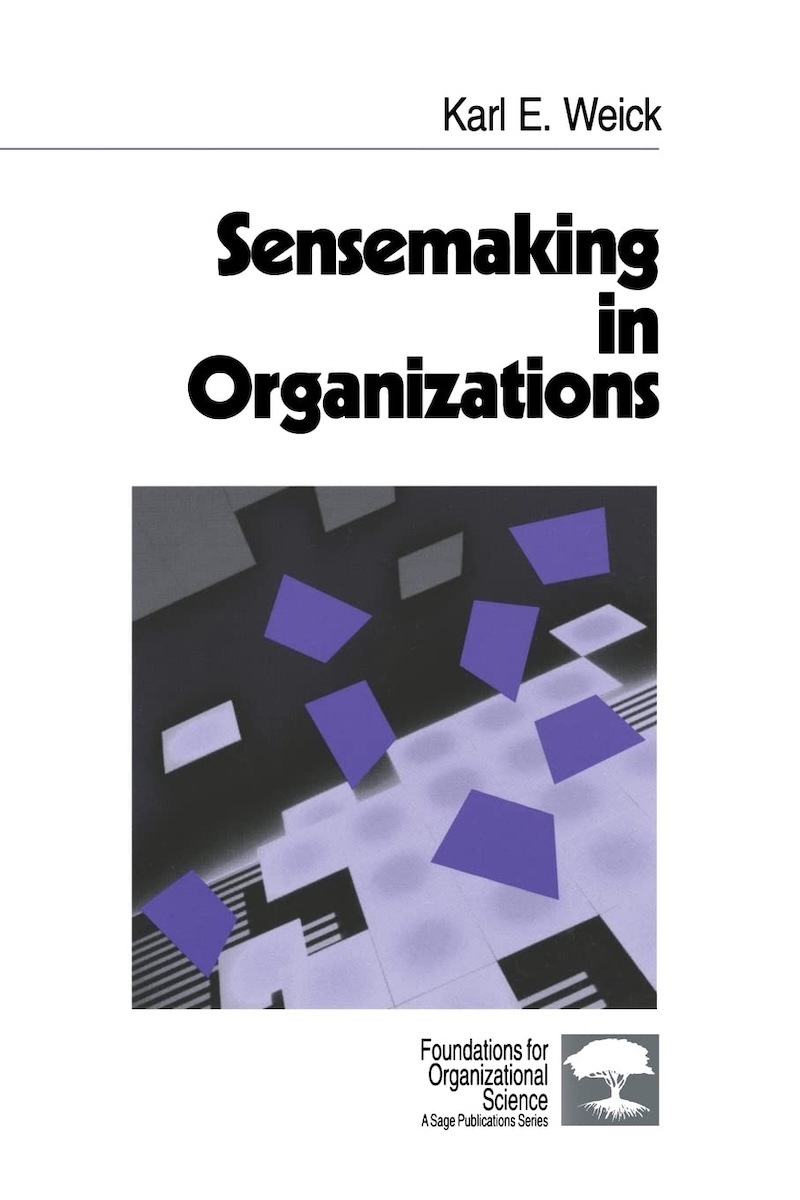
01 / Classic Textbook Recommendation
Classic Textbook Recommendation
Part 1. Citation, Context, Thesis & Key Concepts
Citation
Weick, K. E. (1995). Sensemaking in organizations. Sage Publications.
Author & Publication Information
- Author: Karl E. Weick (1936-2022), distinguished Professor of Organizational Behavior and Psychology at the University of Michigan, renowned for his work on organizational psychology, sensemaking, and high reliability organizations.
- Publication: Published in 1995 as part of the Foundations for Organizational Science series, representing a culmination of Weick's decades of research on organizational cognition and behavior.
Intellectual & Historical Context
- Written during the emergence of complexity theory and postmodern organizational studies in the 1990s.
- Builds on earlier work in organizational psychology, cognitive science, and social construction of reality.
- Responds to limitations of rational decision-making models and linear organizational theories.
- Influenced by pragmatist philosophy, particularly John Dewey and William James, and social construction theories.
- Emerges from Weick's extensive research on organizational crises, disasters, and high-reliability organizations.
Thesis Statement
Weick argues that sensemaking—the ongoing retrospective process by which people give meaning to ambiguous situations and experiences—is the fundamental organizing process that enables organizations to function, adapt, and survive in complex and uncertain environments.
Key Concepts
- Sensemaking Process: The ongoing effort to understand surprising, complex, or confusing events by placing them in frameworks that enable action.
- Seven Properties of Sensemaking: Identity construction, retrospection, enactment, social activity, ongoing nature, extracted cues, and plausibility over accuracy.
- Enactment: How people help create the environments they perceive and react to through their actions and attention.
- Retrospective Coherence: The way meaning is created by looking backward from outcomes to understand what happened.
- Plausible Narratives: How organizational members construct believable stories that enable coordinated action, even if not perfectly accurate.
- Equivocality: The existence of multiple possible interpretations of organizational events and environments.
Part 2. Chapter Summaries
Chapter 1: The Nature of Sensemaking
- Introduces sensemaking as a distinct organizational capability, different from decision-making or problem-solving. Establishes the theoretical foundations and distinguishes sensemaking from related concepts like interpretation and understanding.
Chapter 2: The Properties of Sensemaking
- Details the seven key properties that characterize sensemaking processes:
- Grounded in identity construction: How people's sense of who they are shapes what they notice and how they interpret events
- Retrospective: Meaning comes from reflection on past events and actions
- Enactive of sensible environments: People help create the environments they perceive
- Social: Sensemaking happens in interaction with others
- Ongoing: Continuous process without clear beginning or end
- Extracted cues: Small details serve as basis for larger inferences
- Plausibility over accuracy: Coherent stories matter more than precise facts
Chapter 3: Sensemaking and Organizing
- Explores how sensemaking processes create and maintain organizational structures. Examines the relationship between individual sensemaking and collective organizing, showing how shared meanings emerge and evolve.
Chapter 4: Organizational Culture as Sensemaking
- Reframes organizational culture as a set of shared sensemaking processes rather than static values or artifacts. Shows how cultural meanings are continuously created and recreated through collective sensemaking.
Chapter 5: Sensemaking and Change
- Analyzes how sensemaking processes both enable and constrain organizational change. Explores how organizations make sense of environmental shifts and internal transformations.
Chapter 6: Sensemaking and Strategic Management
- Examines the role of sensemaking in strategic processes, challenging rational planning models. Shows how strategic thinking emerges from ongoing sensemaking rather than formal analysis.
Chapter 7: Technology and Sensemaking
- Investigates how technology affects organizational sensemaking processes. Explores both the opportunities and challenges that technological systems create for collective meaning-making.
Chapter 8: Future Directions
- Outlines implications for organizational theory, research methods, and management practice. Suggests areas for future research and practical applications of sensemaking concepts.
Part 3. Key Quotes & Significance
Key Quotes
- "Sensemaking is about the interplay of action and interpretation rather than the influence of evaluation on choice."
- "People make sense of things by seeing a world on which they already imposed what they believe."
- "The basic idea of sensemaking is that reality is an ongoing accomplishment that emerges from efforts to create order and make retrospective sense of what occurs."
- "How can I know what I think until I see what I say?"
- "Organizations are collections of ongoing processes that are made sensible by the people who engage in them."
- "Sensemaking is about plausibility, coherence, and reasonableness. Sensemaking is about accounts that are socially acceptable and credible."
Significance & Impact
- Theoretical Innovation: Introduced sensemaking as a fundamental organizational process, shifting focus from rational decision-making to meaning construction.
- Research Paradigm: Influenced organizational research methodology, encouraging ethnographic and interpretive approaches to studying organizations.
- Crisis Management: Provided frameworks for understanding organizational failures and disasters, influencing safety and reliability research.
- Strategic Management: Challenged traditional strategic planning approaches, emphasizing emergent and interpretive aspects of strategy.
- Leadership Theory: Influenced understanding of leadership as sensegiving and meaning-making rather than just decision-making and control.
- Organizational Learning: Contributed to theories of how organizations learn and adapt through collective sensemaking processes.
Broader Implications
- Challenges positivist assumptions about organizational reality and rational management.
- Demonstrates the importance of subjective experience and interpretation in organizational life.
- Shows how organizational structures emerge from ongoing processes rather than formal design.
- Highlights the role of narrative and storytelling in organizational functioning.
- Contributes to understanding of how organizations cope with complexity and uncertainty.
- Provides tools for analyzing organizational culture, change, and learning from a process perspective.
- Influences contemporary thinking about organizational resilience and adaptation in turbulent environments.