01 / Classic Textbook Recommendation
Classic Textbook Recommendation
Part 1. Citation, Context, Thesis & Key Concepts
Citation
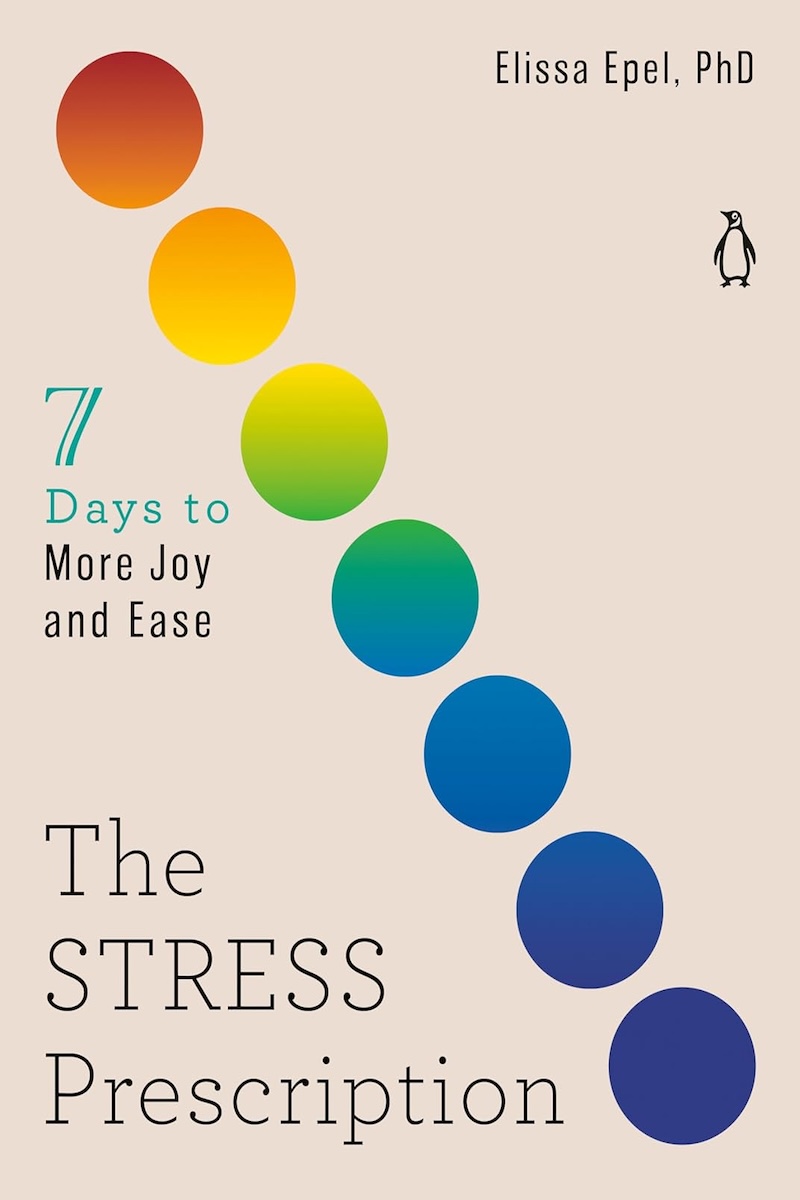
Epel, E. (2022). The stress prescription: Seven days to more joy and ease. Penguin Publishing Group.
Author & Publication Information
- Author: Elissa Epel, PhD, Professor and Vice Chair of Psychiatry at the University of California, San Francisco; internationally recognized stress researcher and co-author of The Telomere Effect with Nobel laureate Elizabeth Blackburn.
- Publication: Penguin Life (Penguin Random House), 2022.
Intellectual & Historical Context
- Written during the COVID-19 pandemic and rising global stress levels.
- Builds on decades of psychobiology research, especially linking stress to cellular aging through telomeres.
- Integrates scientific research with contemplative traditions, mindfulness, and resilience-building practices.
- Designed as an accessible toolkit for the general public, distilling research into a practical seven-day program.
Thesis Statement
Epel argues that stress is an inevitable and necessary part of life, but chronic stress is toxic. Through mindset shifts and daily practices, individuals can transform their relationship with stress, cultivating resilience, deep restoration, and greater joy.
Key Concepts
- Stress as Adaptation: Acute stress is protective and energizing; chronic stress is harmful.
- Baseline Stress: Modern life elevates default stress levels; lowering the baseline is key.
- Telomeres and Aging: Chronic stress shortens telomeres, accelerating aging and disease.
- Uncertainty Tolerance: Building comfort with unpredictability reduces anxiety and PTSD risk.
- Peak-and-Recovery Model: Healthy stress responses require recovery periods for restoration.
- Neuroplasticity: Stress resilience can be trained through repeated practices.
- Seven-Day Toolkit: Structured daily practices to embed adaptive stress responses.
Part 2. Chapter Summaries
Introduction: Expect the Unexpected
- Stress cannot be eliminated; it is woven into life.
- Chronic stress, however, accelerates biological aging.
- Goal: shift mindset to embrace uncertainty and train for resilience.
Day 1: Things Will Go Wrong … and That’s All Right
- Teaches acceptance of uncertainty and impermanence.
- Emphasizes that catastrophizing amplifies stress.
- Encourages reframing setbacks as expected and survivable.
Day 2: Control What You Can … and Put Down the Rest
- Distinguishes between controllable and uncontrollable stressors.
- Encourages letting go of uncontrollable burdens.
- Introduces “stress audit” for daily life.
Day 3: Be the Lion
- Focus on stress mindset: viewing stress as enhancing performance.
- Invites readers to “lean into” challenges with courage and energy.
- Draws from evolutionary biology: stress can be empowering.
Day 4: Train for Resilience
- Stress inoculation: gradual exposure builds capacity.
- Practical strategies: breathwork, visualization, and cognitive reframing.
- Encourages regular resilience training as preventive medicine.
Day 5: Let Nature Do the Work
- Nature immersion reduces stress baseline and restores vagal tone.
- Presents empirical evidence on “green time” and mental health.
- Suggests micro-doses of nature for urban dwellers.
Day 6: Don’t Just Relax … Restore
- Differentiates relaxation from deep restorative states.
- Introduces practices (mindfulness, meditation, naps, sleep hygiene).
- Highlights “blue mind” as a state of biological regeneration.
Day 7: Start Full, End Full
- Cultivating positive emotions and social connection.
- Daily joy practices and gratitude buffer against stress.
- Encourages ending each day with fullness, not depletion.
Conclusion: Renewing Your Prescription
- Practices are portable and cumulative.
- Stress resilience is a lifelong practice, akin to exercise.
- Readers are invited to integrate these tools flexibly, without pressure.
Part 3. Key Quotes & Significance
Key Quotes
- “Stress is not the enemy; chronic stress is.”
- “We can’t control the waves, but we can learn to surf them.”
- “Uncertainty tolerance is a muscle—we must train it.”
- “Our bodies are exquisitely built to handle stress, but only if we allow for recovery.”
- “Joy is not a luxury; it is a form of resilience.”
Significance & Impact
- Health Psychology: Bridges stress research with public health guidance, focusing on cellular aging and telomeres.
- Resilience Science: Offers evidence-based tools for cultivating adaptability in uncertain times.
- Mind-Body Medicine: Integrates biology, psychology, and contemplative practices.
- Public Engagement: Written for accessibility, it democratizes insights usually confined to research.
- Cultural Relevance: Emerged during pandemic uncertainty, addressing collective need for coping strategies.
Broader Implications
- Supports preventative health models emphasizing mental resilience.
- Shapes discourse on stress mindset as central to well-being.
- Highlights need for structural as well as individual interventions to address stress in society.