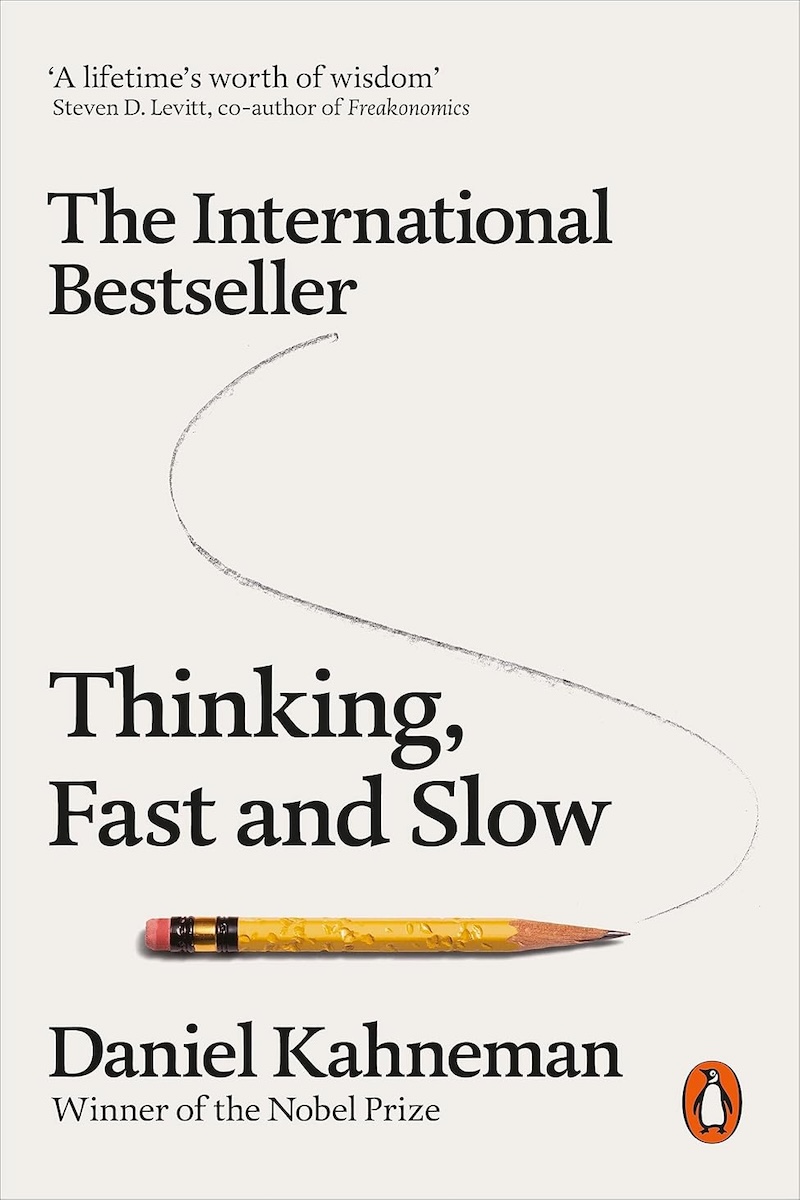
01 / Classic Textbook Recommendation
Classic Textbook Recommendation
Part 1. Citation, Context, Thesis & Key Concepts
Citation
Kahneman, D. (2011). Thinking, fast and slow. Farrar, Straus and Giroux.
Author & Publication Information
- Author: Daniel Kahneman (b. 1934), Nobel laureate in Economic Sciences (2002) with Amos Tversky, known for groundbreaking work in behavioral economics and cognitive psychology.
- Publication: First published in 2011; the text synthesizes decades of research on heuristics, biases, and decision-making.
Intellectual & Historical Context
- Rooted in the “heuristics and biases” program developed by Kahneman and Tversky in the 1970s.
- Challenges the assumption of human rationality central to classical economics.
- Bridges psychology, economics, and philosophy, fueling the rise of behavioral economics.
- Emerged during a period when policymakers and economists increasingly recognized the need to incorporate human cognitive limitations into models of decision-making.
Thesis Statement
Kahneman argues that human thinking is governed by two interacting systems: the fast, intuitive, and automatic System 1 and the slow, deliberate, and effortful System 2. While System 1 is efficient and essential, it often leads to systematic biases and errors, and our overconfidence in its judgments frequently misguides decision-making.
Key Concepts
- System 1 and System 2: Dual-process model of cognition, intuitive vs. deliberate thought oaicitation:0‡Thinking, Fast and Slow By Daniel Kahneman & Mindset - -- Carol S Dweck, Daniel Kahneman -- reprint, 2013 -- Farrar, Straus and Giroux -- 9780141033570 -- d913d60f623491655065d4b67539f230 -- Anna’s Archive.pdf.
- Heuristics and Biases: Mental shortcuts (e.g., availability, representativeness) that lead to predictable errors.
- WYSIATI: “What You See Is All There Is” — the tendency to rely only on available information oaicitation:1‡Thinking, Fast and Slow By Daniel Kahneman & Mindset - -- Carol S Dweck, Daniel Kahneman -- reprint, 2013 -- Farrar, Straus and Giroux -- 9780141033570 -- d913d60f623491655065d4b67539f230 -- Anna’s Archive.pdf.
- Prospect Theory: Explains decision-making under risk, highlighting loss aversion and probability weighting.
- Overconfidence: Illusions of understanding and validity bias judgments and professional intuition.
- Two Selves: Distinction between the experiencing self and the remembering self, with implications for well-being oaicitation:2‡Thinking, Fast and Slow By Daniel Kahneman & Mindset - -- Carol S Dweck, Daniel Kahneman -- reprint, 2013 -- Farrar, Straus and Giroux -- 9780141033570 -- d913d60f623491655065d4b67539f230 -- Anna’s Archive.pdf.
Part 2. Chapter Summaries
Part I: Two Systems
- Chs. 1–9: Introduces System 1 (fast, automatic, emotional) and System 2 (slow, effortful, logical). Demonstrates how System 1 dominates perception and judgment, often unconsciously substituting hard questions with easier ones oaicitation:3‡Thinking, Fast and Slow By Daniel Kahneman & Mindset - -- Carol S Dweck, Daniel Kahneman -- reprint, 2013 -- Farrar, Straus and Giroux -- 9780141033570 -- d913d60f623491655065d4b67539f230 -- Anna’s Archive.pdf.
Part II: Heuristics and Biases
- Chs. 10–18: Reviews research on judgment heuristics:
- Law of small numbers → overinterpreting limited data.
- Anchoring effect → irrelevant numbers influence estimates.
- Availability heuristic → vivid examples distort risk assessment.
- Representativeness → stereotyping and neglect of base rates.
- Regression to the mean and flawed predictions oaicitation:4‡Thinking, Fast and Slow By Daniel Kahneman & Mindset - -- Carol S Dweck, Daniel Kahneman -- reprint, 2013 -- Farrar, Straus and Giroux -- 9780141033570 -- d913d60f623491655065d4b67539f230 -- Anna’s Archive.pdf.
Part III: Overconfidence
- Chs. 19–24: Discusses illusions of understanding and validity, why experts often trust faulty intuition, and the limits of prediction. Introduces the outside view and its corrective potential.
Part IV: Choices
- Chs. 25–34: Expands on Prospect Theory, critiquing Bernoulli’s expected utility. Shows how framing, loss aversion, and probability weighting shape choices. Highlights phenomena like the endowment effect, rare event overweighting, and the fourfold pattern of risk attitudes.
Part V: Two Selves
- Chs. 35–38: Explores subjective well-being, contrasting the experiencing and remembering selves. Finds that duration neglect and peak–end effects distort memory of happiness. Suggests policy implications for measuring welfare.
Conclusion
- Reinforces that intuition is indispensable but systematically flawed. Advocates for humility, awareness of biases, and reliance on statistical thinking and decision aids.
Part 3. Key Quotes & Significance
Key Quotes
- “Nothing in life is as important as you think it is when you are thinking about it.”
- “What you see is all there is.” (WYSIATI) oaicitation:5‡Thinking, Fast and Slow By Daniel Kahneman & Mindset - -- Carol S Dweck, Daniel Kahneman -- reprint, 2013 -- Farrar, Straus and Giroux -- 9780141033570 -- d913d60f623491655065d4b67539f230 -- Anna’s Archive.pdf
- “The idea that the future is unpredictable is undermined every day by the ease with which the past is explained.”
- “Losses loom larger than gains.” (core of Prospect Theory)
- “There are two selves: the experiencing self, which lives in the present, and the remembering self, which keeps score.” oaicitation:6‡Thinking, Fast and Slow By Daniel Kahneman & Mindset - -- Carol S Dweck, Daniel Kahneman -- reprint, 2013 -- Farrar, Straus and Giroux -- 9780141033570 -- d913d60f623491655065d4b67539f230 -- Anna’s Archive.pdf
Significance & Impact
- Behavioral Economics: Revolutionized economics by incorporating psychological realism; earned Kahneman the Nobel Prize.
- Public Policy: Informed “nudge” theory and interventions in health, finance, and governance.
- Cognitive Science: Advanced dual-process theory, influencing research on decision-making, AI, and law.
- Practical Relevance: Offers tools for individuals to recognize cognitive traps, encouraging statistical reasoning and structured decision-making.
- Cultural Impact: The book became a global bestseller, changing how laypeople talk about bias, intuition, and rationality.
Broader Implications
- Undermines the model of the fully rational homo economicus.
- Shows the need for “choice architecture” that protects people from predictable errors.
- Reinforces the paradox that our greatest strength (intuition) is also a persistent liability without corrective awareness.